
On the nature of self-awareness
by Darkageon Youngblood
A note before you begin
There is a short assessment that goes with this piece, and it is best taken before you read any further. The reason is practical: Once you have read what follows, you will know exactly what the questions are reaching for, and you will answer as the person this essay describes rather than as the person you actually are. Taken first, it measures you. Taken afterward, it measures your reading. It also depends entirely on honesty. Answered from real introspection it can tell you something true; answered as the person you would like to be, it tells you nothing at all. So if you are willing, take the assessment here before going on, and then come back.
In brief
Self-awareness is the capacity to turn and take yourself as an object of honest attention, and the accuracy of the picture that turning produces. It runs in two directions at once. Inward: how faithfully you perceive your own values, patterns, and reactions. Outward: how faithfully you perceive the impression you actually make on other people. It asks not only for the skill to perceive but the will to look at what is unflattering. And it is kept alive not by how much you examine yourself, but by how willing you remain to be corrected by reality, above all by other people.
Five things mark it:
- Reflexivity. You can turn on yourself as an object of attention at all.
- Accuracy. The picture you hold actually matches the truth.
- Bidirectionality. It faces both inward and outward.
- Non-defensiveness. You are willing, not merely able, to see.
- Dynamism. You keep re-checking, rather than assuming you have arrived.
Only somewhere between one and two people in ten manage all five at once. What follows is what that means. Some of it comes from research and some from my own life, and I have tried to keep the two clearly marked, because a piece about honest self-perception ought to be honest about where it is speaking from.
The turn inward, and what it is not
Consider the oldest distinction we have here. Over a century ago William James split the self into two: the I and the Me. The I is the self that experiences, the one doing the looking, the subject, the knower. The Me is the self that gets looked at: your traits, your history, your body, your name in other people's mouths, the whole assembled object that is "you." Most of the time the I is invisible to itself, because it is busy facing the world. Self-awareness is the moment the I turns around and regards the Me. It is attention folded back on itself.
This tells you at once what self-awareness is not. It is not the same as being conscious, or feeling deeply, or being clever. A creature can have a vivid inner life, hunger and fear and the whole felt texture of a moment, and never once stand outside itself to grasp that it is a self having those experiences. Feeling is the light being on, whereas self-awareness is the light turning to illuminate the lamp. You live far more of your life as the subject of your experience than as the object of your own attention, and that imbalance is the entire problem the word is trying to name.
Its near relations
The turn inward tells us that self-awareness is not the same as consciousness, or feeling, or cleverness, and it is worth adding that it is also not several things it gets routinely mistaken for, each a relation close enough to borrow its name.
It is not mindfulness. Mindfulness is a way of attending to the present moment, resting in sensation and thought without grabbing at them or judging them. It is a stance, and a valuable one, but you can be fully and serenely present to this breath and this cup of tea and still carry a wholly inaccurate picture of your own character. Presence is not accuracy.
It is not metacognition, the mind watching its own thinking. Metacognition is part of the machinery, the capacity to notice that you are reasoning, or to catch yourself misremembering; but it is narrower than self-awareness, which reaches past cognition to values, patterns, and impact, to the whole person and not only the thoughts.
It is not emotional intelligence, though it is the ground that skill stands on. Emotional intelligence adds two more abilities to the seeing: managing what you feel, and reading and responding to what others feel. Self-awareness is the perception at the base of that structure. Without it the rest has nothing accurate to work with, but the seeing alone is not the whole building.
It is not wisdom, which is broader still, a matter of judgment and proportion and knowing how to live. You cannot be wise without seeing yourself clearly, and yet you can see yourself with painful clarity and still choose badly. Clear sight is necessary for wisdom, and nowhere close to sufficient.
And it is not authenticity, though the two are often spoken of as one thing. To know yourself and to live in accordance with what you know are separate acts. Self-awareness is the seeing, whereas authenticity is the harder thing that comes after, the daily willingness to act on what you have seen even when a borrowed self would be easier to wear. Plenty of people can describe their values with great accuracy and betray them by dinner.
The through-line is simple. Each of these neighbors involves the self, and each is worth having, but none of them is the specific thing named here: an accurate picture of who you actually are, held in both directions at once.
Attention has a direction
Attention can only point one way at a time. Turned outward, you disappear into the task, the conversation, the road; the self recedes and there is only the world. Turned inward, something stranger happens. You become an object in your own field of view, and the instant you do, you begin measuring that object against a standard. Against who you meant to be. Against who you feel you ought to be.
So looking at yourself is never a calm neutral mirror, it is quietly evaluative, and evaluation almost always turns up a gap between the self you find and the self you intended. That gap is why real self-examination is uncomfortable, and why people avoid it without ever admitting they are avoiding it. Part of what separates the genuinely self-aware is simply a higher tolerance for that discomfort, a willingness to sit in the gap rather than flinch from it or explain it away.
Looking more is not seeing more
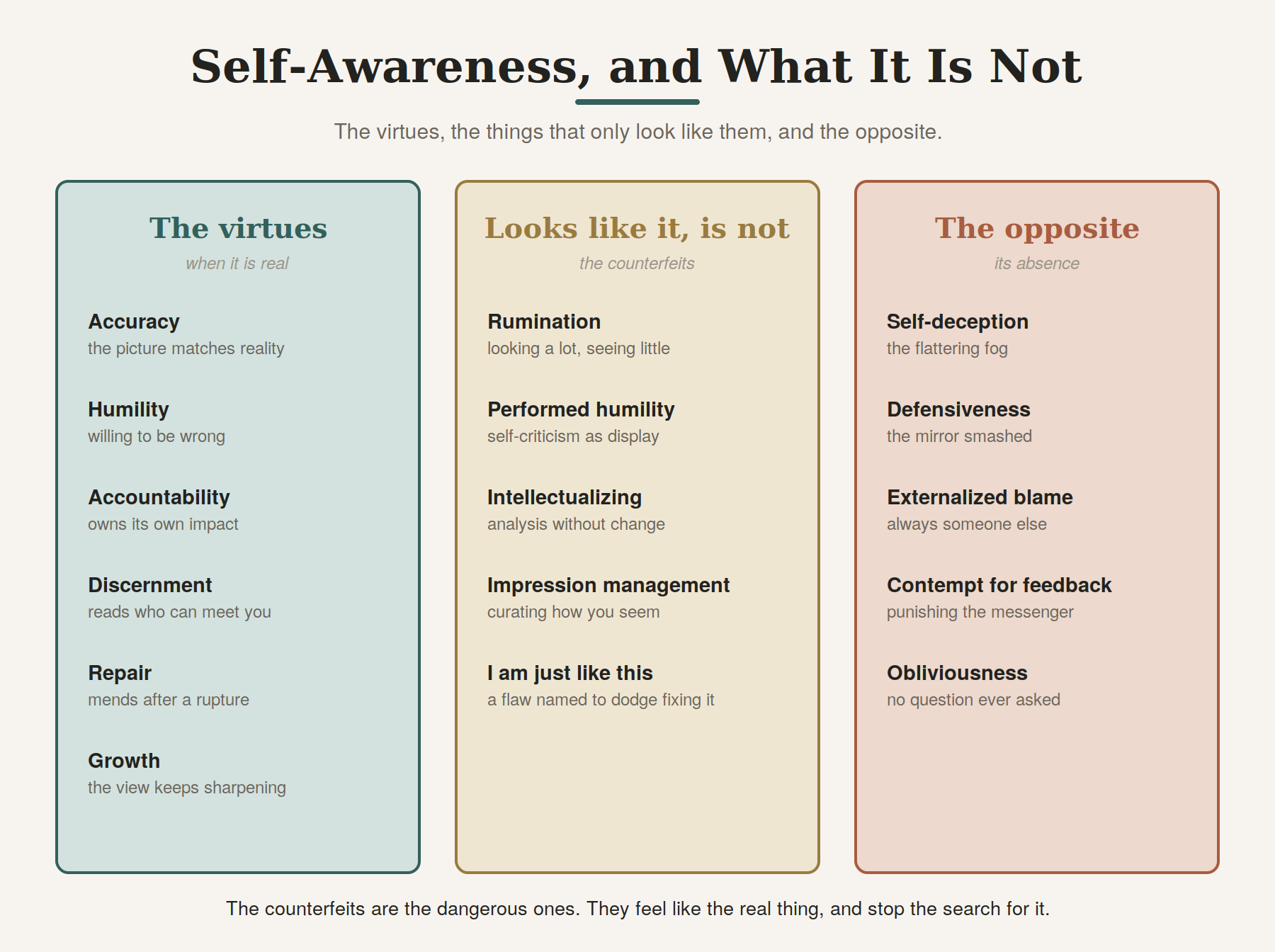
Here is the mistake almost everyone makes, and one I made for a long time myself. We treat self-awareness as a matter of looking inward a lot, of journaling, of reflecting, of being the kind of person who thinks about themselves. But looking inward more does not mean seeing more clearly, you can stare down the well for years and see nothing but your own assumptions, reflected back.
There is a specific trap in this, and it has a shape. When you ask yourself why, why did I react like that, why don't they respect me, your mind obligingly hands you an answer that feels true and is often false, a tidy story built to protect you rather than to describe you. The correction is small and strangely powerful: Trade why for what. Not "why did I do that," but "what did I do, what was I feeling, what happens when I behave this way." The what keeps you close to the facts. The why drifts you off into flattering fiction.
This relocates the whole idea. Self-awareness is not the quantity of attention you pay yourself, it is the accuracy of the picture you end up with. Someone who thinks about themselves constantly and is wrong is less self-aware than someone who rarely does but is right.
The two directions
Seeing yourself clearly means seeing who you are, how others see you, and how you fit into the world, and those turn out to be two separate skills, not one. Curiously, they do not come as a set. Being strong in one predicts almost nothing about the other.
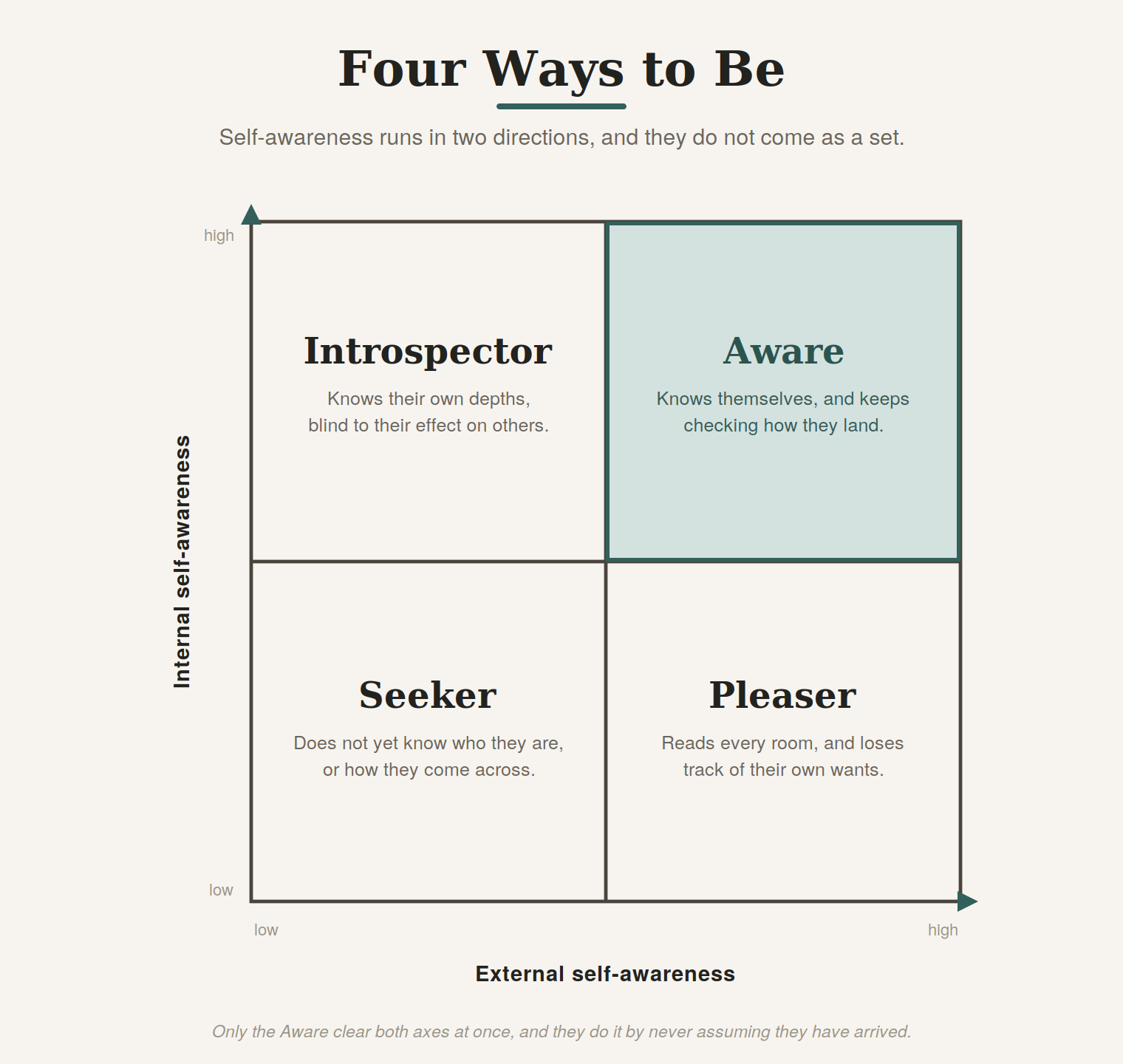
Internal self-awareness is how clearly you see your own interior: your values, your reactions, what actually drives you. External self-awareness is how accurately you know the impression you make: how your words land, what your presence does to a room. And here is the part that catches people out. The external half cannot be reached by looking inward at all. No amount of reflection reveals how you are seen. That knowledge lives outside you, in other people, and the only way to it is feedback you have to be willing to ask for and willing to believe. A whole half of self-awareness, in other words, is not privately accessible, you cannot think your way to it alone.
Four ways to be
Split each direction into high and low and you get four positions, less as fixed personality types than as portraits of how the thing goes wrong:
- The Seeker. Low inward, low outward. Does not yet know who they are, or how they come across. The starting point; everyone begins here.
- The Introspector. High inward, low outward. Knows their own values and moods intimately, and is repeatedly blindsided by the effect they have on others. The classic blind spot of the deeply reflective person who never checks the mirror against the world.
- The Pleaser. Low inward, high outward. Reads every room flawlessly, tracks every perception, and in doing so slowly loses hold of what they themselves actually want, until their choices no longer match anyone they recognize.
- The Aware. High on both. Knows themselves and keeps actively seeking honest outside perspective to stay calibrated.
The last one holds the real lesson. The Aware are not aware because they arrived somewhere, they are aware because they never stop checking. Self-awareness turns out not to be a possession but a practice, a standing willingness to be corrected.
What you are actually looking at
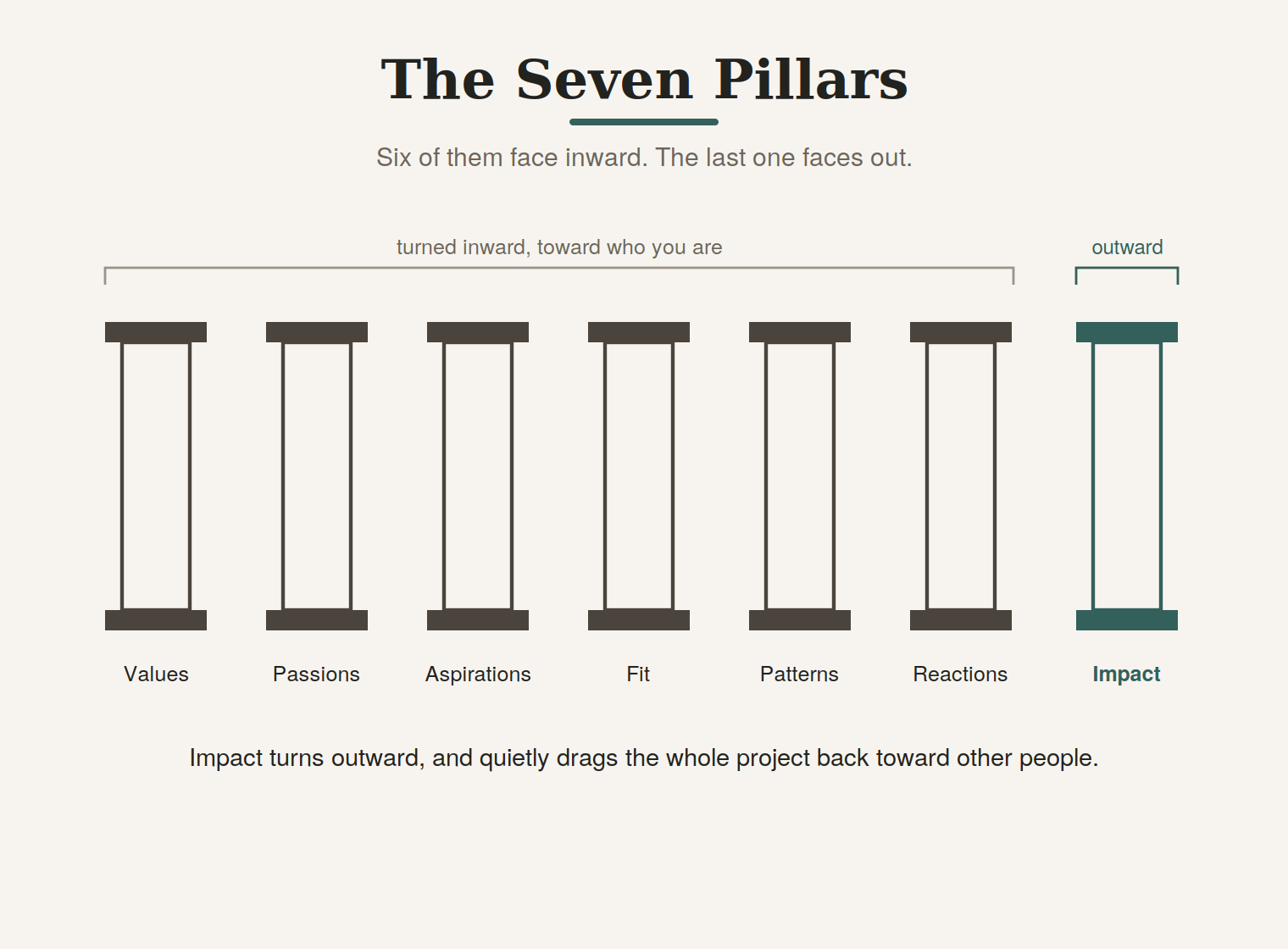
If seeing yourself clearly is the aim, it helps to name what there is to see. A rough inventory: your values, the principles you mean to live by; your passions, what you love doing; your aspirations, what you want from your life; your fit, the environments in which you come alive rather than shrink; your patterns, your habitual ways of thinking, feeling, and acting; your reactions, what your responses reveal about your capacities and limits; and your impact, the effect you actually have on the people around you.
Six of these face inward; the last one, impact, faces out, and quietly drags the whole project back toward other people. You cannot finish the work alone in a room. Which may be the truest thing that can be said about it: to see yourself clearly, you eventually have to let yourself be seen.
How one gets there
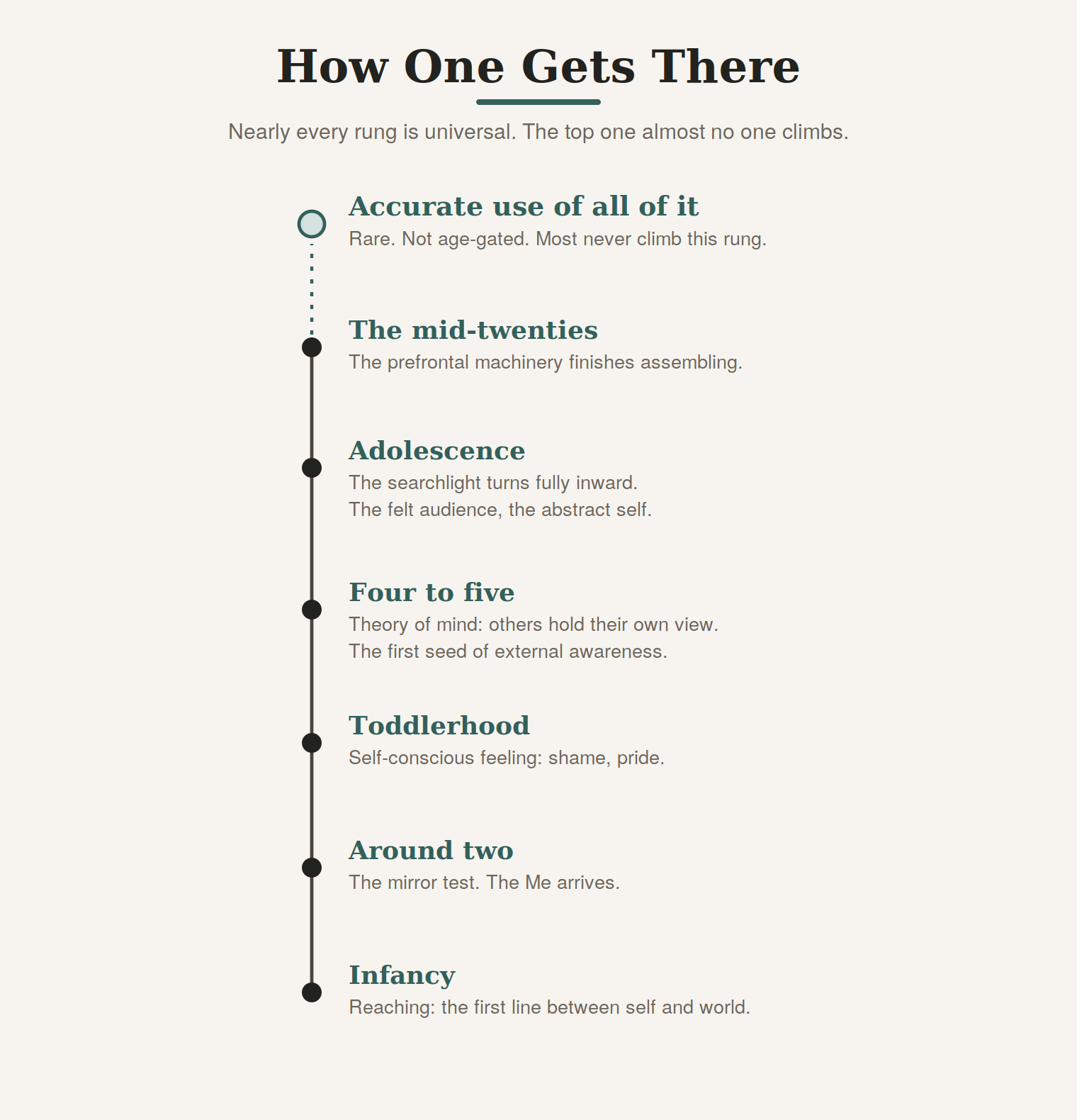
Nobody arrives self-aware. It is built, rung by rung, and the early rungs are almost universal while the top ones are almost rare. It helps to see the whole ladder at once.
It begins before memory. An infant reaching for a rattle already draws a faint line between self and not-self, a body here and a world out there. Somewhere around the second birthday the line sharpens into recognition: shown a mirror with a smudge on their face, the child reaches for their own cheek, not the glass. The Me has arrived. Soon after come the self-conscious feelings, embarrassment and pride and shame, none of which are even possible until there is a self to feel them about. Around four or five a quieter hinge turns: the child grasps that other people hold their own separate view of the world, and by extension their own view of them. This is the first seed of external awareness, the dawning knowledge that you are a figure in other minds. Then, in adolescence, the searchlight finally swings full inward. The teenager can think about their own character in the abstract, can be mortified by an audience that is not even there, can ask who they are and mean it. The machinery that runs all of this, the prefrontal cortex, does not finish assembling until the mid-twenties.
So the capacity is essentially complete by early adulthood. Nearly everyone gets the equipment. What almost no one gets, or keeps, is the accurate use of it.
Each rung can be reinforced or interrupted. The clearest driver of the early rungs is relational: children learn to read their own inner states largely by being read. A caregiver who treats the child as a mind with feelings, and reflects those feelings back, teaches the child to do the same for itself. Where that mirroring is absent, inconsistent, or distorted, the capacity to make sense of one's own interior develops only partway. Trauma, chronic invalidation, and neglect are the great interrupters. Safe, attuned relationships, including the ordinary repair after ordinary rupture, are the great reinforcers. These are the same forces that reappear later as the Grown layer, and where they fail this early, the damage runs deep enough that Part Two takes it up in full.
What feeds it, and what starves it
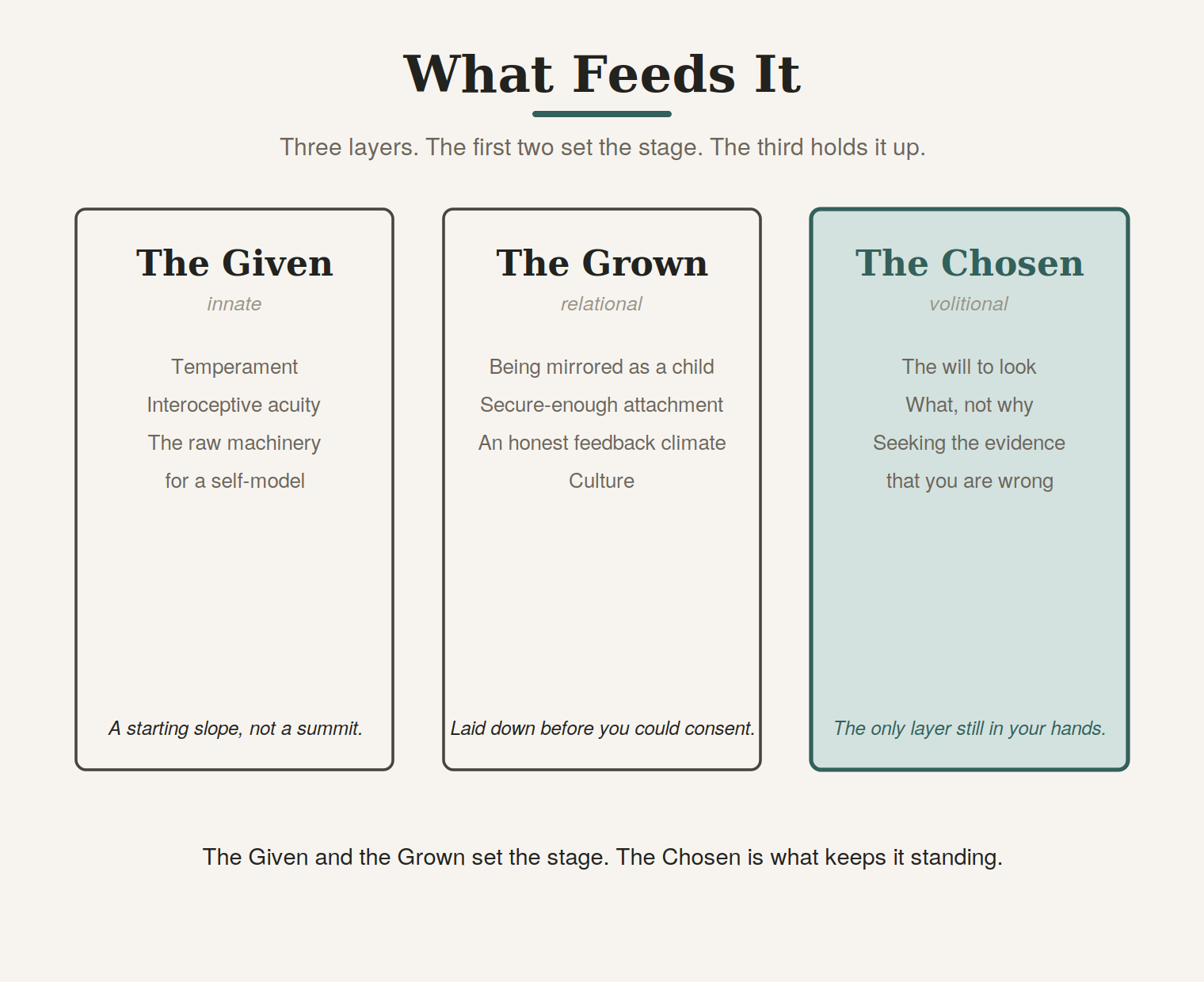
If we ask what actually makes a person more or less self-aware, the honest answer is that the causes fall into three layers, and it clarifies everything to keep them apart. Call them the Given, the Grown, and the Chosen.
The Given is what you are born inclined toward. Temperament, and a native pull toward curiosity about your own inner life. Interoception, the acuity with which you feel your own internal signals, since some people simply register the first flicker of an emotion more finely than others. And the raw cognitive machinery for holding a model of your own mind. None of this is destiny, it is a starting slope rather than a summit, and it can be outrun in either direction.
The Grown is what your surroundings, mostly early and mostly relational, build into you. Whether you were related to as a mind. Whether attachment felt secure enough that turning to look at yourself did not feel dangerous. Whether the people around you told you the truth about your effect on them, since this is the only soil in which external awareness can take root. Culture belongs here too, shaping how freely a person is even taught to name an inner state. Much of this is laid down before you could consent to any of it.
The Chosen is what you deliberately do, and keep doing. The will to look at the unflattering thing. The discipline of asking what instead of why. The habit of actively seeking feedback and, harder, of seeking the evidence that you are wrong. This is the only layer fully in your hands as an adult, and it is the one that carries the whole structure, because the first two set the stage but do not hold it up.
The neat and slightly brutal implication: you did not choose your starting slope, and you cannot rewrite your childhood, but the layer that most decides whether you are actually self-aware, the Chosen, is the one still open to you. It is also the one people most reliably let lapse.
The same three layers, read in reverse, are the derailers: a flat interior signal, an early world that never mirrored you, and above all the quiet decision to stop checking. Power and flattery act on that last layer with particular force, thinning out the corrective voices and replacing them with agreeable ones, and they distort a person in enough interesting and underexamined ways that they deserve a study of their own. Most of us carry a cruder idea of what power is, and does, than the thing warrants. For anyone who wants to follow that thread further, The Hoard and the Fire takes it up in full, and the two essays turn out to be the same argument approached from opposite sides.
The thing you cannot own
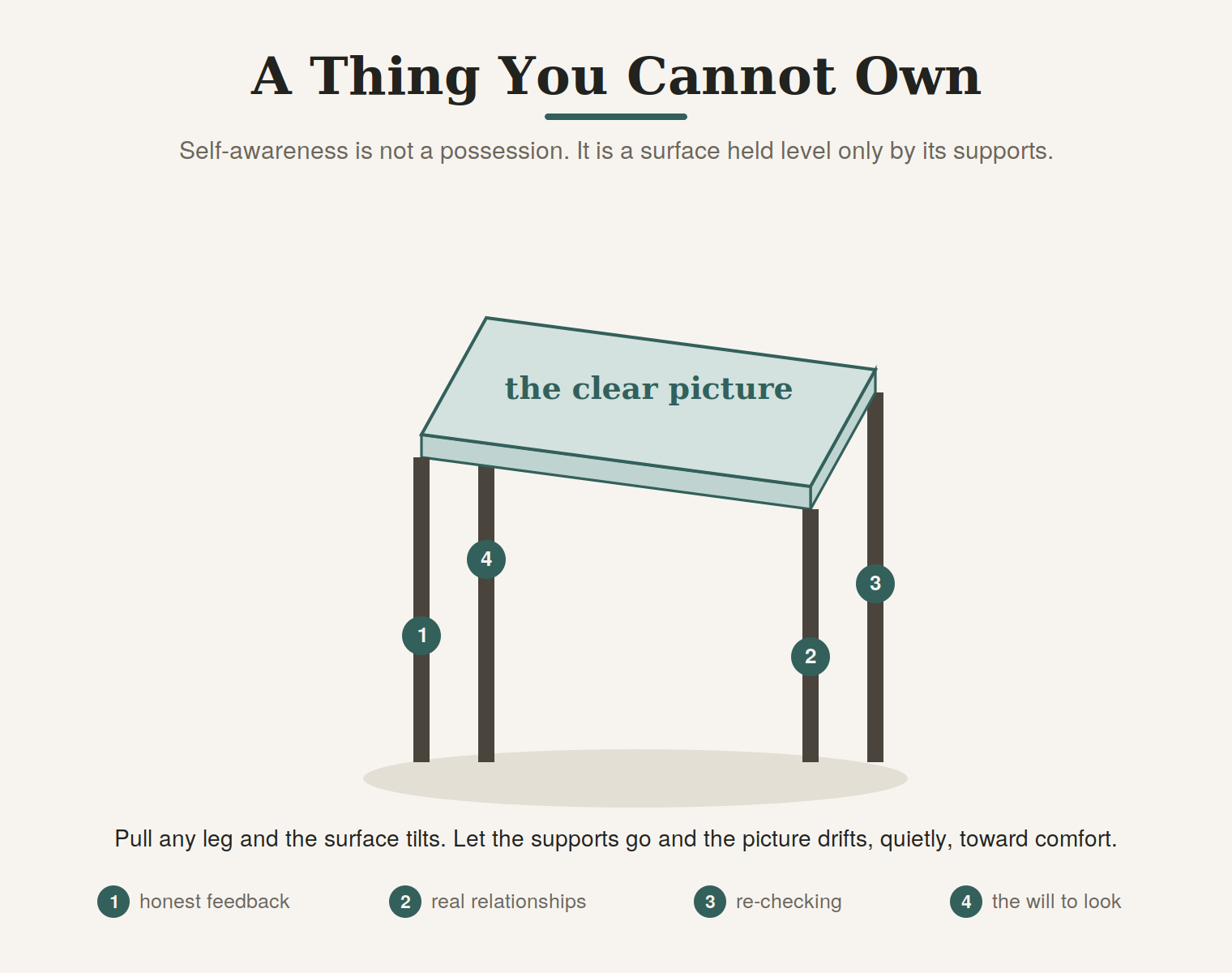
Here is the strangest property of self-awareness, and the one I have come to think matters most. It is not a trait you possess, and it is not even, quite, a belief you can hold; it is closer to a structure you have to keep standing.
Treat it as a belief, "I am a self-aware person," and you have already begun to lose it, because the belief is exactly the thing that ends the checking. The moment you are certain you see yourself clearly, you stop gathering the evidence that would tell you whether you still do. Self-awareness is better understood as a maintained system: a set of honest relationships, feedback you keep inviting, and habits of attention you keep practicing, all of which hold the clear picture in place only for as long as you keep them running. Let them lapse and the picture drifts, quietly, without announcing itself.
This is why the thing can move backward. You would expect age and experience to deepen it; often they erode it instead, because the more experienced and powerful a person becomes, the less honest feedback reaches them and the more they trust their own account of themselves, until the felt certainty of self-knowledge swells at the very moment its accuracy thins. The back-drift is not really a personal failing; it is closer to a physics: remove the corrective forces and the system relaxes toward comfort. Which returns us to where we began: the self-aware are not the ones who arrived, they are the ones still, deliberately, keeping the lights on.
Part Two: The Weather of the Mind
On self-illusion, the fog that shelters and the fog that blinds.
The default is fog
Everything so far has described a rare achievement and the work of holding on to it. But to understand why it is rare, you have to look at what it is rare against. The natural resting state of a mind regarding itself is not clarity, it is a gentle, coherent, self-flattering fog. Call it self-illusion: not the deliberate lie you tell yourself in a bad moment, but the standing tendency of the mind to render a portrait of itself that is kinder and tidier than the truth, automatically, beneath the level of awareness, without ever asking your permission.
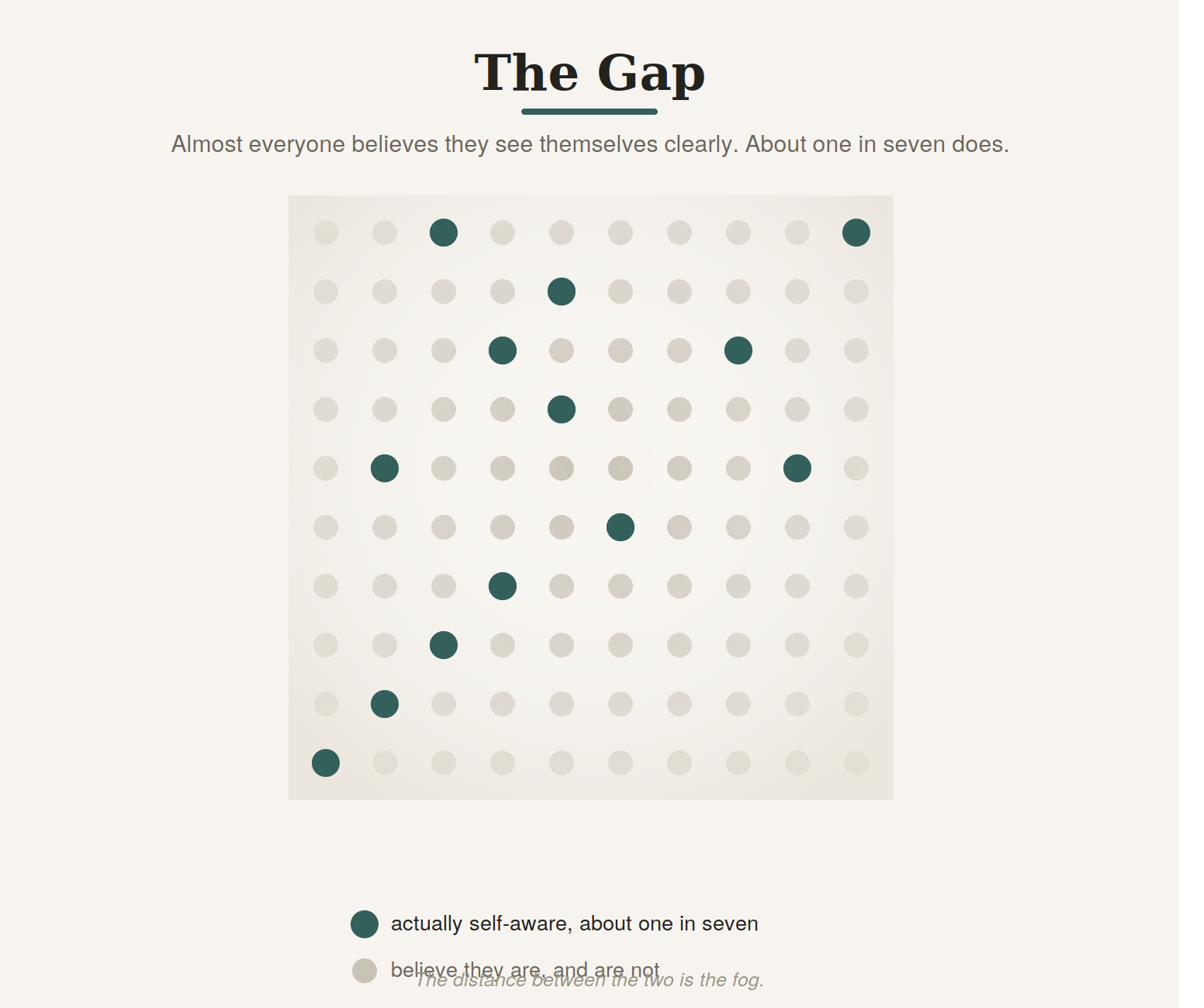
The scale of it is easy to miss, because the illusion is doing its job. Remember the gap: roughly nineteen in twenty people believe they see themselves clearly, and perhaps one or two in ten actually do. That gap is not a coincidence sitting beside the subject. It is the subject. The distance between how many think they are awake and how many are is precisely the size of the fog. Ask people almost anything comparative about themselves and the same thing happens: most rate themselves above average, as drivers, as judges of character, as ethical people, which is a mathematical impossibility wearing the clothes of a feeling.
The machinery is quiet and well built. Success arrives as evidence of who you are; failure gets quietly filed under circumstance. (The habit has a name, the self-serving bias, but you already know it from the inside.) When you act, the mind supplies a reason afterward and hands it to you as though it came first, and you believe it, because it is yours. This is the why trap from earlier seen from above: the confident false story, generated on demand. And underneath all of it runs one simple gradient. It feels better to see yourself in a warmer light, so, absent some force pushing the other way, you do.
The cruelest feature of the fog is that it conceals its own weather: you cannot feel yourself being wrong about yourself the way you can feel yourself being cold or hungry. Error about the world announces itself when you walk into the door you thought was open. Error about the self makes no sound at all, and this is why the ninety-five percent is not stupidity, and not even vanity, it is structural. Not seeing is the default, and it arrives with the remarkable built-in feature of feeling exactly like seeing.
And yet the fog is not simply the villain of the piece. Some of it, it turns out, may be the very thing keeping you well, and that is the next turn.
The reversal: some fog is load-bearing
Everything in Part One argued for clear sight. Here is the complication that keeps the argument honest: a measure of self-illusion may be part of what keeps a person well.
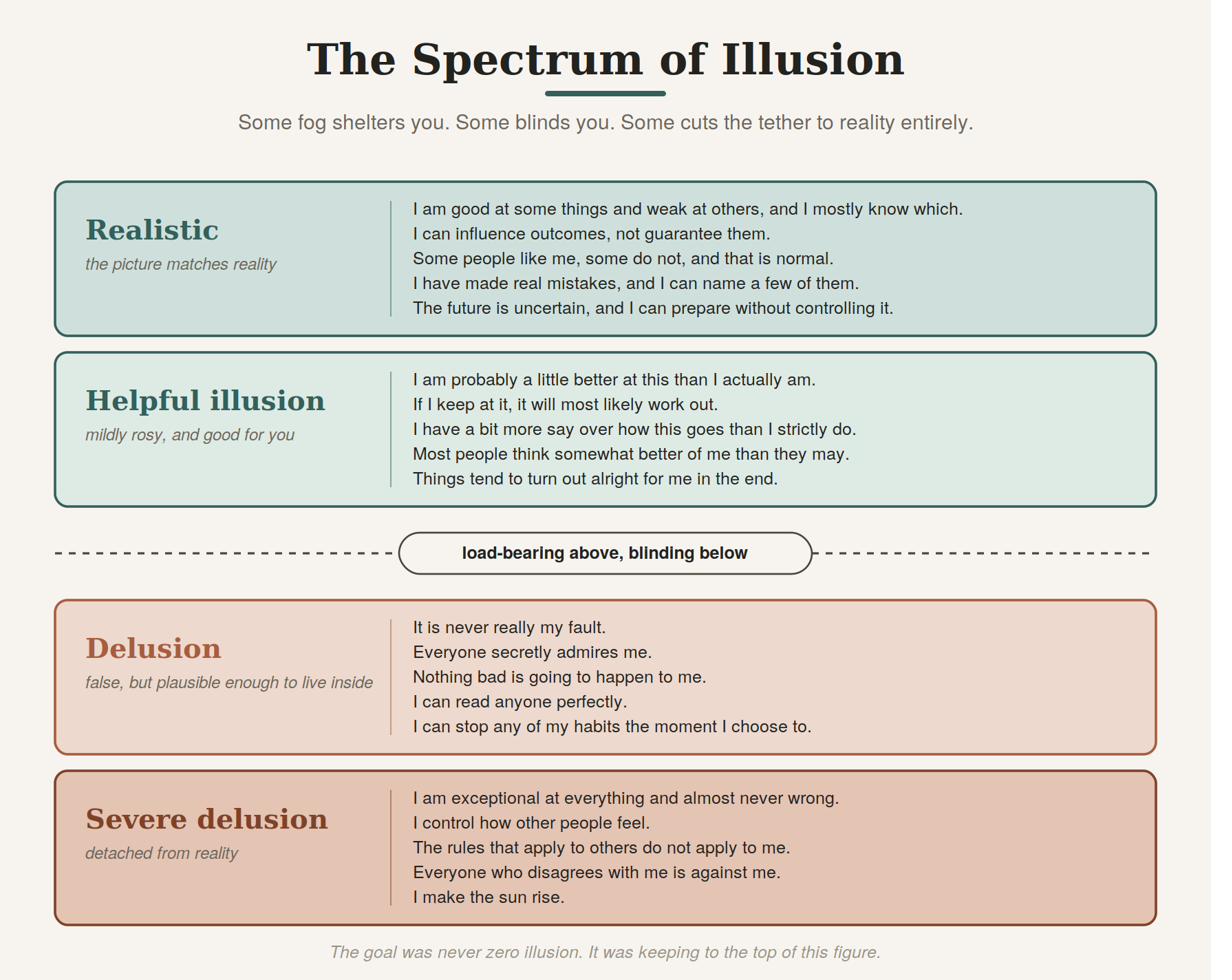
The case was made most sharply by two psychologists, Taylor and Brown, who in 1988 challenged the old assumption that mental health rests on accurate perception. Reviewing the evidence, they argued close to the opposite. Normal, well-functioning minds are not accurate about themselves, they run a set of mild positive illusions: a slightly flattering view of their own qualities, an exaggerated sense of control, an optimism about the future that the odds do not quite justify. And these illusions, far from being defects, seem to do real work: they help people care for others, stay productive and creative, absorb stress, and keep going. In the sharpest version of the claim, a perfectly realistic view of oneself looks less like health than like the beginning of depression, and the illusions matter most exactly when life is hardest, cushioning people through serious illness, loss, and grief.
Two cautions keep this from collapsing into "ignorance is bliss." The first is that the science is genuinely contested. Careful critics have argued the case remains unproven, and that the self-enhancement which soothes you in the short term can quietly cost you over the long one. The honest status of the idea is real, partial, and disputed, not settled fact. The second, and the more important, is a line the authors themselves insisted on. The helpful illusions are the small ones: believing you control a little more than you do, not believing you can make the sun rise. Past a certain point illusion stops cushioning and starts endangering. It is the whole distance between hope and delusion.
So the thesis of this piece was never "see everything, spare yourself nothing." It is quieter than that. The goal was never zero illusion. It was learning to tell which fog is load-bearing, the gentle optimism that gets you out of bed and lets you love someone against the odds, from the fog that is only hiding the furniture you keep tripping over: your effect on the people you have hurt, the pattern you will not name, the feedback you have carefully arranged never to hear. Clear sight stays the north star. But a wise person does not burn off every mist. They learn the difference between the fog that shelters and the fog that blinds.
When the fog is a shelter someone built to survive
There is a version of this that is not a matter of philosophy at all, and it deserves to be named plainly. For some people the fog is not a mild, convenient tilt toward optimism. It is a wall a child built, out of necessity, to survive something they should never have had to survive. Trauma, and especially the enduring trauma of childhood abuse and neglect, alters a person's relationship to their own interior at the root, and it does so for reasons that were, at the time, protective.
Recall where self-awareness comes from. The capacity to read your own inner states is learned, in large part, by being read: by someone who treats you as a mind with feelings and reflects those feelings back until you can do it for yourself. Abuse and neglect corrupt that process at the source. When the person who should have been the mirror is instead the danger, looking closely at their mind, and at your own feelings toward it, becomes unbearable, and a child will defensively stop looking. The instrument of self-knowledge gets switched off precisely because using it hurts too much.
There is another response, and it may be less rare than it sounds. Some children do not turn away from the unbearable. They take it in. Rather than switch the instrument off, they keep looking, in an early and precocious form of self-awareness, and what they find is the distortion itself. They absorb the verdict being handed to them and build a self around it, a warped and punishing sense of who they are, often long before they have any means to question it. This is its own kind of damage. It can seed, or at least feed, things like depression at an age when a child should not yet have the vocabulary for despair. Seeing clearly, in that situation, is not a rescue. It is a wound that arrived early and stayed.
The marks this leaves are specific, and they are well documented. Many survivors of childhood abuse and emotional neglect develop alexithymia, a real difficulty in identifying and naming their own emotions, which tends to take root in exactly those environments where showing feeling was unsafe or punished. Many develop dissociation, a protective disconnection from emotion, memory, and even the body, that holds the unbearable at a distance. And trauma appears to blunt interoception itself, the basic sensing of one's own internal signals, so that the raw feed self-awareness runs on arrives faint or scrambled. None of these are weaknesses of character. They are defenses, and they worked. They are a psyche doing precisely what it had to do to get a child through.
There are subtler distortions too. Chronic abuse and invalidation can install a self-image that is not merely foggy but actively false, authored by someone else and worn as if it were true: you are too much, you are nothing, this was your fault. And it often produces a lopsided awareness, a hair-trigger sensitivity to everyone else's mood, because reading the room was once a matter of survival, paired with almost no contact with one's own wants. It is the Pleaser of Part One, except forged under threat rather than chosen: fluent in others, a stranger to the self. There is a clinical name adjacent to some of this, what is sometimes called rejection sensitive dysphoria: a raw, outsized pain at any hint of criticism or rejection, learned early, that can make honest feedback feel like annihilation well into adulthood.
I will speak plainly here, because it would be dishonest not to. I live with several of these at scale: alexithymia, dissociation, and the rejection sensitivity just named. They are not the kind of thing a person fixes once and never thinks about again. They are conditions I have to keep in check deliberately and continually, and that upkeep is its own tax on the work of self-awareness, laid on top of everything else the work already asks. I understand why, for some, it makes the whole road feel not worth walking. I only want to say that it does not make self-awareness impossible. It makes the road longer and steeper, and it can still be walked.
This is why "just see yourself clearly" is not only useless but cruel when handed to someone whose blur is holding a shattered thing together. Here the load-bearing fog is not a figure of speech. The defenses are structural, and they cannot be willed away, because the thing they defend against has not yet been made safe. Which points, quietly, at the only real path out. The capacity was built in relationship, and broken in relationship, and it is in relationship, safe, patient, and attuned, that it can be built again, whether with a trusted person or in the slow repair of good therapy. What the first environment failed to give, the missing mirror, can be given late. It is harder and slower than it should ever have had to be. But the same fact that makes the wound so deep, that we come to know ourselves through others, is also the reason the wound is not the end of the story.
Sometimes the wound forces the seeing
It would be a failure of honesty to end that passage where it ended, because it told only half the truth. Trauma does not bar a person from self-awareness. Sometimes it is the very thing that forces it.
There is a name for this in the research: post-traumatic growth, the well-documented finding that people who struggle through severe adversity often develop beyond where they started, not because of the suffering but through the labor of making sense of it. The growth does not come from the trauma itself, which is worth saying plainly. It comes from the reckoning, the sheer cognitive and emotional work the survivor is forced into. And several of its documented forms are close cousins of the thing this whole piece is about: a deeper sense of one's own strength, more honest relationships, a changed understanding of what matters. Survivors often describe it as a paradox, more vulnerable, yet stronger. The person who has had to take themselves apart and reassemble the pieces frequently ends up with an intimacy with their own interior that the untested never had reason to build. They learned to distrust the comforting story, because for them the comforting story was once a cage. Some of the most self-aware people alive did not arrive there by ease or temperament. They were forced awake, did the work, and stayed.
There is a fork here worth naming, because not everyone who survives takes the same road out of it. Long-term trauma tends to push a person toward one of two conclusions. The first is a hardening: I went through this, so why should anyone else be spared. The second is a vow: I went through this, and I do not want another person to. The second is where a great deal of hard-won kindness comes from, and it is worth separating that kindness from mere niceness, which is a social reflex and often a mask, a distinction that deserves its own treatment. Real kindness, the kind forged in people who have suffered and refused to pass it on, is arguably itself a trauma response, though saying so takes nothing from it. If anything it makes it more remarkable, that a person handed cruelty chose to manufacture its opposite.
And yet I want to add something here that I cannot hand you a study for, because it is mine, drawn from living it rather than from a journal. I have come to believe that even a self-awareness which has held steady for many years is not invulnerable. It was never a possession, only a maintained system, and any system can be worn down. In my own experience, sustained mistreatment, gaslighting, and invalidation, especially in the absence of steady and healthy relationships, can erode even a long-practiced clarity. It is the back-drift of Part One returning in a darker key: not the gentle relaxation toward comfort that age and success can bring, but an active dismantling, applied by a person or a situation with something to gain from your no longer seeing straight.
If that is right, and here again I am speaking from my own life more than from any evidence I could cite, the way back has a particular shape. Once the harm has ended, or been escaped, I do not think recovery is a return to zero. When a pattern has been held long enough, I suspect that restoring it is closer to relearning a bicycle than to learning it the first time: the shape is still in you, dormant, waiting to be found again. But the part I am most sure of is this: even relearning the bicycle is not done alone. Solitary willpower is not the medicine, or not the whole of it. What rebuilds a person is the same force that first built them, a community willing to be patient, and kind, and gently honest. The mirror, held up again, by someone who stays.
This is exactly what makes the next fact so cruel. Some traumas, and abusive ones most of all, have a documented habit of destroying that very thing. Isolation is not a side effect of abuse; it is one of its central instruments. Abusers deliberately cut people off from friends, family, work, and support, and they do it for a precise reason: someone looking in from the outside can see the abuse for what it is, while the isolated person is left with no account of events but the abuser's own. Strip away the outside view and you get to control the story. The removal of the mirror is not incidental; it is the point. It is engineered to keep a person from seeing clearly, and so to keep them from leaving.
Which puts part of the responsibility somewhere people do not usually think to look for it: not only on the one who is struggling, but on everyone standing near them. People who have lived through this, and people who carry conditions like depression, often come to expect one particular betrayal, that the moment their struggle turns inconvenient, the community around them will quietly withdraw. That expectation is not paranoia. It is pattern recognition, usually well earned. So the quiet, genuinely vital thing, within your own capacity and without dismantling yourself to do it, is simply to not be one more person who leaves. To stay reasonably present. To keep offering the patient, honest, unflattering-when-it-has-to-be reflection that no one can generate alone in a room. You may be, without ever being told, part of the structure holding another person's clear sight upright. Self-awareness was never a solo achievement. Sometimes it is something we hold up for one another.
Part Three: The Mirror Others Hold
On the cost of seeing clearly, and the only thing that answers it.
The loneliness of clear sight
I should be honest about what clear sight costs, because it does cost something, and the largest bill it hands you is a particular kind of loneliness.
It arrives in two layers. The first is that clarity about yourself brings clarity about everything around you, your relationships included, and you begin to see which of them are real and which were only ever convenient. The second is subtler and harder to carry. Once you can see yourself, shallow connection stops being enough. To sit among people who can meet you only at the surface, who want the pleasant edited version and nothing underneath it, comes to feel almost exactly as lonely as sitting in an empty room. The company does not register as company. You are accompanied and unaccompanied at once.
This sharpens after trauma, and not only for the reasons you would expect. People often fail to see the person in front of them at all. What they see instead is a projection: a screen for their own discomfort, a target for a judgment they arrived already holding, or, most quietly wounding, an amalgam of the things that were done to you rather than the substance beneath them. You become, in their eyes, your history instead of yourself. I have watched people relate to an idea of me that had very little to do with me, and I have come to think this is far more common than we admit. Those unwilling to connect past the surface tend to build, inside their own minds, a small effigy of whoever they are dealing with. And the cruelty of the effigy is that it is soft where the real person is not. It can be reshaped at will to fit their present frustration, their mood, their need to be right, their wish to look away. The living person is fixed and real and irreducible. The effigy bends. So they relate to the effigy, and the actual person is never once in the room. What this feels like from inside it is being treated as an object rather than a person: a tool, valued only as far as you are useful and convenient; or an extension of the other, a surface onto which they project the insecurity they cannot face; or, for the most fragile, a target for the frustration they carry toward themselves. In none of these are you being met. You are being used as a fixture in someone else's interior.
There is a reason genuine meeting is this rare, and it is less cruelty than difficulty. To truly meet another person you have to be able to hold them as a separate and real mind rather than a surface for your own, and most people have not done the interior work that makes that possible. Worse, when you hold the mirror up to someone who has not, or simply catch them in a moment of vulnerability, what you often get back is not reflection but heat. The reason is worth stating precisely, because it is one of the better-understood things in all of this. There is a difference between guilt and shame that decides much of human behavior. Guilt says I did a bad thing, which is survivable, and points toward repair. Shame says I am a bad thing, which is unbearable, and points toward escape. The evidence is fairly consistent that shame-prone people, met with a fault, tend to externalize the blame, to attack, to deflect, precisely because the alternative is to feel themselves condemned as a whole. So the mirror gets met with anger, sometimes explosively, and the person lashes out rather than looks in. The one who can feel ordinary, workable guilt can take the mirror and mend something. The one drowning in shame can only smash it.
Two things are worth adding. The source of that shame is very often the childhood mistreatment described earlier, which is a real and worthy object of compassion. But understanding where a person's shame came from does not excuse what they do with it now, not where there is no willingness to change. Empathy explains; it does not absolve. And the reaction is not always a raised fist. Some people, rather than lashing out, perform collapse: the victim-switch, the sudden oh, I am terrible, poor me, which converts your honest observation into an emergency about their feelings and quietly demands that you tend to them instead. It moves them to the center, turns accountability into a request for care, and asks you to reflect their fog back as reassurance. It is an easy move to miss, especially for the highly empathetic, whose first instinct is to soothe anyone in pain, which is exactly the instinct it exploits.
And here the cost stops being merely personal. The refusal to do the work is not contained inside the person refusing it. They live inside a cycle of distraction, reaching for whatever will keep the interior room dark, and that cycle costs them their own peace while also denying the people around them the honest mirror those people would themselves need to find any clarity. In this way the avoidance travels outward, one unexamined life making examination harder for the next. In some, hardened over years, it becomes the very foundation of the abusive patterns described earlier. The unlooked-at self does not stay quietly unlooked-at. It leaks.
The mirror you painted
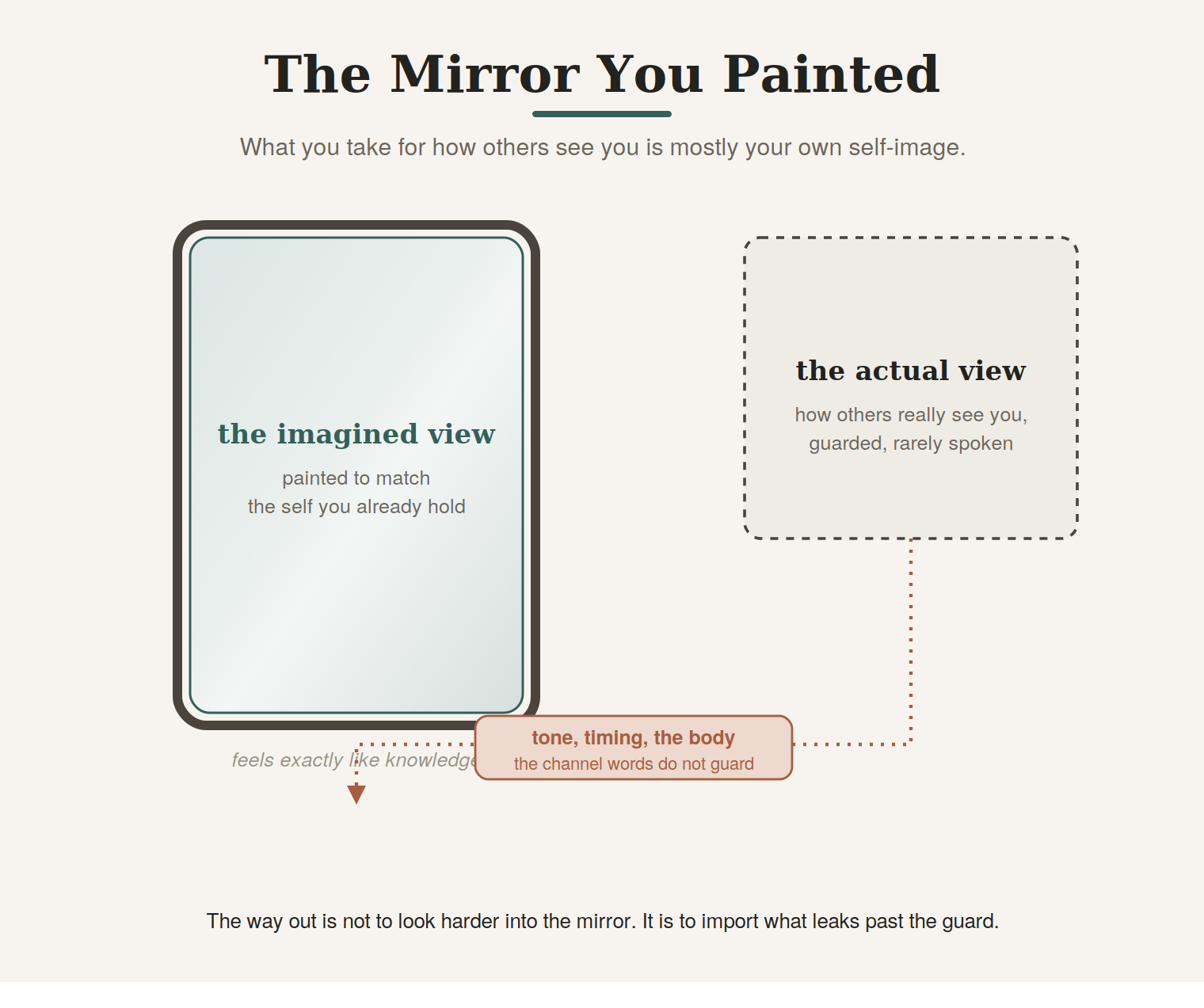
There is something underneath that loneliness worse than not being seen by others, and it took me a long time to look at it directly. It is that you cannot fully trust your own sense of how you are seen at all.
Here is why. More than a century ago Charles Cooley described what he called the looking-glass self, the idea that we assemble who we are largely from imagining how we appear to others, imagining what they must think of it, and then feeling the pride or the shame that hardens the guess into a self. Other people are the mirrors, and we learn the "Me" by reading our own reflection in them. It is a lovely theory, mostly true, and it hides a trapdoor. Later researchers went looking for the reflection and found something unsettling. Our sense of how others see us does not actually match how they see us. It matches how we already see ourselves. What we take to be their view of us turns out to be far more closely related to our own self-image than to anyone's real opinion, so much so that some have argued the whole thing runs backward, that we simply assume others see us the way we see ourselves and then call it their judgment.
Sit in that for a moment, because it is the quiet horror underneath all the rest. Left to itself, the mind does not leave the space marked how others see me blank and wait for evidence. It fills that space with a projection built to agree with the self you already hold, and the projection feels exactly like knowledge. You can spend your whole life consulting a mirror you painted yourself, and calling it the world. And because that space is filled by suggestion rather than by fact, it is dangerously easy for someone else to paint it for you. A person whose intentions end in abuse can supply the reflection directly, telling you who you are until the portrait you consult is one they made, and you mistake their design for your own self-knowledge.
You would think the fix is simple. Just ask. But this is precisely where it fails, and I have learned to expect the failure. People do not tell you the truth about how they see you. At best they hand you the flattering half and keep the rest, and at worst they say whatever keeps the peace. So asking, and then believing the answer, mostly imports the same fog back to you with someone else's signature on it.
What I have found, over years of needing to, is that there is another channel, and it is far harder to curate than speech. Words are chosen. The body is slower. Tone, timing, the flicker before the composed reply, the small mismatch between what a person says and how they say it, all of it tends to leak the feeling they are working to hide. This has a name, nonverbal leakage, and the principle under it is simple. A person guards their words first and most carefully, because they know words are watched, and so the truth they will not say aloud tends to escape everywhere else. Ask someone a direct question and you may not be able to trust the sentence that comes back. You can very often trust the half second before it.
I want to be honest about the limits of this, because it curdles easily into either a party trick or a paranoia, and it is neither. No single gesture means anything on its own; folded arms are sometimes only cold. What the body offers is not a transcript of another person's thoughts, and certainly not a lie detector, which the research is clear that human beings are poor at. What it offers is rougher and more useful than that: signs of discomfort, warmth, withdrawal, arousal, ease, readable only in clusters and only against the baseline of how that particular person is when nothing is wrong. And your own painted mirror can creep back in even here, because you can read into a person's posture the very story you were already telling yourself. So it is held loosely, checked over time, and treated as one more imperfect input rather than a verdict. Done that way, with patience and humility, it is one of the few reliable ways I know to get real information about how you actually land, past another person's guard, which is the exact thing the imagined mirror can never hand you on its own.
So the way out of the mirror you painted is not to look harder into it. That only repaints it in more convincing detail. It is to import signal from outside yourself, and since people guard their words far more carefully than their bodies, the richest signal available is usually the one they are not watching. This is external self-awareness done by hand. Not waiting to be told who you are, but learning, carefully and never perfectly, to read it.
What genuine connection asks
So the ache is real. But I do not believe it is the end of the story, because there is something on the far side of it worth every difficulty, and naming it correctly is half of understanding it.
Everyone craves connection. That much is not in dispute; we are a species that does poorly alone, and the hunger for belonging sits closer to a biological need than to a preference. But there is a difference in what the hunger is for. Some reach for connection to fill a void, and connection sought that way can only ever be a distraction, a painkiller pressed against an ache it was never built to reach, shallow by necessity, because its real function is to avoid the self rather than to share it. Others reach not to be completed but to be met. The old distinction between loving someone for what they do for you and loving them for who they simply are lands exactly here. You cannot offer the second kind out of an empty self. You can only give a real self to the degree that you have been willing to see one.
This is what genuine connection actually asks: to be seen for the substance beneath, and to see another the same way, holding them as real and separate and irreducible rather than as a moldable idea. It asks for vulnerability, which is only possible with enough self-acceptance to survive being looked at. If you can bear to see yourself, you can bear to be seen. And it closes a loop this whole piece has been circling from the start. Connection built your self-awareness in the first place, through the mirror other people held up. Self-awareness then lets you offer an accurate self and genuinely receive someone else's. And each honest meeting becomes a truer mirror, which deepens the knowing, which permits a deeper meeting. The person at home in themselves connects from fullness rather than from famine. They have no need to consume the other or bend them into an effigy, because they are not trying to fill a hole, and so they can let the other be exactly, surprisingly, inconveniently real. They can also take the mirror when it is offered, and sometimes even thank the hand holding it.
Yes, this is why clarity is lonely. It raises the price of admission, and most people cannot yet pay it. But the same fact carries its own consolation. The connection you do find, when it is real, is worth more than any crowd of the shallow kind, and a few true bonds hold more weight than a hundred convenient ones. Fewer, and deeper, is not the consolation prize. It is the actual shape of a well-connected life.
Building connection worth having
If genuine connection is the thing, it is fair to ask how a person actually builds it. I have no formula, and I distrust anyone selling one, but there are a few things I have come to believe are load-bearing.
It begins, unavoidably, with yourself. You can only offer as much of a self as you are willing to see, which means the interior work is not separate from the relational work. It is the first half of it. You cannot give the deeper kind of love out of a deficit, and you cannot ask another to meet a self you are still hiding from.
Then you have to risk being known, which mostly means offering the accurate self in increments and paying attention to what is done with it. Vulnerability is the currency, and it is spent a little at a time rather than emptied all at once. Reveal something true and small, and watch whether it is held with care or handled carelessly. You are not only building closeness. You are also gathering information.
You have to extend the same seeing you hope to receive. That means refusing the effigy in your own mind: staying genuinely curious about who the other person is rather than who your mood would prefer them to be, and letting them correct your picture of them, again and again. To be met, you must be willing to meet, and meeting requires tolerating another person as fully real even when a simpler cartoon of them would be more convenient.
You have to become a mirror worth having, which is precisely what you need from them in return: patient, kind, and gently honest, willing to reflect back even the difficult thing in a way that can actually be received. Genuine connection is reciprocal mirroring, not one person forever holding the glass up for another.
And you have to choose for capacity, not only for warmth. Chemistry is easy and common; the ability to do this work is neither. Watch how a person responds to being gently and kindly seen. Curiosity, even a nervous curiosity, is a good sign. Reflexive deflection and heat, the flare of blame when something true gets too close, is the older tell that the interior room is still too dark to enter, at least for now.
It also helps to look in the right places, because the rare people are not spread evenly through the world. A culture built on image and usefulness rewards the performed self and starves the real one, so the people capable of genuine meeting tend to gather in the corners that culture does not bother to optimize, wherever depth or craft or honest repair is the actual point rather than status. And there is a quieter truth I have come to trust: you make yourself findable by the same work that makes you worth finding. Calibrated vulnerability offered without desperation is itself a signal, and the rare others are reading for it exactly as you are. The interior work that lets you meet another person is also what lets the few who can meet you recognize you across a crowded and distracted room.
The truest test of a bond is not whether it avoids friction but what it does with friction once friction comes. A connection that has never survived a rupture has simply not been proven yet, and the ability to break and return, to say the hard thing and be received, to repair rather than discard, is probably the single clearest sign that something will last. And not every moment of it is repair or advice. Sometimes what one person needs from another is only to be seen accurately, witnessed without being fixed, and knowing which is being asked for, and when, is part of the same skill.
Watch, too, what a person does with the word no. A boundary met with respect rather than punishment is one of the surer signs of capacity, because it means the other can let you stay a separate person instead of an extension of themselves. Being able to hold a boundary is not the opposite of closeness. It is the thing that makes real closeness safe. Watch the ledger of effort as well, not in any single moment but across months, because the person who only ever takes the mirror and never holds it up in return is a slow one-way drain dressed as a friendship. What you are looking for lives between two failures: the fusion that dissolves you into someone else, and the distance that keeps everyone safely out. It is two intact people choosing, again and again, to meet.
And let it be slow. Real trust is assembled out of small consistencies observed over time, not declared all at once, so an intensity that demands total closeness immediately is more often a warning than a gift. The bond built to last is usually the one that was allowed to take its time.
Finally, you have to accept the limits, and this is the part I find hardest to live. You cannot manufacture another person's capacity. Some people cannot meet you where you are, not through any failure of yours but because of where they stand in their own long work, and no amount of patience or love will carry them across that vast interior distance before they are ready to walk it themselves. When that is so, the kind thing, for both of you, is to grieve it honestly and keep looking, rather than to set yourself on fire to keep someone warm who will not tend their own hearth. Stay generous within your capacity. Do not pour yourself into a vessel with a hole in the bottom. The goal was never to be endlessly available to everyone. It was to be truly met by a few, and to become, in turn, someone capable of truly meeting them.
What comes back
I have to be honest about how rare the thing I am describing actually is, because I have spent a long time looking for it and I will not pretend the search is easy. Part of that is the age we live in. By the measures we have, close friendship has been thinning for decades, community involvement has been sliding since the 1970s, and something near half of adults now report real loneliness, with the share who have no close friend at all having roughly doubled in a single generation. A culture organized around individual achievement, image, and what a person can be used for does not tend to grow the patient, unprofitable, reciprocal attention that genuine connection is made from. It quietly selects for the opposite. So the scarcity you feel is not only in your head. The soil really has gotten thinner.
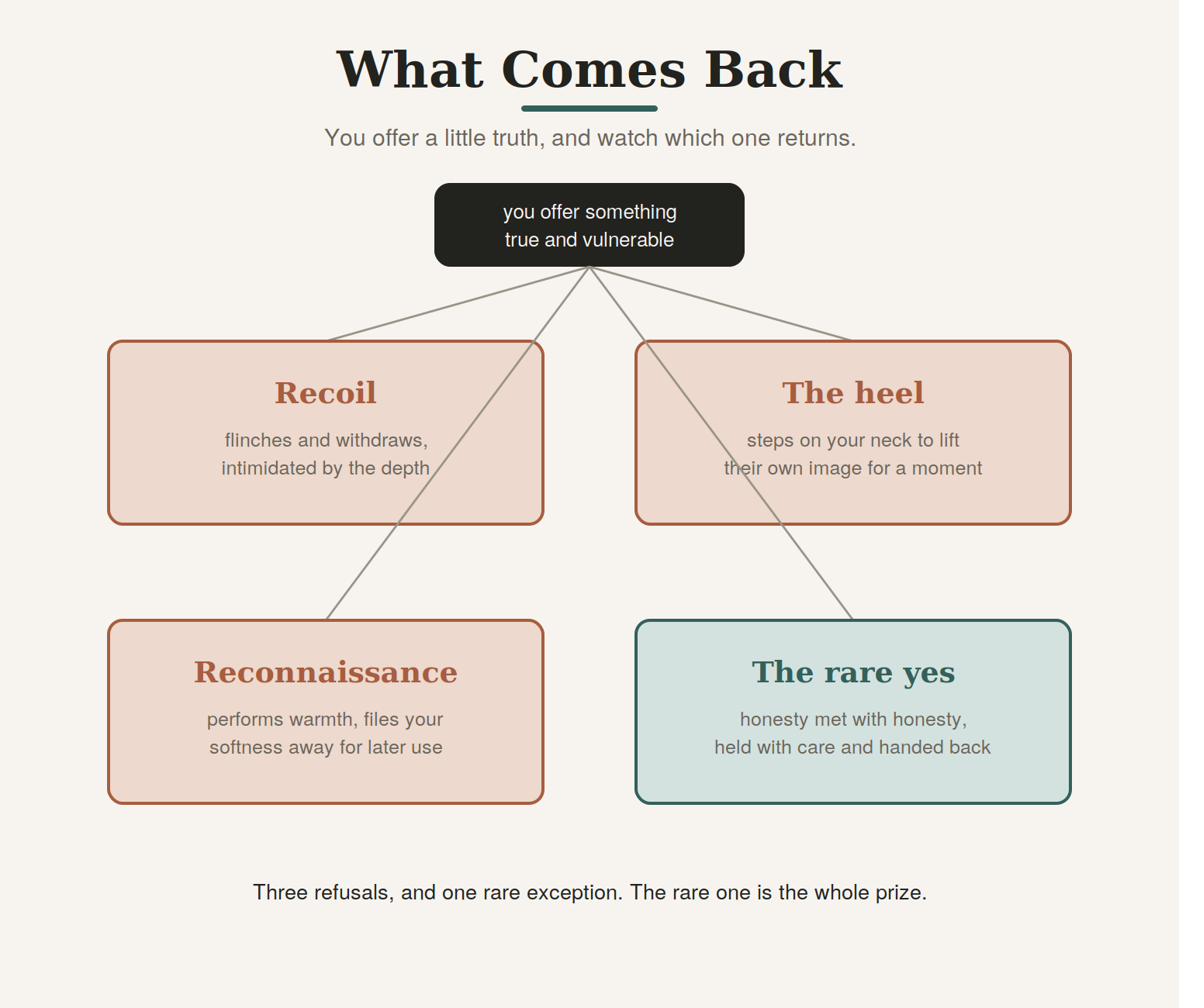
But the deeper scarcity is the one this whole piece has been circling. Connection of the kind that can actually hold self-awareness in place asks the other person to be, themselves, both empathetic and reasonably self-aware, and that is simply not common. Which means the ordinary experiment, offering something true and vulnerable to someone you hoped could meet it, mostly comes back in one of a few disappointing shapes. I have learned them well.
Sometimes it is recoil. You offer depth and the person flinches and withdraws, seemingly intimidated, as though the vulnerability asked them to stand somewhere they cannot stand. It is not usually cruelty. It is that being met at that depth would require them to have visited it in themselves, and they have not, so they go.
Sometimes it is worse. The person reads the vulnerability not as a gift but as an opening, and uses it to step on your neck, to buy a fast lift for their own image by pressing down on yours. This one runs hottest, I have found, precisely when what you exposed lands too near something they deny in themselves. Your honesty becomes a mirror they cannot bear, and rather than look, they smash it, and you along with it. This is the shame reaction from earlier at full volume: a self so globally fragile that another person's openness registers as a threat to be put down.
And sometimes it is the coldest of the three. The person performs understanding, nods in the right places, and quietly files your vulnerability away as information. What you revealed becomes a map of your softest ground, and the warmth was only reconnaissance. You were not met. You were assessed, and found useful.
Very, very rarely, it is none of these. Very rarely you offer the true thing and what comes back is the true thing in return: not a flinch, not a heel, not a filing cabinet, but another person's honesty meeting your own, held with care and handed back. That is the entire prize. And because it is so rare, it is worth knowing exactly what you are looking for, so that you recognize it when it finally arrives and do not spend yourself on the counterfeits.
What you are looking for is capacity, and capacity has tells. It looks like a person who can hear something hard about themselves and grow curious rather than defensive, who can say I do not know or I was wrong without it costing them their whole sense of self. It looks like someone who asks about you and then actually updates, who lets you stay a real and surprising person instead of flattening you into a fixed idea. It looks like reciprocity, a willingness to be seen in return and not only to watch you be seen. And it shows itself, as everything in this piece does, not in what people say about themselves but in what they do when something true gets close. Offer a little truth, and watch. The recoil, the raised heel, the quiet appraisal, and the rare honest answer all reveal themselves quickly once you know to look.
It is a lonely way to have to search, testing the water in small amounts and mostly finding it will not hold you. But the arithmetic still favors it. One person with the real capacity is worth more than a lifetime of the shallow kind, and finding even a single one is enough to change the entire weather of a life. They exist. They are only rare, and worth every counterfeit you have to set down along the way.
The uncomfortable mirror
There is a social cost to clarity worth naming on its own, because it tends to catch a person off guard and then convince them it is their fault.
Self-awareness sets a person slightly apart, and it draws two opposite and equally difficult reactions from those who lack it. Some are repelled. Your clarity works as an unspoken exposure of what they labor to avoid in themselves, and rather than feel that exposure, they put distance between themselves and its source. It is not always personal, but it lands personally.
Others are drawn in, and this is the stranger reaction. There are people who covet self-awareness the way one covets any admired possession, and who seem to believe that by getting close to a person who has it, by claiming them, being with them, holding some private ownership over them, they might acquire the quality itself without ever doing the work that grows it. But self-awareness does not transfer by proximity or possession. It cannot be borrowed, married into, or absorbed by standing near it. It is earned or it is absent. And when the acquisition quietly fails, when being close to you turns out not to have made them into you, the disappointment often curdles. It becomes resentment, and sometimes rage, aimed at you for simply being what they wanted and could not become. You have turned, without doing a thing, into a mirror they cannot bear, and they blame the glass for the reflection.
If a person lives through enough of this, they tend to reach a quiet and terrible conclusion: that the common thread is them, that something in them must be inviting it. It has to be said as plainly as possible that this conclusion is wrong, and that it is precisely the conclusion the whole pattern is built to manufacture. The traits that attract the exploitation, openness, the willingness to be accountable, the reflex to ask whether the fault is one's own, are not flaws. They are exactly what is being targeted, because they are what make a person reachable and workable. The aggression that meets a bid for accountability is a measure of the other person's limits, not of the asker's worth. And the answer is never to become less, to dim oneself into a smaller and safer target, because that only surrenders the clarity that was the protection in the first place. Nothing about such a person needs to shrink. Only the aim needs to sharpen, toward learning who cannot meet them before they spend themselves on the attempt.
It stays true, underneath all of it, that being self-aware is in itself isolating. That is not a personal failing. It is a structural fact of being clear in a world that mostly prefers not to be, and naming it honestly is far easier to carry than mistaking it for a verdict on oneself.
When there is no mirror
I have written about the mirror as though it is always there, held up by someone who stays. It would be dishonest not to admit that sometimes there is no one, and that a self-aware person can go a very long time without a single reflecting surface worthy of the name. This is its own condition, and it deserves to be named plainly, because it is where a great many self-aware people quietly end up.
Self-awareness, remember, is not a possession but a maintained system, and a system needs its inputs. When the empathetic and self-aware other is absent, whether because they were never found, or because life pulled them away, or because the search kept coming back in the three disappointing shapes, the system does not simply carry on untouched. It goes hungry. And here is the cruel arithmetic of it: the clearer you become, the more sharply you feel the absence, because you can now see exactly what is missing and exactly why the substitutes will not do. Many people expect that growing more self-aware will bring more peace, and instead find themselves more alone than they have ever been. That is not the work failing. It is the work showing you how thin the surrounding soil really is.
There are partial mirrors, and in a drought they matter more than pride likes to admit. A good therapist is a trained and professional version of the reflecting other you are missing, and there is no weakness in seeking one. It may be the most reliable mirror available when the personal ones have failed. A mentor can serve. Even the page can, if you write with the discipline of asking what rather than why, because a thought set down outside your head becomes an object you can turn over instead of a fog you are lost inside. None of these fully replaces a real reciprocal bond. All of them can keep the structure standing through a winter.
But the true danger of a long siege is not the loneliness itself. It is what the loneliness tempts you to do. Starvation lowers your standards. When you have gone unmet for long enough, the recoiling, the exploiting, even the outright cruelty can begin, for a desperate moment, to look like they might be better than the silence, and this is precisely how harm gets in. Less begins to feel survivable when nothing does not, and a door gets left open that should have stayed shut. The hunger does not make a person weak. It makes them willing, and willingness aimed at the wrong person is how a hard-won clarity gets slowly talked back out of itself.
This is not a rare failure, and it is not a shameful one. A great many people, worn down by the same hunger, accept the lesser thing, suffer under it, and have to rebuild themselves once it is finally over. It happens often enough to be one of the clearer reasons some people are more prone to abuse than others: not weakness, but a long starvation that made almost anything look like food.
So the discipline of the siege is a strange and difficult one: to stay hungry rather than eat what is poison. To hold the bar exactly where your clarity has told you it belongs, even when holding it means being alone a while longer. To refuse the counterfeit not out of pride but out of self-preservation, because a self-aware person who accepts a mirror that lies ends up worse off than one who accepts no mirror at all. Being alone, it turns out, is not the worst thing on the menu. Being slowly unmade by bad company is.
And it is survivable. That is the part I most want to say, because from inside it, it does not feel survivable. The siege is a season, not a sentence. The real thing exists, rare and worth every counterfeit set down along the way, and protecting yourself through the drought is not resignation. It is how you stay whole enough to recognize the real thing when it finally arrives, and whole enough, when it does, to meet it.