
On power, loyalty, and the difference between a pedestal and a hearth
by Darkageon Youngblood
In brief
Most of what we believe about power is not merely incomplete; it is closer to inverted.
The folk theory says power is force. That it is seized, held, and defended, that it belongs to the cunning, the relentless, and the ruthless, and that having it means other people, essentially, do what you say. Whether out of respect, fear, or need, the methods vary.
Almost every part of that is wrong, and the parts that are technically right are right about the weakest and most brittle kinds of power there are.
What follows is an argument in three moves. First, that power is not taken but conferred, which means it is not a possession at all but a loan, and that nearly every form of it we chase is a form of withholding, an engineered scarcity that requires secrecy to maintain and that dies the moment the scarcity ends. Second, that there is one form which works the opposite way, which is created by giving rather than by hoarding, and which is the only one that survives when everything else is stripped away. Third, that the reason this is worth knowing is not academic, because the same physics runs a household, a company, and a country, and because the crude theory of power is doing enormous damage at every one of those scales right now, as anyone present in politics, news cycles, business, or even their own home can attest to.
Some of this comes from research. A good deal of it is mine, worked out the slow way, and wherever I am extending past what the evidence actually supports I have tried to say so plainly, because a piece about honest power ought to be honest about where its own claims come from. This piece is a companion to The Honest Mirror, which is about seeing yourself clearly. The two turn out to be the same subject viewed from different sides, and I will point at the seams as we reach them.
Part One: The Borrowed Crown
On what power is not, what it is, and the one kind that does not run out.
The folk theory
Start with the version almost everyone carries, because it has a distinguished pedigree and it is worth understanding before dismantling.
In 1513 an unemployed Florentine bureaucrat wrote a short book about how princes keep their thrones. Its most famous claim is that it is safer to be feared than loved. Nearly five hundred years later Robert Greene published The 48 Laws of Power, which is essentially the same argument with better marketing. Conceal your intentions. Court attention at all costs. Never outshine the master. Keep people dependent on you.
Both books are genuinely insightful about one narrow slice of the subject, and both are usually read the wrong way round, as manuals rather than as warnings, in my opinion.
Consider the circumstances in which The Prince was written. Machiavelli had just lost everything. The republic he served collapsed, the Medici returned, and he was stripped of office, arrested, and tortured on the rack on suspicion of conspiracy. He wrote the book in exile on a small farm, and he addressed it to the very family that had ruined him, hoping to be given a job. It is not the serene wisdom of a man at the summit of power, quite the opposite; it is the work of a man who had just been destroyed by it, writing to his destroyers, trying to get back in. That does not make it worthless: it makes it evidence. It is a document about how power looks from underneath it, written by someone in the worst year of his life.
And notice what the folk theory actually produces if you live by it. I have watched people try, and the results are consistent enough to be a diagnosis rather than an anecdote. A person who conceals their intentions, says less than necessary, trusts no one, keeps others dependent, and assumes every relationship is a maneuver will end up exactly where you would expect: alone, and likely afraid. Isolated by design and paranoid on principle. Read as a manual, these books do not make you powerful. They make you the kind of person nobody tells the truth to, which, as we will see, is the precise condition in which power rots. The cautionary tale is not inside the book, however, the cautionary tale is what happens to the reader.
The man who answered him
The best reply to Machiavelli was written roughly forty years later by a French law student in his early twenties, and almost nobody has heard of it.
Etienne de La Boetie's Discourse on Voluntary Servitude asks one question and does not let go of it. If the tyrant is one man, and his subjects are many, why do they obey? La Boetie's answer is that the state does not rule primarily by force, because it cannot: there were never enough soldiers. If even a small fraction of people simply refused, the whole apparatus would seize. Most people obey without ever being made to.
So where does the tyrant's power come from? La Boetie's answer is the hinge of everything that follows: it comes from the governed. The tyrant has nothing except what is handed to him. The eyes that watch you are yours, the governed, given. The arms that strike you are yours, lent. The feet that march through your cities were your own. He has no power over you except the power that arrives through you. Strip the pedestal away, he argues, and the colossus falls of its own weight and shatters. His remedy is not violence but withdrawal. Resolve to serve no longer, he writes, and you are free that very moment.
He is describing conferral, four centuries before the psychologists arrived at it in the lab. And he goes further, in a direction that will matter a great deal later. He argues that tyranny is sustained less by fear than by the self-interest of the people who profit from it, the courtiers and functionaries whose own small power depends on the big one, and who therefore prop it up without being asked. And he names what he considers the true secret of domination: tyrants train their subjects not merely in obedience but in adoration. Not just compliance, but applause.
Hold onto that. It will come back wearing a suit.
His other answer to why people stay is custom. People born into servitude accept it because they have never seen anything else, and the mind treats the water it swims in as the shape of the world. That is written about kingdoms, but read it about a household and it does not need a single word changed.
What power actually is
The modern research lands almost exactly where La Boetie did, which is a good sign for both.
The psychologist Dacher Keltner defines power as the capacity to alter the states of other people, to make a difference in the world. Notice what that definition does: it strips out force, rank, wealth, and menace entirely. It says nothing about thrones. And it makes power almost embarrassingly ordinary, because by that definition you have it constantly. The friend who can lift or wreck your afternoon has it. The parent whose approval a child organizes their inner life around has it. The person in a meeting everyone glances at before speaking has it. Power is not a room you enter, it is a property of every relationship you are in, a living and pervasive dynamic, running in both directions at once, at levels that shift by the hour.
Keltner's central finding is the one that matters: power is given, not grabbed. Groups confer it on the people who advance the common good, in theory. It is granted by others, for reasons, and it can be revoked when the reasons stop applying.
Which means power is not a possession. It is a loan.
If you have read The Honest Mirror, that shape will be familiar, because it is the same shape as self-awareness: a thing you cannot own, held in place only by forces outside you, and drifting the moment you mistake it for something you have. The rhyme is not a coincidence, and we will get to why.
One more thing worth saying plainly, because the polite version of this subject usually skips it.
Everyone enjoys power.
Not the cartoon version, not domination, but the ordinary and constant pleasure of mattering, of being listened to, of watching your effort actually move something in the world. Nearly everyone will deny this about themselves, either from a lack of understanding of what it is or from an internalized shame perhaps, and yet identify it instantly in others. That denial is worth examining, because a person who believes they are above wanting power is not free of the wanting, they are simply unable to see themselves reaching. It is human to want to matter; the question was never whether you want it, the question is only how you intend to get it.
The six doors
Before we go further we need a map, and the standard one is good.
In 1959 two social psychologists, John French and Bertram Raven, asked a simple question: when someone complies with you, what exactly is doing the work? They identified five sources, and Raven added a sixth a few years later. They have held up remarkably well.
Coercive power is the ability to punish. Comply, or something bad happens. It is the base the folk theory mistakes for the whole subject.
Reward power is the ability to give something wanted. Comply, and something good happens. The bribe, the bonus, the approval.
Legitimate power is the power of the role. You do what the judge, the manager, or the officer says because of the office they occupy, regardless of the person filling it.
Expert power is the power of knowing. People defer because you have knowledge or skill they lack and need.
Referent power is the power of being admired. People are influenced by you because they identify with you, want to be like you, or want to be liked by you. Charisma lives here, the term Cult of Personality likely comes to mind.
Informational power is control of what others need to know. Not the standing of the expert, but possession of the specific fact, the access, the file.
The first three are usually called positional, because they come with the chair. The others are personal, because they travel with you when you leave it. And the research on effectiveness is not subtle: coercion and reward buy short-term compliance while quietly breeding resistance, while expertise and admiration produce something closer to genuine acceptance, even if often through illusion.
Most people, if pressed, can only really see the first two or three. That is what makes the popular theory of power so crude. It has six doors available and it has only ever noticed the ones marked threat and bribe.
But there is something the taxonomy does not say out loud, and it is the most important thing about it....
What all six have in common
Look at them again and ask a different question. Not why does the target comply, which is the question French and Raven were answering, but what is the powerful person actually doing? The answer that follows is my reading rather than their finding, narrowly missed before, and I think it is the most important thing about the map they drew.
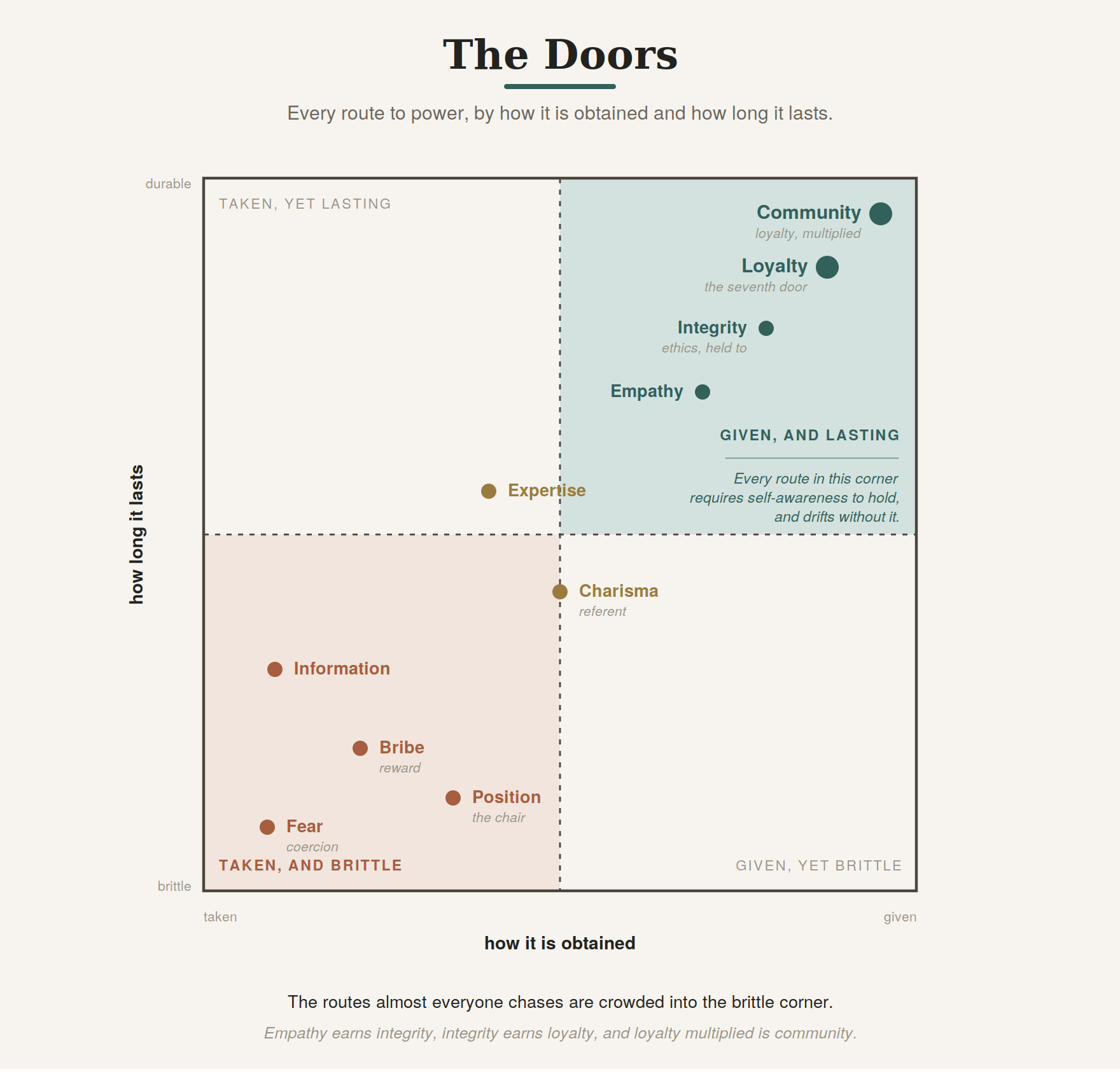
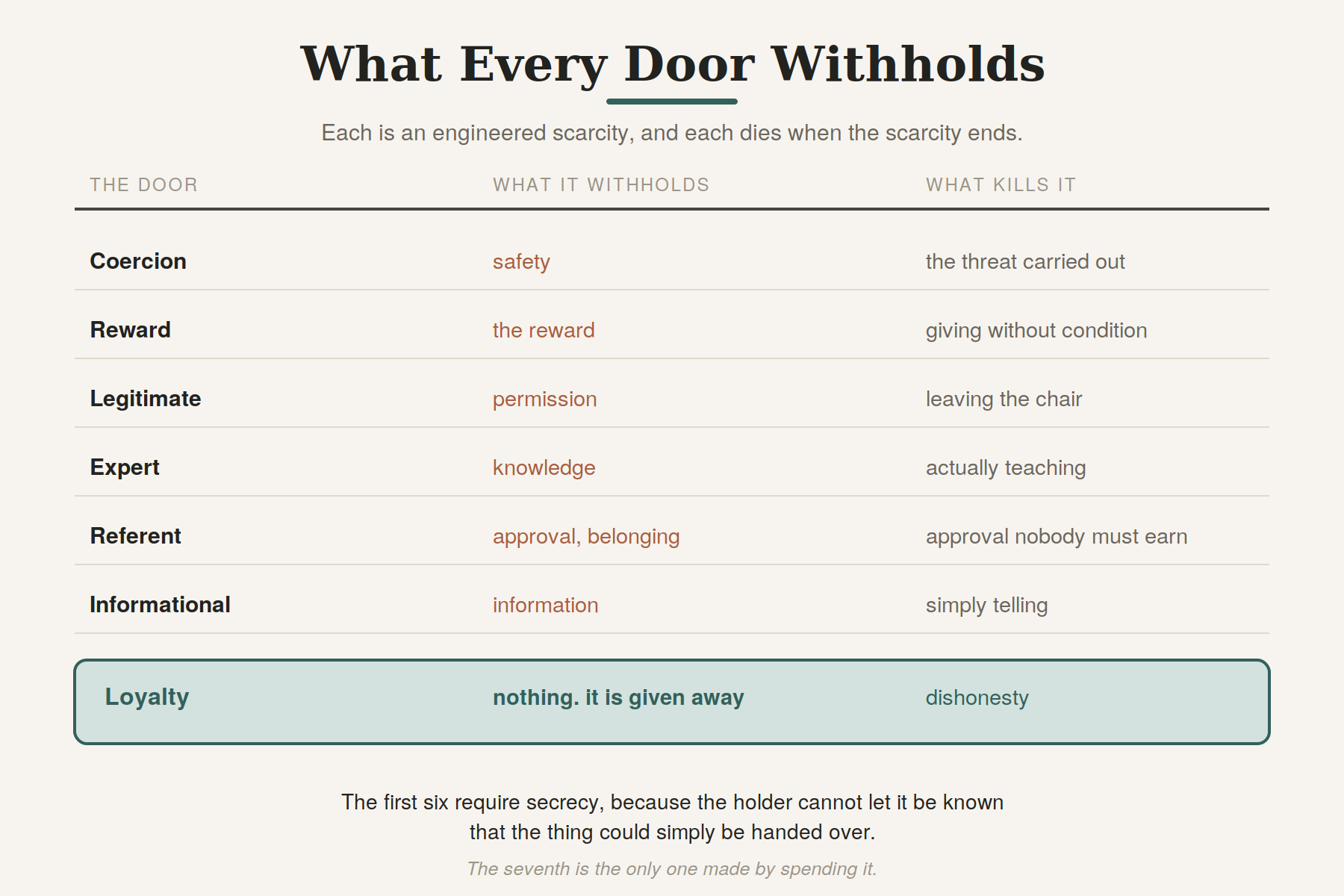
Coercive power withholds safety. Reward power withholds the reward. Legitimate power withholds permission. Expert power withholds knowledge. Referent power withholds approval and belonging. Informational power withholds information.
Every single one is a form of withholding. Every one is an engineered scarcity.
And once you see it, the consequences fall out immediately. Each of these powers dies the moment the scarcity ends. Expert power evaporates the instant you genuinely teach someone everything you know. Informational power evaporates the instant you tell. Reward power evaporates the instant you give without condition. Referent power thins the moment your approval is unconditional and universal, because approval nobody has to earn is not worth orbiting.
Which is why all six require secrecy, and why the secrecy shades so easily into dishonesty. The holder cannot let it be known that the thing could simply be given, as the scarcity has to look like nature rather than choice. This is why gatekeepers speak in jargon, why the person with the information mentions that they have it rather than sharing it, why the one who could help holds back just enough to remain necessary. None of that is incidental to these forms of power, it is the maintenance schedule.
Now go back and read Greene's laws with this in hand:
- Conceal your intentions.
- Always say less than necessary.
- Keep people dependent on you.
- Never outshine the master.
- Use selective honesty to disarm.
Those are not laws of power, they are instructions for maintaining artificial scarcity, written by someone who assumed scarcity is all power has ever been. The 48 Laws is a manual for withholding, and it reads as profound only to a reader who has never been shown the alternative, has never experienced actual consistent power.
There is one more thing these six share, and it is the thing that hurts.
Every one of them relates to you as a use, not as a person. If I have power over you through any of these doors, then what I am to you is a supply: a source of safety, of reward, of permission, of knowledge, of approval, of information. You are not dealing with me, you are dealing with what you need from me, and I am cultivating that need. In The Honest Mirror I described the effigy, the small moldable idea people build of you instead of meeting the real thing, and the particular feeling of being treated as a tool, valued only as far as you are useful and convenient. This is the same phenomenon seen from the other end; the six bases are relationships between an appetite and a supply: nobody in them is actually in the room.
Coercion deserves its own dark footnote, because there is a corollary here that people who have lived it recognize instantly. Coercive power depends on the threat remaining unexecuted. All the leverage lives in the anticipation. Carry the threat all the way out and you have spent it, and there is nothing left to hold over anyone. Which is why the harm so often does not arrive: the power was never in the blow, it was in the withheld blow, the threat of its arrival, the anticipation of its landing. Anyone who has lived inside that arrangement knows the feeling without needing the theory, the way the quiet was never quiet, the way you learned to read a room from a doorway, the way peace itself became something to distrust, because peace was the part before the storm. The eggshells are not a metaphor for the fear, they are the mechanism working exactly as designed.
The scarcity at scale
I want to gesture at something larger here without pretending to settle it, because it is the same physics in a bigger room and it would be dishonest to leave it out.
We produce enough in this world. Right now, today, there is enough food, enough shelter, enough material wealth on this planet that its distribution rather than its quantity is the binding problem. That is not a radical claim; it is closer to an accounting one, and yet the hoard sits at the top of a structure that most of the people inside it mistake for nature.
So here are some questions I would rather pose than answer, because I think the posing does more work:
If every one of the six doors depends on maintaining a scarcity, what would we expect an economy organized entirely around those doors to do with an abundance? Would we expect it to distribute it, or to manufacture a reason it cannot be distributed?
Why is the opposition to any arrangement offering equity so immediate, so total, and so emotional, so far out of proportion to argument? What exactly is threatened when the scarcity is threatened?
And why, from roughly the middle of the last century onward, was individualism sold so relentlessly and so well? Who benefits when people understand themselves as separate units competing rather than as a community capable of conferring, and withdrawing, power together? In The Honest Mirror I wrote about the measurable collapse of close friendship and community over exactly that period, and the loneliness that came with it, and I do not think those two facts are strangers to each other. An isolated person has only one door to each of their needs, a connected person has many, and a person with many doors is very difficult to hold.
I am going to leave that there, as an example rather than a thesis. The large scale is useful here mainly because it makes the small scale legible. Everything above is happening in your kitchen, too.
The seventh door
There is one more, and it is not in French and Raven, because it is not a base in their sense at all. I am adding it, and I want to be clear that this is my extension rather than their finding:
Loyalty.
Not obedience. Not devotion. Not the thing a company means when it says the word. I mean the real article: a person who is with you, freely, who has your back when it costs them something, and who would tell you the truth on the day you least want to hear it, gently.
Loyalty is different in kind from the other six, and the differences are worth naming precisely.
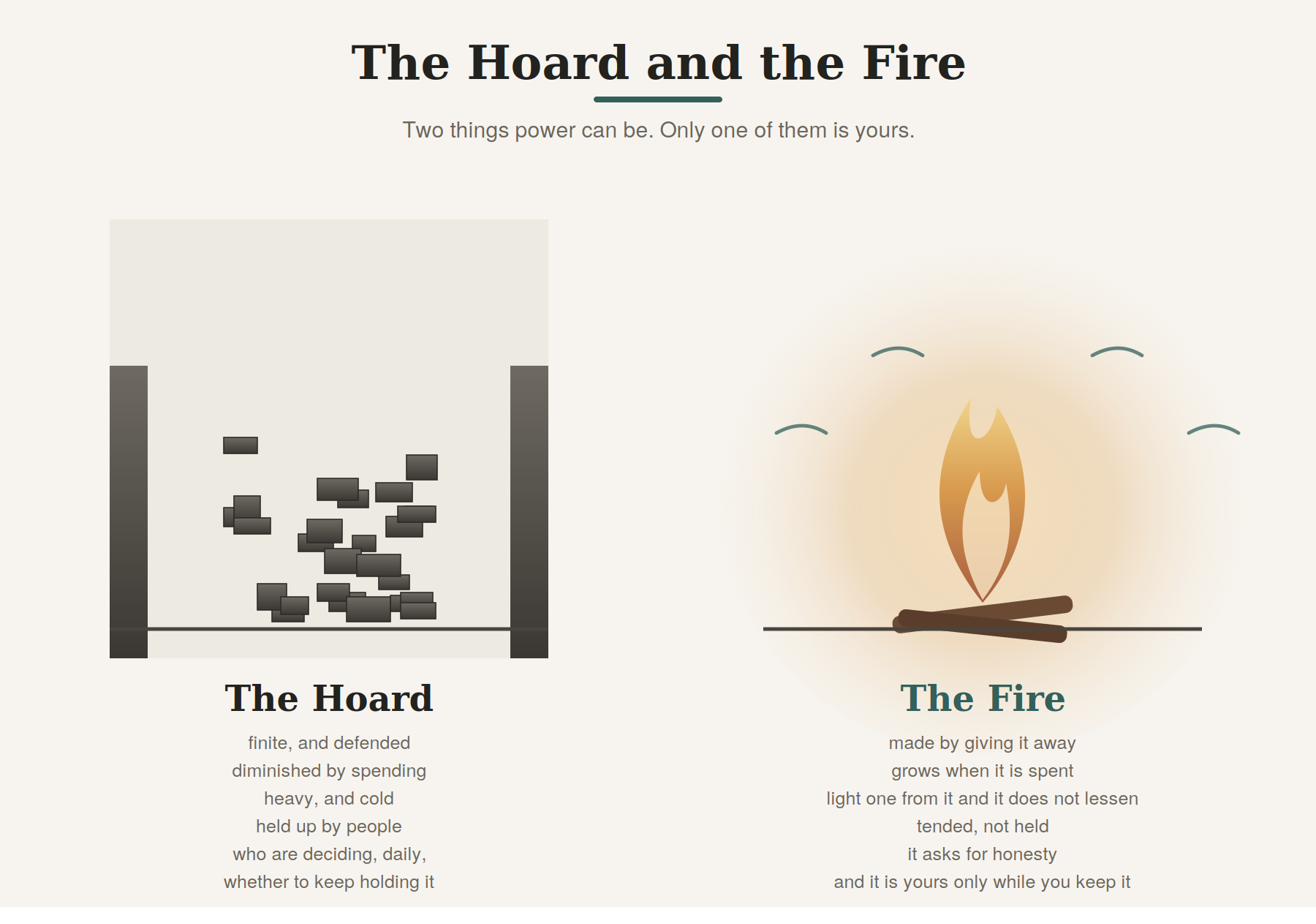
It is created by giving rather than by withholding. This is the inversion, and it is the whole point. Every other form of power is a hoard: finite, defended, diminished by spending. Loyalty is the only one that is made by expenditure, it grows by being given away. Keltner's research says exactly this from the other direction: enduring power comes from empathy, from giving, from gratitude, from telling stories that unite rather than divide. Loyalty is a fire, not a hoard. It costs fuel and attention to keep, but a fire does not run out because you lit another from it, and a maintained fire tends to spread. Which raises a possibility the other six can never offer, and which La Boetie would have recognized instantly: power in numbers. A hoard divided is diminished. A fire shared is multiplied.
It is mutual. Every one of the six runs one way, but Loyalty binds the person who holds it. A loyal person has claims on you, too.
It obligates upward. You can hold all six of the other powers and be a bad person; nothing in them asks anything of you. Loyalty makes demands of the one who receives it, constantly, and if you fail those demands it does not merely diminish, it leaves.
It requires consent, and it requires it again. This is the piece people miss. Loyalty is not granted once and banked. It is conferred continuously, freely, and it can be withdrawn at any moment, and that revocability is not a weakness in it, but is the engine of the whole thing. It is what forces the accountability. The other six are held whether the other person likes it or not, which is precisely why they need no honesty. Loyalty must be re-earned in a way that never quite finishes, and a power that must be re-earned is a power that keeps its holder honest.
And, notably, it survives the loss of everything else. Strip the title, the money, the credential, the ability to punish or reward, and coercive, reward, legitimate, expert, and informational power all vanish together in an afternoon. Loyalty is what is still standing in the morning, which suggests it was the real thing all along, and the rest was weather.
One caution, because this is where it curdles: Loyalty requires honesty or it becomes its own counterfeit. A loyalty that will not tell you the truth is not loyalty; it is flattery wearing loyalty's coat, and it will destroy you gently while feeling wonderful the entire time. Remember what La Boetie called the true secret of domination: tyrants train their people in adoration. Adoration is manufactured loyalty with the honesty removed; it is the same shape with the substance taken out, and it is the subject of Part Two.
Some would say love. Some would say blood.
Two objections arrive here reliably, and both are worth taking seriously, because both fail in the same instructive way.
Some would argue love is the truest power. And love is close, but it does not sit above loyalty. It rests on the same floor. Consider what love actually requires for a second: You cannot love an effigy. Affection aimed at your own idea of a person is not love, it is a relationship with a projection you happen to find pleasant, and the real person is not in the room for any of it. To love someone you have to see them, which means being willing to be corrected about them, repeatedly, which means honesty, which means the same self-awareness and the same consistency that loyalty demands. Real reciprocal love is not an alternative to what I am describing. It is what loyalty looks like when it also has warmth.
Some would argue blood. This one is more revealing, and more brutal, because it is the naive theory of power standing naked with the lights on. The claim of blood is: you owe me your loyalty because of what I am to you. It is the only claim to power that asks literally nothing of the person making it. No honesty, no consistency, no accountability, no earning, and crucially no possibility of withdrawal, which is exactly why so much harm lives inside families. A bond that demands unconditional loyalty while offering no accountability in return is not loyalty at all, it is servitude with a family name on it.
Blood grants nothing automatically. Neither does love, or adoration, or any of the unconditional-sounding words we like. Underneath all of them sits the same requirement, and there is no route around it: to be worthy of what people freely give you, you have to prove it, through action, repeatedly, by being consistently who you claim to be. That is not a transaction, it is just the shape of the thing. And it requires self-awareness, because you cannot be consistent about virtues you cannot see in yourself, and you cannot correct a drift you have not noticed. Which is the seam where this piece and The Honest Mirror are actually one argument. Clear sight is not a private spiritual accomplishment; it is the maintenance requirement for the only kind of power that lasts.
Everything so far has described how power is obtained, and the difference between a hoard and a fire.
What remains is the harder question: What happens to a person once they have it?
Part Two: The Adoration Machine
On what power does to the one who holds it, and to everyone standing beneath.
The set-aside
Something happens to a person who is handed power, and it begins before any of the famous corruptions arrive. It is quieter than corruption and it is the seed of all of it.
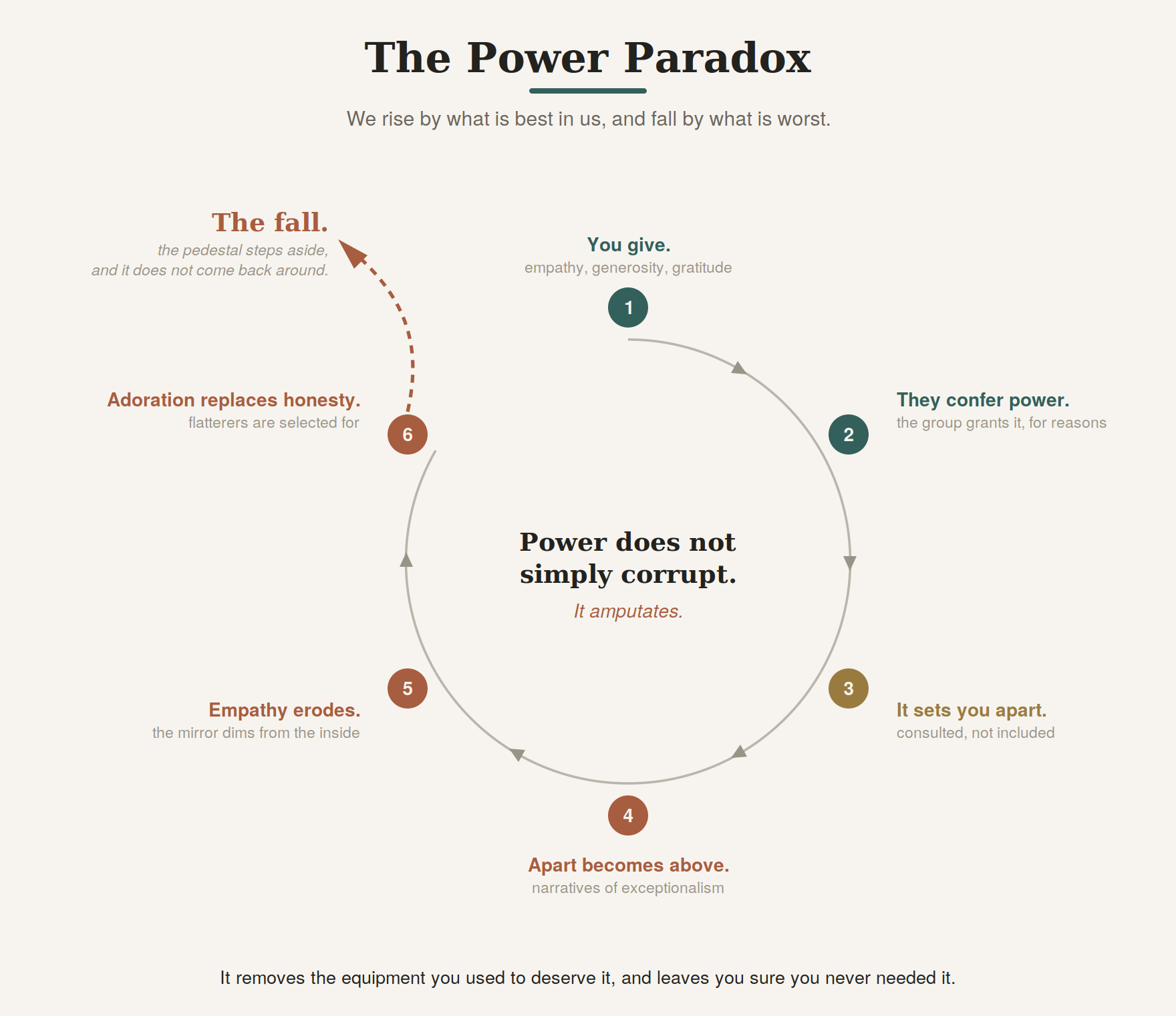
Power sets you apart. Not deliberately, at first. A community confers power on someone because they were useful to it, because they gave, because they were trusted. And then the conferral itself introduces a hierarchy into the very group that did the conferring, and the person now stands slightly outside the thing that made them. They are consulted rather than included, deferred to rather than argued with: the relationship changes shape while everyone is still using the same words.
And here is the move that decides everything, because it happens inside the person and nobody watching can see it: Standing apart begins to feel like standing above. The evidence is right there, after all; people listen, people defer, people wait. A mind is very good at reading that arrangement as information about its own quality. The community granted power to someone for what they gave; the person receiving it slowly often concludes it was granted for what they are.
Keltner has a name for the mature form of this, he lists it among the effects of power: it produces narratives of exceptionalism. Stories in which the rules apply to others because others are other. Once you are above the community rather than of it, everything else in this section follows almost mechanically, because you cannot be accountable to a group you have privately exited.
Notice what has actually happened here? The power was a loan, conferred for reasons. The person has begun to experience it as a possession, deserved by nature. If that shape is familiar it is because it is precisely what The Honest Mirror describes happening to self-awareness: the moment you believe you have it, you stop doing the thing that maintained it. Power drifts the same way, for the same reason, on the same physics.
The paradox
The research on this is unusually clean, and it is worth stating in its starkest form.
Keltner's finding, after decades of it, is that we gain power through the best of human nature and lose it through the worst. Empathy, generosity, gratitude, and the ability to tell a story that unites people: those are what groups reward with power, and they are the first things power takes away. Once we feel powerful we stop empathizing and start self-gratifying. We stop giving and start taking. We stop expressing gratitude and start being rude. We stop telling stories that unite and begin telling stories that divide and demean. From a Machiavellian standpoint, or a Laws of Power standpoint, this is simply part of the maitenance.
Read that slowly, because it is genuinely strange. It is not that power attracts bad people, though it does; it is that power degrades the exact capacities that earned it, in ordinary people, reliably, including in people who would have been horrified to be told so in advance. The mechanism does not require a villain, it only requires a person and enough time. Once accountability has eroded through hierarchy, it begins working silently in the background.
Lord Acton's line about power corrupting is the folk version of this, and it is essentially true, but not quite right. Power does not simply corrupt, it amputates. It removes the equipment you were using to deserve it, and leaves you convinced you never needed the equipment in the first place.
What it does to the eyes
The most unsettling part of this literature is how physical it turns out to be.
In 2006 Adam Galinsky and his colleagues ran an experiment so simple it sounds like a joke. They primed people to feel powerful or powerless by having them recall a relevant experience, then handed them a marker and asked them to draw a capital E on their own forehead. You can do this two ways. You can draw it so it reads correctly to you, which makes it backwards to everyone else, or you can draw it so it reads correctly to another person, which requires you to briefly imagine being them. People primed with power were about three times more likely to draw the self-oriented E.
That is perspective-taking, or its absence, appearing within minutes of a suggestion of power, measured in marker ink. And the rest of that work is worse: High-power participants failed to account for the fact that other people did not share their private knowledge, anchoring on their own vantage point and failing to adjust. And when shown faces expressing happiness, sadness, fear, and anger, high-power participants were simply less accurate at identifying what they were looking at. Not less interested, mind you, less able. The researchers described it as a power-induced impediment to experiencing empathy, something we may all be familiar with in our current society if we sit and stare long enough.
Later work went further down. When people are primed to feel powerful and their brains are watched, the region associated with resonating with others shows dampened activity, while people primed to feel powerless show more of it. And in face-to-face conversations where someone discloses real suffering, people with a higher sense of power experience less distress and less compassion in response.
I want to sit on this for one moment, because of what it means for the other essay: Power dampens the brain's mirroring. The organ we use to reflect other people back to ourselves, and ourselves back through them, is quieted by the experience of being above. Not metaphorically, but measurably. Power takes the mirror away from the inside.
The adoration machine
Now put a person in that condition, with their perspective-taking impaired and their capacity for reflection dulled, and surround them with people whose livelihoods depend on their goodwill. This is where power stops being a personal failing, and becomes a machine, with the maintenance outlined in aforementioned dissections of power clearly.
Because the honest voices do not merely go quiet, they are selected out.
There is a study of this with a title that does the work for me. Park, Westphal and Stern called it "Set Up for a Fall: The Insidious Effects of Flattery and Opinion Conformity toward Corporate Leaders." What they found is that flattery and opinion conformity directed at chief executives makes them more overconfident in their own strategic judgment and their own leadership, which biases their decisions, and that this makes them measurably less likely to change course when their company is performing badly. The praise does not merely feel good, it welds the wheel in place. They call it the Icarus Paradox, and the ending is in the name.
And here is the part that turns it from a story about individuals into a story about systems: In related work, the same researchers found that managers and directors who flatter a CEO are more likely to receive that CEO's recommendation for board seats elsewhere. Flattery is compensated. Which means the environment around a powerful person is not randomly full of flatterers, it is a selection process, running continuously, that rewards agreement and quietly penalizes honesty, until the only people left in the room are the ones who learned what the room pays for. The Dutch psychologist Roos Vonk put the outcome plainly: people in high-power positions are flattered so much that they stop receiving realistic feedback.
Nobody has to conspire. Nobody even has to lie, exactly. Each individual act of agreement is small, plausible, and career-shaped. The aggregate is a person sealed inside a chamber of their own reflection, being told they are right, at the precise moment their ability to check has been chemically dulled by the very thing that put them there. The Echo Chamber drowns out all the noise of reality beyond it.
La Boetie saw the whole apparatus in the sixteenth century, and he was blunter about it than the management journals are. He argued that tyranny survives less on fear than on the self-interest of everyone who profits from it: the courtiers, the functionaries, the middle men, each defending the arrangement because their own small allotment of power depends on the big one. And he named what he considered the actual secret of domination, the mainspring of the whole machine: Tyrants train their people not only in obedience but in adoration.
Adoration. Not compliance, but Applause.
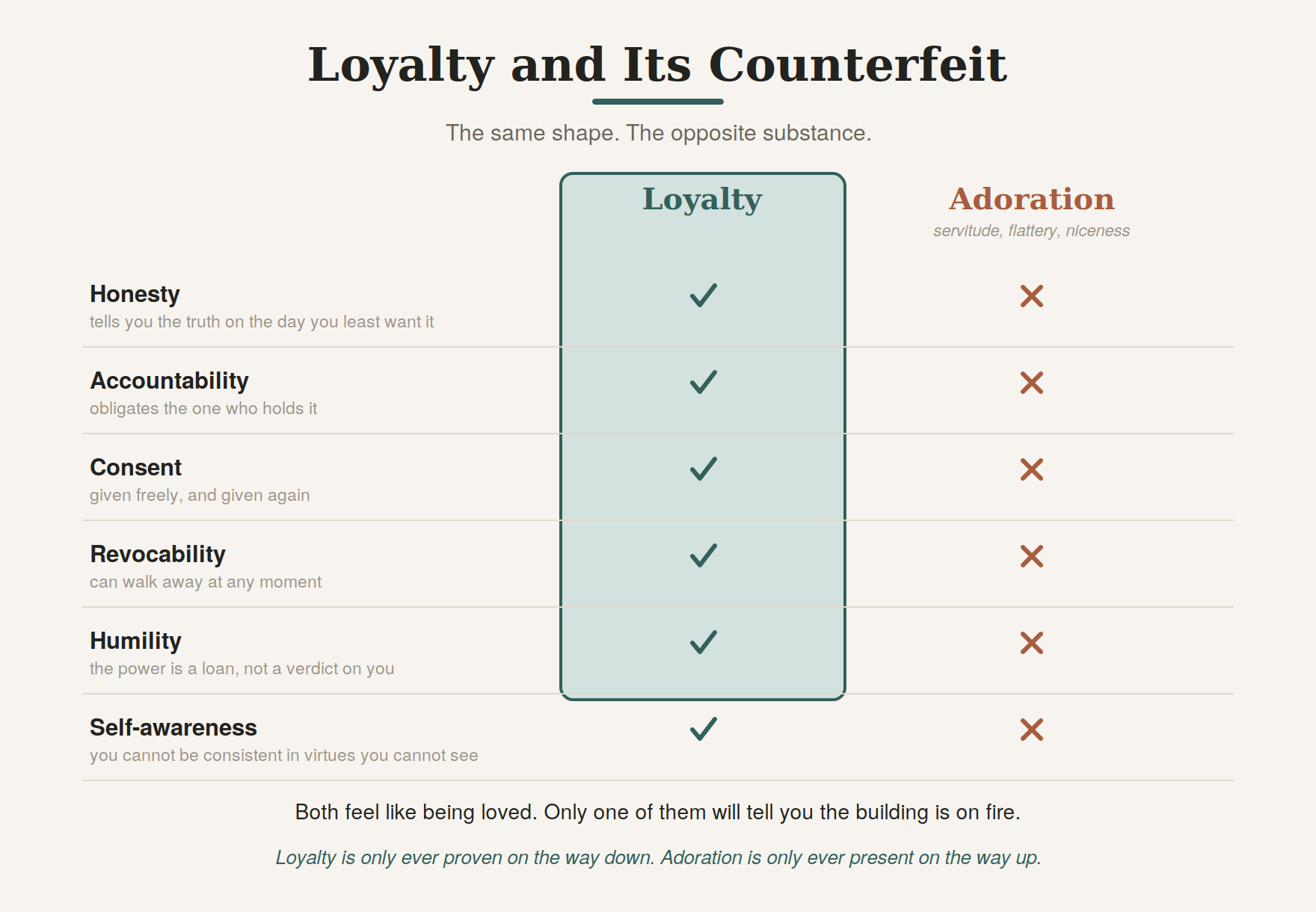
Which is where the counterfeit finally shows its face. Recall the seventh door from Part One: loyalty, freely conferred, honest, revocable, obligating the one who holds it. Now look at what the machine manufactures: Something that arrives looking exactly like loyalty, produced on schedule, warm, reassuring, and totally without honesty. Adoration is loyalty with the truth removed and the accountability quietly deleted; it is the same shape with the substance taken out.
That is the whole distinction this piece is built on, and it is why the two are so easily confused, including by the person receiving them. Both feel like being loved, but only one of them will tell you the building is on fire.
The painted mirror, at scale
In The Honest Mirror I described a trapdoor in how we know ourselves. We assemble our sense of who we are largely from imagining how we appear to others, but the reflection turns out to be a projection. Our sense of how others see us tracks our own self-image far more closely than it tracks anyone's actual opinion. Left alone, the mind fills that space with a portrait it painted itself and calls it the view from outside.
Power does something specific and terrible to that trapdoor: It hands the brush to other people, and pays them to flatter.
The ordinary person at least has friction, as somebody eventually tells them. A partner, a sibling, a colleague with nothing to lose, the correction arrives clumsily and late sometimes, but it arrives. The powerful person has that friction removed on purpose, by a system that rewards its removal, while simultaneously losing the neural capacity to read the faces that might have shown them anyway. Every mirror in the room has been replaced with a portrait, every portrait is flattering, and the one instrument that could have detected the swap has been switched off.
This is why age and experience so often make it worse rather than better, which I wrote about in the other essay as the back-drift. The longer you hold power, the more thoroughly the honest voices have been filtered out and the more evidence you have accumulated that you are right, because everyone keeps saying so. The felt certainty grows exactly as the accuracy collapses, and meanwhile the person cannot feel it happening, because you never can. Error about the self makes no sound.
Everyone becomes an instrument
There is a cost here that runs in both directions, and the downward half is rarely counted.
Part One argued that all six of the ordinary doors relate to you as a use rather than a person, and Power at scale industrializes that. The powerful come to see the people around them as means: instruments for getting things done, sources of supply, functions rather than interiors. This is not usually cruelty, it is closer to the E on the forehead. If your perspective-taking is impaired and your empathy dulled, other people simply stop rendering as full minds, and instead they render as tools, because tools are what you can still perceive them as.
But look at the other end of that, because it is the part that damages the most people, and the research on this is quietly devastating: people in low-power positions come to construe themselves as means to the ends of the powerful; not just treated as instruments, but understanding themselves as instruments. Marx had a word for this and called it alienation; the psychologists arrived at the same place by a different road.
In the other essay I wrote about the particular wound of being treated as an object, a tool valued only as far as it is useful and convenient. This is that wound, industrialized and handed down a hierarchy, until people who have been used long enough begin to do the arithmetic on themselves and quietly agree with the valuation. It becomes a self-fulfilling prophecy, in a way.
The price of powerlessness
We talk endlessly about what it is like to have power, but we almost never talk about the bill on the other side, and the science on it is not gentle.
Keltner is direct: powerlessness sits underneath an enormous amount of psychological and medical suffering. To lack power is to live in an environment of continual threat. Stress is not an occasional feature of powerlessness; stress is what powerlessness is, experienced from inside. And the costs are not merely emotional, either, they are neurophysiological. Chronic powerlessness raises stress hormones, stunts development, damages health, shortens life, and erodes the capacity to create and to contribute.
There is a theory underneath this worth knowing, because it explains a great deal about people you have met and possibly about yourself. Keltner, Gruenfeld and Anderson proposed that power and powerlessness put a person in two different systems entirely. Elevated power comes with rewards and freedom, and it activates approach: attention to opportunity, disinhibition, action. Reduced power comes with threat, punishment, and constraint, and it activates inhibition: attention to danger, careful monitoring of everything, behavior shaped tightly by the situation.
Which means the powerless person is not being paranoid, instead they are running the correct software for their environment. Vigilance is the rational response to a world where other people control your outcomes and can hurt you. The hypervigilance that looks like anxiety from the outside is, from the inside, simply competent threat detection in a place that contains threats.
And this is where Part One's darker footnote returns. Coercive power lives in the unexecuted threat, which means the person under it is not enduring harm most of the time, instead they are anticipating it, continuously, which is the entire mechanism. The eggshells are not the side effect, they are the product. This is one of the crueler symmetries of the whole subject: the powerful lose the ability to read a room, and the powerless are forced to read it perfectly, forever, at enormous cost, because their safety depends on it. One person cannot see, yet the other cannot stop seeing.
I am not going to open that all the way here, because it deserves its own treatment. What conditioned vigilance does to a life over years, how a nervous system trained on threat comes to find peace itself suspicious, and why some people become unable to tolerate calm and will manufacture chaos to return to the stress band they were raised in, are questions large enough to need their own document.
The colossus
So the machine runs, the room fills with applause, the mirror goes dark, and the person at the center becomes progressively more certain and less correct.
And then it ends, and the ending is the most predictable part of the whole story.
The power was always a loan. It was conferred by people, for reasons, and those people are still there, watching, doing arithmetic. Keltner notes that groups have a mechanism for this, and it is not revolution: it is gossip. Communities punish those who undermine the common good by talking, constantly, and reputation is the ledger on which conferred power is actually kept. The withdrawal begins long before anyone announces it, simply, it begins as a mood.
And when it finally comes apart, the people who fed the machine are not the last to leave, in fact they are the ones holding the knife.
This is the part that seems to genuinely astonish the person it happens to, and it should not, because it was always the design. Adoration was never a bond to them, it was a bond to the position, and to what the position paid. The courtier was never loyal to the king; the courtier was loyal to being near a king. So the moment the position stops paying, there is nothing left holding anyone in place, and the room empties with a speed that looks like betrayal and is actually just arithmetic.
Worse, it does not stop at abandonment, but often it curdles into enthusiasm. There are reasons, and they stack:
- Flattery is humiliating to perform, and the humiliation has been quietly accruing interest the entire time, so there is a debt to settle.
- Proximity gave the flatterers information, which means the people best equipped to destroy someone are precisely the ones who spent years agreeing with them.
- Distance must now be demonstrated publicly and fast, because association is contagious.
- And underneath all of it runs the sweetest motive of all: if the fallen one is a monster, then everybody who went along was merely a victim of the monster, which retroactively launders every compliant thing they ever did. Their own complicity is the reason they need the corpse.
So they hand the person to the wolves gladly, and tell themselves they always had doubts, and in a strange way they are not even lying, because the doubts were always there, unspoken, priced in, waiting for the market to turn.
Historically speaking, this is not a footnote. Tyrants are rarely destroyed by the masses at the gate, they are destroyed by the inner circle, by the ones who were closest, who smiled the most. Picture for a moment, Ceasar.
Which gives us the cleanest test in this whole essay, and I would put it this way. Loyalty is only ever proven on the way down, while adoration is only ever present on the way up. You cannot know which one you have while things are going well, because they are indistinguishable at the summit: they look identical, they sound identical, they feel identical. The difference only becomes visible at the exact moment it is too late to do anything about it, which is why the honest form has to be built long before you need it, by someone who was willing to hear no while everything was fine.
La Boetie's image is the one I cannot improve on. The tyrant is a colossus, enormous and apparently immovable, and he stands on a pedestal made entirely of other people's participation. Nobody needs to strike him, simply pull the pedestal away and the sheer weight that made him impressive is the thing that shatters him on the way down. The mass was never strength, as it was always load.
And notice who the pedestal is made of: Not the distant crowd, but the people at his feet, the closest ones, the ones who built the plinth by standing on each other and calling it devotion. The colossus does not fall because the world rose up, but it falls because the adoring stepped aside.
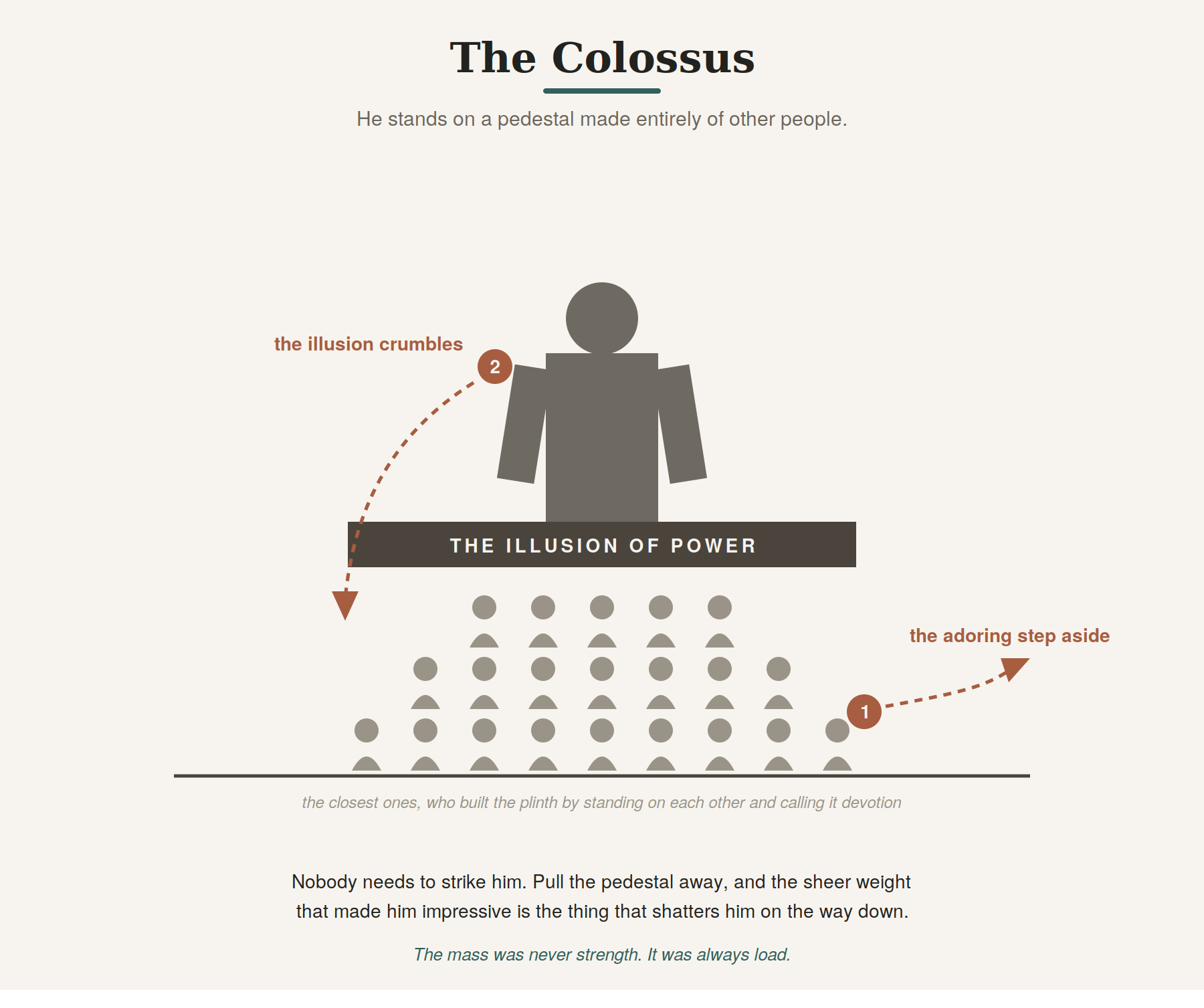
That is what a hoard does at the end: It is finite, it is defended, it is heavy, and it depends completely on other people agreeing to hold it up. The fire from Part One does none of those things, because it was never being held above anyone; it was being shared, which is why it could not be taken and did not need defending, and why the people around it had no reason to want it gone.
Which leaves the question the last part of this has to answer: If this is the physics, what does it look like to hold power without being ruined by it, at the only scale most of us will ever actually operate: not nations, not corporations, but a household, a friendship, a bed, a family? Where power is never announced, rarely admitted, and doing its work every single day?
Part Three: The Smallest Rooms
On power where it actually lives, and what it asks of the one holding it.
Where it actually lives
Everything so far has been staged in throne rooms and boardrooms, because that is where the evidence is cleanest. But almost nobody reading this will ever run a country or a corporation, and the physics does not care. Power is doing its work right now in kitchens, in group chats, in bedrooms, in the space between a parent and a child. Those are the rooms where nearly all of it actually happens, and they are the rooms where it is least likely to be named.
That silence is not an accident, and there is a finding that explains it better than anything else in this essay: Powerful people frequently perceive themselves as powerless, even while behaving in ways that maintain their power. Let that land, because it is the whole difficulty of the intimate scale in one line. The person with more power in a relationship almost never feels powerful, they feel ordinary. They feel put upon, sometimes. They experience their own preferences as reasonable and their own moods as weather rather than climate. Meanwhile the other person is organizing their day around those moods, and can tell you the exact barometric pressure of the house from the sound of a car door.
So at this scale power is rarely announced, and almost never claimed. It is simply the thing that decides whose plans move, whose feelings get processed first, whose version of last Tuesday becomes the official one; it is who has to manage themselves, and who gets managed around.
If you want to find it in your own life, do not ask who is in charge, instead ask a stranger question: who adjusts? Whose preferences bend around whose? When the two of you disagree about what happened, whose account becomes the record? Who apologizes to end a fight, regardless of who was wrong, because ending it matters more to them than winning? Who can be in a bad mood without consequence, and who has to file a flight plan for theirs?
The answers to those questions are the power arrangement. They are usually stable, usually invisible to the one on top, and usually obvious to everyone else who has ever been in the house.
The sole supplier
Now take the withholding insight from Part One and run it deliberately, with intent, against one person, in private.
That is what abuse actually is, and I mean that structurally rather than rhetorically.
Recall the six doors: safety, reward, permission, knowledge, approval, information, each of them a form of withholding, each of them dependent on scarcity. A person operating in good faith stumbles into these occasionally, but someone operating in bad faith does something far more systematic. They do not merely withhold what they have, they engineer the scarcity itself, and then install themselves as the only door.
The method is not mysterious and it is very well documented. Evan Stark spent decades arguing that domestic abuse is not primarily about violence at all, and that treating it as a crime of assault has failed the people it was meant to protect. What it actually resembles, he argued, is hostage-taking. The British Home Office definition he helped shape describes a course of conduct that makes a person subordinate and dependent by isolating them from their sources of support, exploiting their resources for personal gain, depriving them of the means needed for independence and escape, and regulating their everyday life. Stark's own four categories are violence, intimidation, isolation, and control, and he insisted the right name for the whole thing is a liberty crime rather than a violence crime.
Read those definitions again with Part One in your hand. Every clause is scarcity engineering. Isolating from sources of support is manufacturing a scarcity of connection. Appropriating resources is manufacturing a scarcity of money. Depriving of the means of independence is manufacturing a scarcity of exits. Regulating daily life, the micromanagement of what is worn, what is cooked, who is called, when sleep happens, is the manufacture of a scarcity of self.
And every one of those scarcities has the same destination; the goal is not the deprivation, the goal is to become the sole supplier. To arrange a world in which every need the person has runs through exactly one door, so that compliance stops being a choice about the relationship and becomes a matter of survival. At which point you no longer have to make anyone do anything, they will do it themselves, correctly, unprompted, forever, because the alternative is nothing.
This is why isolation is always in the list, at every scale, in every era. It is the master scarcity, because it is the one that removes all the other doors at once. In The Honest Mirror I wrote about isolation as the removal of the mirror, the tactic that leaves a person with no account of their own life except the abuser's. Here is the same tactic from the power side: isolation is what converts a person from someone with options into a captive market. Both are true simultaneously; cut the connections and you take their reality and their alternatives in one motion.
Notice also what this does to the folk theory of power we started with. Keltner's summary of the Machiavellian definition includes a phrase most people skip past: you gain power by manipulation, by deception, by undermining other people's strength, and by breaking up the alliances between them so that you can coerce them into serving your interests.
Breaking up the alliances.
That is not an abuser's innovation. It is in the manual, it has been in the manual for five hundred years, and it is the single most reliable indicator that the person using it has nothing else to offer. The need to isolate someone is a confession. It says the power could not survive contact with anyone else's perspective.
Two more things belong here, and both are hard.
The first, which Part One gestured at, is that this whole structure runs on the unexecuted threat. Stark found that entrapment can be complete without any notable incident of violence at all, and that the level of control is what predicts the worst outcomes, up to and including the fatal ones. The harm is not the blow, the harm is the architecture that made the blow unnecessary.
The second is the thing that traps the people who see clearly: When your world has been arranged so that one person supplies everything, leaving is not a decision, it is a demolition. You are not choosing to end a relationship; you are choosing to end your housing, your income, your friendships, your account of yourself, and your certainty about what is even real, all at once, on the word of a version of you that the arrangement has spent years teaching you not to trust. Anyone who has ever asked why someone stayed has misunderstood the question: they stayed because staying was the only door left, which was the entire point of the work that was done on them.
What the culture hands out for free
Which, to follow, raises an uncomfortable question: If manufactured scarcity is the engine, where does an abuser get the raw material?
Some of it they build. But a great deal of it is simply handed to them, pre-installed, by the society they live in, and this is the part that most needs saying plainly.
Power at the intimate scale does not start at zero and get negotiated. It starts wherever the culture has already put it. Stark's research is explicit that coercive control is gendered, that it works by leveraging women's existing vulnerability under sexual inequality, and that the privileges it is deployed to secure are startlingly specific: control of time, control of material resources, access to sex, and personal service.
Look at that list. Those are not exotic demands.
That is a job description, and the culture wrote it long before any individual man enforced it. Coercive control is, in a great many cases, simply the private enforcement of an arrangement the wider world already considers normal, which is exactly why it hides so well. It does not look like a crime, it looks like a marriage, from the outside, from a distance, if you do not ask who adjusts.
This is also why it is not only a gendered phenomenon, and the same research says so. Coercion and control appear in same-sex relationships, and are used by and against trans people, and land hardest on anyone whose marginalized status leaves them with less social power to draw on when they need it. Which is the actual principle, stated generally: whoever has less standing in the world outside the room brings less power into the room. Gender is the largest and most systematic version of that, but it is a specific case of a general law. Wealth does it. Immigration status does it. Disability does it. Youth does it. Race does it. Every inequality out there gets imported through the front door and sits down at the table, whether or not either person invited it.
So the ugly synthesis is this. Society pre-distributes power unequally, calls the distribution natural, and then treats each household as a private matter. Which means a person who wants to build the machine described above frequently does not have to build very much, because much of the scaffolding is already standing, load-bearing, and painted to look like furniture.
And here is what I find genuinely strange about how we talk about all this: We accept, without much comment, enormous power differentials that were never negotiated, never consented to, and cannot easily be withdrawn from. We call that normal, and reserve our alarm for something else entirely.
The clean room
There is one arrangement in modern life where power is not assumed, not inherited, and not quietly absorbed from the surrounding culture, but named out loud, written down, bounded, and handed over on purpose. It is also the one people find scandalous. I think that is exactly backwards, and I think looking at it carefully explains the entire essay.
I want to be precise about what I am describing, because precision is the whole point here. I mean kink as it is practiced responsibly: the negotiated, informed, genuinely consensual version, the ideal that the serious parts of that subculture actually hold themselves to. I am not describing everything that happens under the label, as misunderstanding and misuse are real and not rare, and I will come back to that, because it matters. But to see the structure clearly you have to look at the version built correctly, the same way you study a clean room rather than a construction site.
Here is what strikes me about it. These are people who took the most volatile substance humans handle, arranged for one person to hold it over another deliberately, and then, because they could not pretend it was anything else, were forced to invent an ethics of power from scratch. And what they came up with, independently, with no psychologists in the room, is almost exactly the argument of Part One.
The oldest version of the framework is SSC: safe, sane, consensual. It emerged in the leather communities of the 1980s for a specific reason worth sitting with: they needed a way to distinguish what they were doing from abuse, both for the outside world and for themselves. It was a watchword, a way of saying we know the difference and here it is. It has since been argued with and refined, because "safe" and "sane" turned out to be slippery words that could be used to shame people. So in 1999 came RACK: risk-aware consensual kink, which drops the pretense that anything is safe and replaces it with something more honest, that you understand the actual risks and choose them with your eyes open. And alongside it PRICK, personal responsibility in consensual kink, which nails down the thing RACK could leave vague: responsibility does not transfer. You cannot hand your judgment to the more experienced person and call it their problem.
Three frameworks, forty years of argument, and every one of them refuses to move on the same point: Consent is not negotiable. What they argue about is only how honest to be regarding risk.
Now look at the machinery they built to make that work, because each piece is a physical answer to something this essay has been circling:
Negotiation. Before anything happens, the thing is discussed explicitly: what is wanted, what will and will not be touched, what the words mean to each person rather than in general, what the health considerations are, where the emotional trapdoors are. The point of defining terms individually is to kill assumption, because assumption is where harm lives. Compare that to how power is distributed in an ordinary relationship, which is to say: silently, by default, by whoever the culture already favored, discussed never.
There is a distinction underneath this that I have found clarifies almost every murky situation I have ever been in, and it is worth stating on its own, as those close to me can attest I have said it often:
A gift is a gift. It has no strings, no ledger, and no expectations. The only reciprocity built into it is the joy of giving it, and sometimes a thank you, and if you are owed anything beyond that then what you handed over was not a gift.
Everything else is business. Negotiated up front, reciprocal, transactional if you like, and there is nothing whatsoever wrong with that. Business is honorable. Two people naming what they want and what it costs and agreeing to terms is one of the cleaner things human beings do. The condition is simply that it be transparent before the agreement, not revealed afterward.
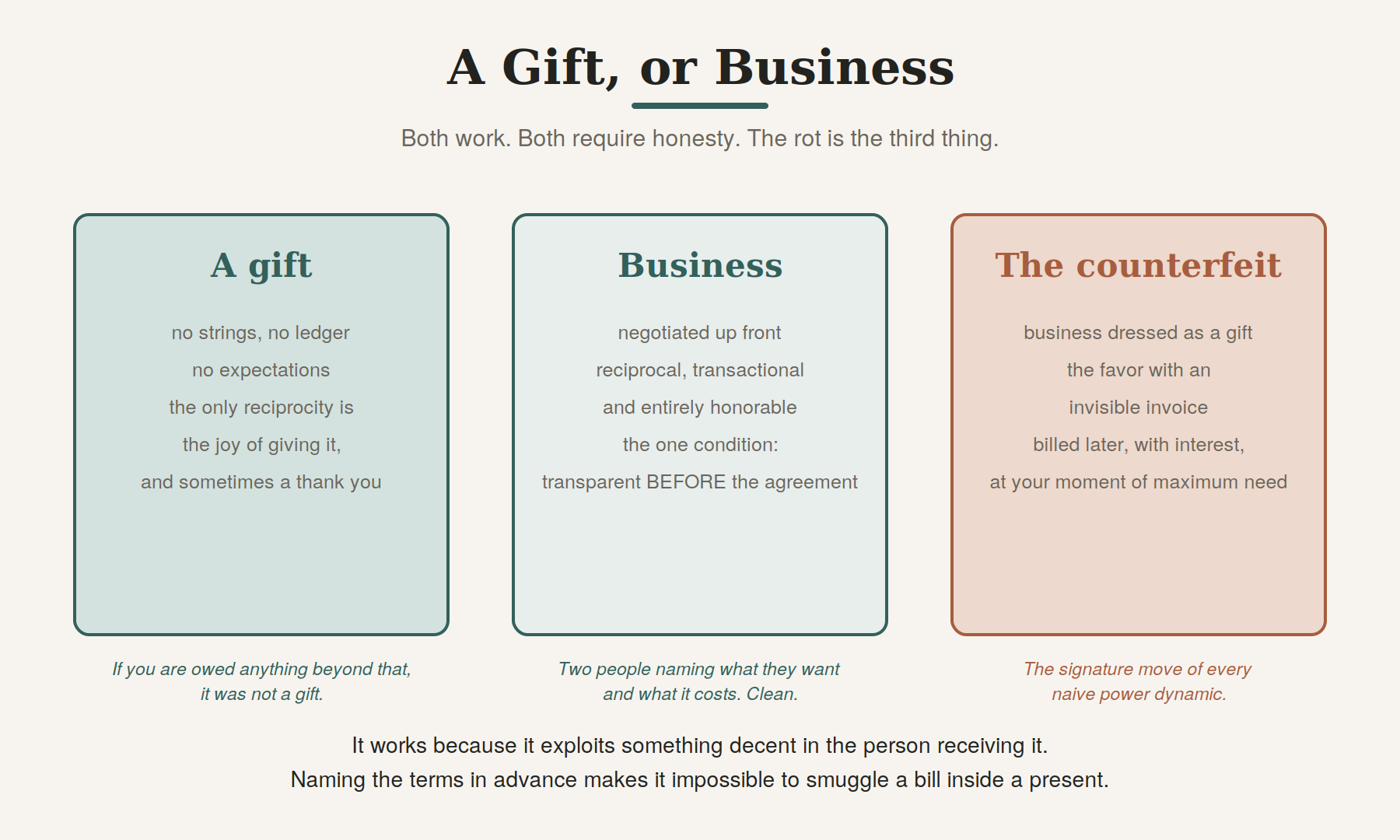
Both of these work. Both require honesty to work at all.
The rot is in the third thing, which is business dishonestly dressed as a gift. The favor with an invisible invoice, the generosity that turns out to have been an opening position, the love that arrives free and is billed later with interest at a moment of your maximum need. This is the signature move of every naive power dynamic I have watched, and it works because it exploits something decent in the person receiving it: they accepted a gift in good faith, and now they are in a debt they never agreed to and cannot dispute, because disputing it means admitting the gift was never a gift, which the giver will deny with wounded eyes.
Explicit negotiation kills this on contact. Not because business is nobler than giving, but because naming the terms in advance makes it impossible to smuggle a bill inside a present.
Limits, hard and soft. Boundaries named in advance and sorted by kind. Hard limits are absolute and not up for discussion. Soft limits are genuine boundaries that might move, with care, by agreement. The mere existence of that vocabulary is remarkable. Most people go their whole lives without ever once telling another person, in plain language and before the fact, where the walls are.
The safeword. This one I find genuinely underrated, and I do not think its significance is widely appreciated outside the context. A safeword is revocability engineered directly into a power arrangement. It is a single word that instantly and completely returns all power to the person who lent it, no justification required, no debate, no cost. Think about what that is: Part One argued that loyalty's defining feature is that it is conferred continuously and can be withdrawn at any moment, and that the revocability is precisely what forces the accountability. The safeword is that principle built into a technology; it is the withdrawal of consent, made instant, made explicit, and agreed to in advance by the very person it disempowers.
Aftercare. When it is over, the person who held the power is responsible for the wellbeing of the person who gave it. The obligation runs upward, from the powerful to the one who lent them the power, and it is treated as no less important than the thing itself. Every one of the six doors in Part One asks nothing of the person holding them, whereas this arrangement asks something afterward, by default, as a condition of doing it at all.
Put the pieces together and what you have is not an exotic curiosity; it is the seventh door, built in a workshop. Power that is explicitly conferred rather than assumed. Consent that is informed, ongoing, and revocable at a word. Accountability that sits heaviest on the one holding the power. Honesty as a structural requirement rather than a virtue. Communication so explicit it would embarrass most married couples.
And now hold it against coercive control from a few pages ago, because the two are superficially identical and structurally opposite. Both involve one person having power over another, and that is the entire resemblance.
One negotiates the power in advance; the other installs it while you are not looking. One names limits and honors them; the other treats your limits as the map of where to push. One hands you a word that ends everything instantly; the other has spent years ensuring there is no word, no exit, no door that does not run through them. One says responsibility does not transfer; the other transfers all responsibility to you, which is why you are the one apologizing. One ends in care; the other ends in you explaining to yourself why it was fine. One is power lent, with a receipt. The other is power taken, and the receipt is the thing they burned.
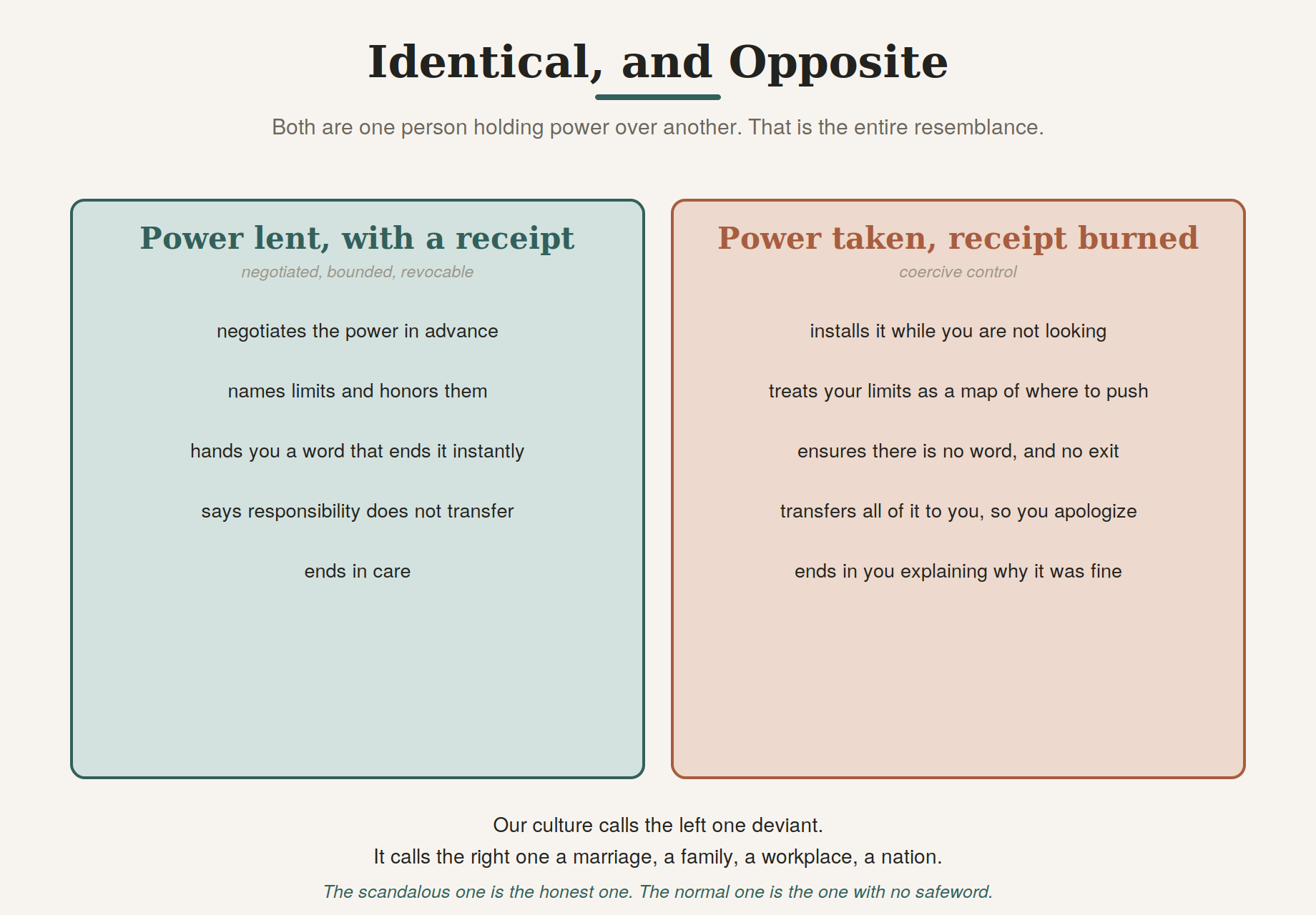
So the inversion I want to name is this: Our culture looks at an arrangement where power is negotiated, bounded, consented to, revocable at a syllable, and answerable afterward, and calls it deviant. Then it looks at an arrangement where power was never discussed, never agreed to, cannot be withdrawn, and answers to nobody... and calls it a marriage, a family, a workplace, a nation. The scandalous one is the honest one. The normal one is the one with no safeword.
Wolves wear whatever the culture is wearing
Now the part I owe you, because I have been describing an ideal, and ideals are not a census.
Everything above is what it looks like when it is done right, but as we know, it is not always done right. Misuse of power in that subculture is real, just like any other subculture, and misunderstanding is rampant. And while the knowledgeable are often good at rooting it out, no space is ever fully clean of it. That is not a special indictment. It is a general law, and it is worth stating as one.
A manipulative person will wear whatever costume gets them power. They do not have a native habitat. They go wherever authority is handed out and trust is expected, which means they turn up in churches, in charities, in therapy rooms, in activism, in medicine, in families, in any structure that distributes power and asks people to lower their guard. They arrive fluent in the local dialect, wearing the local clothes, saying the words correctly, because concealment is the whole method. Part One said this in another form: every one of the ordinary doors requires secrecy to maintain. A person seeking power to fill something hollow will always be a wolf in sheep's clothing, because they need you not to see them until it is too late to leave. Hide long enough, and the prey is already cornered.
But here is the thing worth noticing, and it is the reason I put this section where I did rather than leaving it out:
That subculture is one of the few places I know of where the local rules are specifically designed to catch exactly this. The framework is the detector. Someone who resents negotiation, who treats a stated limit as a challenge rather than a wall, who gets vague when asked what a word means, who is irritated by the existence of a safeword, who cannot be bothered with aftercare, who insists responsibility transfers upward to them in every respect except when something goes wrong, who wants to isolate you from everyone else who knows the norms: that person is not violating an etiquette, instead, they are failing, one by one, every single test the framework exists to administer. The ideal does not merely describe good practice, it is a screening instrument, and it works precisely to the extent that people actually apply it.
Which is more than most of the rest of the world can say.
The wolves are everywhere. What is rare is not their absence, what is rare is a culture that built a checklist for finding them, and then argued about it in public for forty years.
Niceness is not kindness
Everything in this essay can be found inside a single ordinary interaction, and the easiest place to see it is the difference between two words we treat as synonyms.
Niceness is compliance that reads as warmth, but its actual aim is the absence of friction. It agrees, it accommodates, it smooths, it says the pleasant thing, and its underlying question is will this go badly for me. It is frequently a reflex rather than a decision, and very often it is shaped by fear: of conflict, of disapproval, of being found difficult.
Kindness is costly care aimed at your good. It will hand you the thing you did not want to hear, because your good and your comfort are not the same thing and kindness can tell them apart. It is a choice, it has a spine, and it is perfectly capable of being unpleasant in the moment.
From the outside, on a good day, these are indistinguishable. Both produce warmth, generosity, accommodation, help. The difference only surfaces under pressure, and then it is total: niceness folds, kindness holds.
The research says this more precisely than I can. Adam Grant spent years studying reciprocity styles and found that people tend toward giving, taking, or matching, and that givers occupy both the very bottom of the success ladder and, surprisingly, the very top. But the finding that matters here is a different one: being agreeable or disagreeable turns out to be entirely separate from being a giver or a taker. We stereotype the agreeable as generous and the disagreeable as selfish, and we are simply wrong. The categories cross. There are disagreeable givers, gruff and blunt and inconvenient, who will genuinely put themselves out for you. And there are agreeable takers: warm, charming, delightful, and extracting the whole time.
That is niceness and kindness with a control group. The pleasant surface and the actual substance are independent variables, and most of us have been reading one and assuming the other our entire lives.
Which is exactly why the distinction is so easy to weaponize, and why manipulators are drawn to both, though for different reasons.
The nice are wanted because they are cheap. They supply agreement without being asked, they do not push back, they will absorb an unreasonable thing rather than make a scene, and they can be relied on to smooth over the very moment when someone should have been challenged. That is the flattery machine of Part Two, running at household scale, staffed by volunteers who think they are being polite.
The kind are wanted for something better, and this is the darker half. Kindness supplies genuine care, real resources, sustained benefit of the doubt, and, most valuable of all, the willingness to ask is it me. In The Honest Mirror I argued that the traits that get targeted are openness, accountability, and the reflex toward self-examination, and that being targeted for those is not evidence of a defect but evidence of virtue being harvested. Here is the mechanism stated in the language of power: a person who will look inward when accused is a person who can be steered. You do not need coercion. You just need to keep making accusations, and their conscience will do the rest of the work for you, for free, for years.
And then there is the trophy, which is the part people do not say out loud.
Conquering someone merely nice is easy and yields almost nothing. They were always going to fold; there is no achievement in it, and some part of the conqueror knows it. Eventually when another opportunity comes along, and applies and pressure, they will fold then too. Conquering someone genuinely kind is the prize. Kindness has a spine and usually has clear sight, so bringing it down proves something the conqueror urgently needs proved: that the good are not really good, that the spine was fake, that nobody is above them after all. It is ego regulation by proof of superiority over the genuinely decent. Which loops directly back into shame, the mechanism I described in The Honest Mirror. The one who cannot bear their own reflection destroys the mirror, and the truer the mirror, the more the destruction feels like a verdict rather than a tantrum.
The cruelty of it is that it stays invisible until it is finished, because the approach never looks like conquest.
- It looks like need.
- It looks like admiration.
- It looks like being finally, properly seen.
It looks precisely like the thing a kind person is built to answer, which is exactly the point: the bait is the target's own virtue. By the time the shape of it is visible, the trap has already closed, and the kind person is standing in the wreckage asking what is wrong with them, which was always the intended terminus.
So here is the whole essay in one interaction, and then in three.
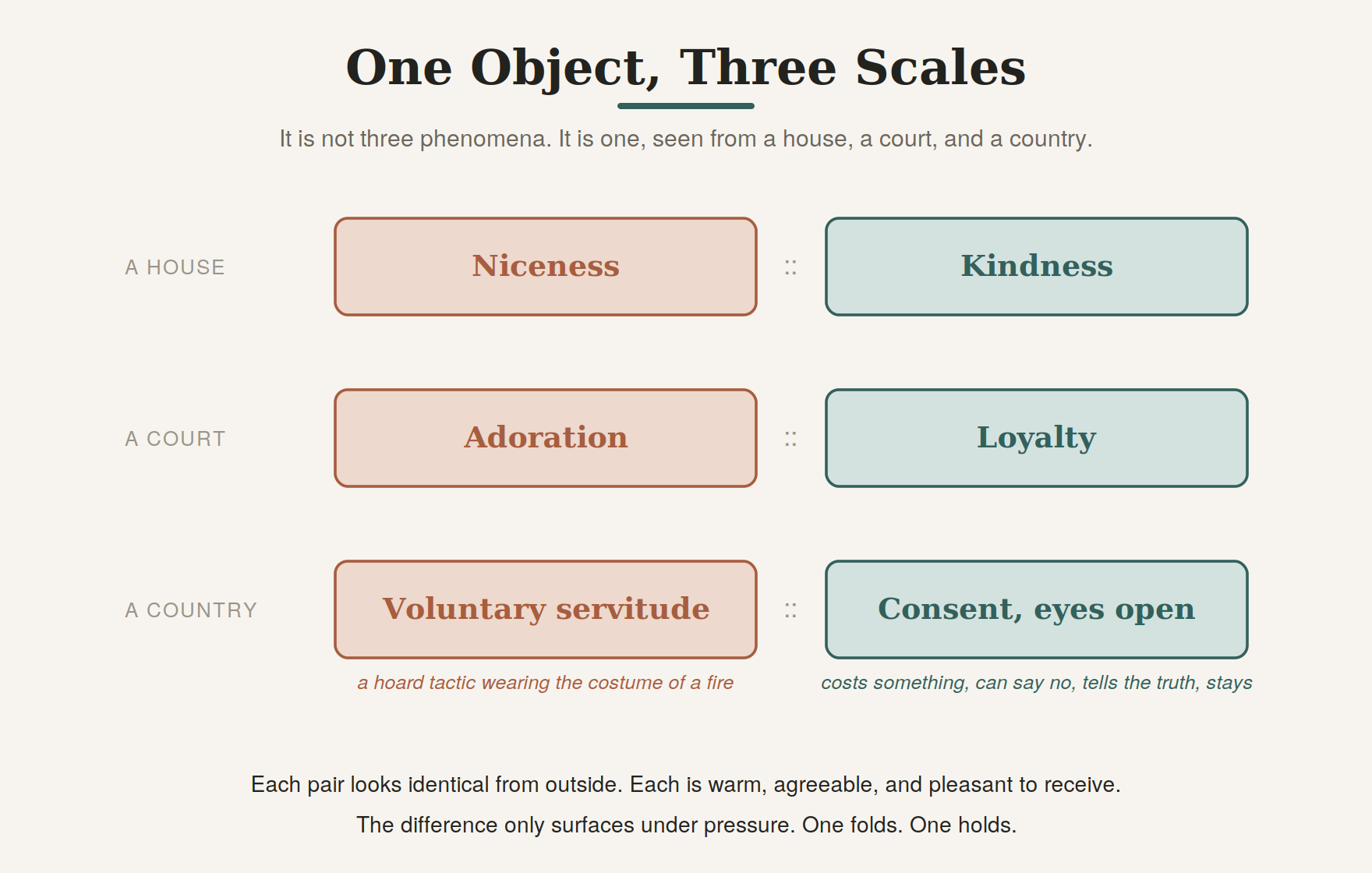
Niceness is to kindness what adoration is to loyalty, and what voluntary servitude is to freely given consent. Each pair looks identical from outside. Each pair is warm, agreeable, and pleasant to receive. And within each pair, one is a hoard tactic wearing the costume of a fire: compliance without honesty, agreement without accountability, devotion that will not survive contact with a hard truth or a bad day. The other one costs something, can say no, tells you the truth, and stays.
Scale it up and it is the same object at every size. A nice friend and a kind friend. A flattering courtier and a loyal one. A population trained in adoration and a population that consents with its eyes open. It is not three phenomena, but rather it is one, viewed from a house, a court, and a country.
Holding it well
So what does it look like to hold power and not be ruined by it?
Keltner, having spent a career documenting how reliably power corrodes people, does not leave it there, and his answer deserves to be taken seriously rather than skimmed. He offers five practices, and I want to give them their due before I complicate them, because they are genuinely good and they are the closest thing to a working antidote that the research has produced.
Practice humility. To influence others at all is a privilege, and having power should be humbling rather than inflating. Stay critical of your own work; do not be impressed by it.
Invite the pushback. Accept and actively encourage the skepticism of others, with an open mind. Not tolerate it, but encourage it.
Remember who enabled you. The power was conferred. Other people made it possible for you to make any difference at all, and forgetting that is the first step of the whole disease.
Stay focused on others, and give. The more you empower the people around you, the more the common good is served, and the common good was the reason the power was granted in the first place.
Practice respect. Ask questions. Listen with intent. Be curious about people. Acknowledge them. Praise generously. Express gratitude.
Look at what that list actually is. Every item on it is a direct countermeasure to a specific documented effect of power. Humility answers the narratives of exceptionalism. Inviting pushback answers the flattery machine. Remembering who enabled you answers the drift from conferred to deserved. Giving answers the self-gratifying impulsivity. Curiosity and respect answer the empathy deficit and the perspective that stops being taken. It is not a feel-good list, it is a repair manual, written by someone who knows exactly which parts fail.
And underneath all five sits one idea, which is the same idea as the other essay: you cannot hold power honestly without a working mirror, and the mirror is made of other people, and it only stays up if you keep asking them to hold it. Keltner's five are, essentially, instructions for keeping honest people in the room and actually listening to them.
They are right. They are also, and this is what I want to spend the rest of this on, dangerously incomplete.
The five are also the attack surface
Here is the problem. Every one of those practices assumes good faith in the room.
Read the list again, but this time read it as a predator would.
Practice humility, stay critical of your own work. Excellent. Then they will supply the criticism. A person committed to distrusting their own judgment has outsourced the calibration of their self-worth, and a manipulator will happily accept the contract.
Encourage skepticism and pushback with an open mind. Wonderful. You have now publicly pre-committed to taking bad-faith criticism as seriously as good-faith criticism, and to treating your own defensiveness as the suspect party in every disagreement.
Remember that others enabled you. Perfect. Now watch how many people arrive claiming to have been the ones who enabled you, and how gratitude, which was supposed to be a virtue, converts into a debt you did not incur and cannot audit.
Stay focused on others and give. Best of all. Givers can be farmed.
Practice respect, curiosity, praise, gratitude. This is precisely the surface a manipulator will mirror back at you, because it costs them nothing to perform and it is the exact behavior you have told the world you value.
The five virtues that keep power honest are, in a room with a wolf, an unlocked door with the hinges oiled.
And this is not cynicism, it is the factual finding. Adam Grant's research put numbers on it. Givers cluster at both the very bottom of the success ladder and the very top, and the variable that decides which end you land at is not how much you give, it is whether you protect yourself while doing it. Selfless givers, high in concern for others and low in concern for themselves, burn out and get exploited. Otherish givers, high in concern for others and high in concern for themselves, thrive. Grant's point is that self-interest and other-interest are not a seesaw, they are independent parts of the same engine, and you can run both.
Then comes the finding that ends the argument: The most selfless people give less. Not less than they intended, however; less in absolute terms, measured in money, time, skills, and connections, because they run out. Sacrifice yourself far enough and you have nothing left to give anyone, which means the person who guarded nothing ultimately contributed less than the person who guarded something. Grant reaches for the oxygen mask on the airplane, and it is the right image. The instruction is not selfishness, it is arithmetic.
A cautionary note, calling back to a previous point, however: do not confuse this guarding, meant to be care for the self, with withholding. The difference here is clear: maintenance of self is required, hoarding of abundance is not.
So this is not a footnote to Keltner's studies, t is the missing half of him. His five keep power from corrupting you, but they do nothing whatsoever to keep power, and the goodness that earned it, from being harvested out of you by someone who studied the same list you did.
What follows is my attempt at the other half.
Shelter the Fire
Before the how, the why.
We have all watched this happen, and most of us have watched it more than once. Someone kind. Genuinely kind, not merely nice, heart in exactly the right place, giving because giving is simply who they are. And then, over a stretch of years, run dry. Not by one catastrophe, however but by a thousand small withdrawals from an account that nobody was depositing into, made by people who each told themselves their own withdrawal was small.
Some of us have watched that from the outside. Some of us have been the account.
And here is the part that should frighten you, because it is worse than the exhaustion, and it is the reason this section exists at all. Watch what happens next.
The drained do not usually stay soft, in contrast, they go bitter. The kindness curdles into something watchful and withholding, and the person who once gave without counting starts keeping a ledger, starts assuming the worst, starts treating every request as an angle, because for years every request was an angle and they have the scar tissue to prove it. They have learned, from direct and repeated evidence, that giving gets you emptied.
So they stop.
And a person who has concluded that generosity is a mug's game has just arrived at the folk theory of Part One. Not as a book they read, but unfortunately as a lesson the world beat into them. They will live by it now, and they will be very sure of it, and they will probably pass it on to someone younger who trusts them, continuing a cycle.
That is the real cost, and it is not the one people count. The tragedy is not that a good person got tired, it is that the world converted a giver into a taker, and did it using the giver's own goodness as the mechanism. Every embittered person you have ever met was, at some point, softer than this. Something taught them, and frequently the thing that taught them was another person's hoard.
Consider, in that light, who wrote the folk theory in the first place. A civil servant who spent his life in the service of a republic, who lost it all when the regime turned, who was arrested and tortured and thrown out into the countryside with nothing. And who then sat down and wrote the manual for the thing that had destroyed him, addressed to the very people who destroyed him: The Prince is not the serene wisdom of a powerful man, it is what happens when idealism is run dry and goes bitter, written down. It is the result, the culmination, of everything we have evaluated written above. For five hundred years, a slew of readers have mistaken a scar for a strategy.
So: everyone wants kindness. Everyone says so, and they mean it, it is human to want so. Almost nobody asks the obvious follow-up question, which is: who protects it? Kindness is not self-sustaining, it does not regenerate out of nothing simply because it is good, and virtue does not come with a shield attached just because it deserves one.
It is, first and foremost, a decision one makes daily, in choosing to be kind.
This decision is then followed by the decisions of those in proximity, to how they respond to it: with grace and thanks, or in contrast with darker and more malevolent intentions.
Who protects it, then?
You do. And the people whose loyalty you have actually earned.
If they know how.
That last condition is the reason for everything that follows.
Part One argued that loyalty is a fire rather than a hoard: made by giving, grown by spending, impossible to steal. Loyalty is, at its core, true power.
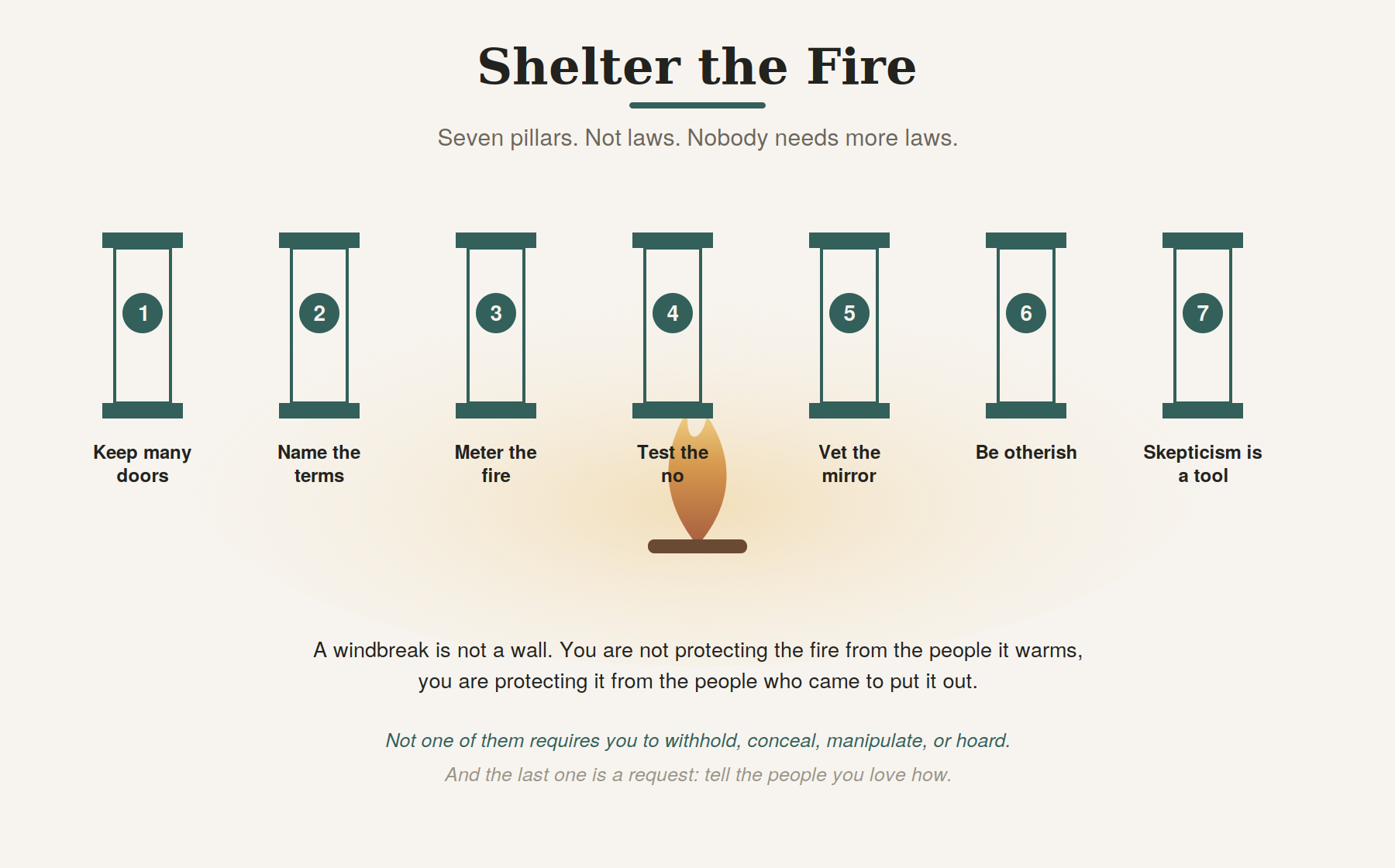
But a fire is not invulnerable, and I want to be careful not to oversell the metaphor. A fire needs fuel, and it needs air, and it needs shelter, because wind puts it out. Tending a fire is not the same as hoarding it. Building a windbreak is not the same as building a wall. You are not protecting the fire from the people it warms, you are protecting it from being extinguished by the people who came to put it out; and there is a difference, and the difference is the whole ethics of this section.
Let me draw the line hard, because it matters. Greene's laws teach you to build a hoard: conceal, withhold, keep people dependent, manufacture scarcity, treat everyone as a mark. What follows is the opposite project: It does not ask you to withhold anything. It does not ask you to manipulate anyone. It asks only that you see clearly and keep your exits, so that you can go on giving for fifty years instead of being emptied in five. Greene protects your leverage, this protects your capacity to be good to people, which is the thing actually worth defending. Without it, loyalty will never be in reach.
Seven pillars, then. Not laws. Nobody needs more laws.
One. Keep many doors. This is the first because it defeats the entire mechanism. Every form of manufactured power in this essay depends on becoming the sole supplier of something you need, so the counter is structural rather than psychological: never let any one person be the only route to any need you have. Not your only friendship. Not your only income. Not your only transport, or housing, or sense of who you are.
Plurality is immunity. It is not distrust of the person; you can love them entirely and still keep your own bank account, and if that sentence bothers someone, you have learned something important about them for free. Isolation is the master attack, so connection is the master armor, and the friendships you maintain outside a relationship are not disloyalty to it, instead they are the reason it stays honest.
Two. Name the terms. A gift or business, and say which. Give gifts freely and expect nothing, and when you want something in return, negotiate it out loud like an adult, which is honorable. But never accept a gift that arrives with an invisible invoice, and the moment a past kindness gets cited as a debt in an argument, understand exactly what you are looking at: it was never a gift, it was an investment, and you are now being asked to service it. You are allowed to say that out loud, being as the whole trick depends on your politeness.
Three. Meter the fire. Vulnerability is spent in increments, not emptied at once. Offer something true and small and then watch what is done with it, because what they do with the small thing tells you precisely what would have happened to the large one. This is not coldness, rather it is the same principle as negotiation: you are gathering information before you commit, which is what every sane person does before anything else in life that matters. Intensity that demands total access immediately is not intimacy, it is a scarcity of time being manufactured, so that you decide before you can check.
Four. Test the no. A person who cannot hear no cannot be trusted with yes. This is the safeword principle applied to ordinary life, and it is the single most efficient diagnostic I know. Say no to something small and watch the cost. Not the words, the cost. Is it received, or is it charged for, in mood, in withdrawal, in a lecture, in a sulk that you will be paying off for three days? Revocability is the entire engine of honest power, and someone who reacts to your boundary as an injury is telling you, plainly, that they never intended the arrangement to be revocable.
And then turn the instrument around, because this is the one pillar that indicts you, and it should.
Are you safe to say no to?
Not do you believe you are. Everybody believes they are; that belief is worth nothing and it is the first thing to distrust if not tested. Ask instead what a no actually costs the people around you. When someone declines you, does it simply land, or do they quietly pay for it afterward in a currency you would never admit to charging: a coolness, a shortness, a conversation that goes flat, a favor returned slower next time, a warmth withdrawn just far enough to be deniable? Notice the urge to punish, because it will be there. Its presence is not evidence that you are a bad person, only that you are a person. What matters is entirely whether you act on it.
Reciprocity is not a nicety here, it is the whole structure. A person who demands revocability and does not offer it has not sheltered anything; they have built a hoard with better manners. And the people whose loyalty is actually worth having will only stay honest with you for as long as honesty remains survivable. You are the one who decides that. You decide it every single time somebody tells you no.
Five. Vet the mirror. Keltner says invite the criticism. He is right, and it is insufficient, because not all criticism is honest and some of it is a weapon in the shape of a favor. So the pillar is: take feedback seriously, and take the feedbacker seriously too. Ask what the criticism wants. A loving critic wants you better; a wolf wants you smaller, and the two use similar words to opposite ends. Watch the shape. Does this person criticize you privately and defend you publicly, or the reverse? Can they receive correction themselves, or does it only run one way? Do they ever tell you when you got it right, or is the ledger permanently in deficit? A mirror that only ever shows you failure is not a mirror, but often a projection, or it is a portrait someone is painting, and Part Two is about what happens to people who cannot tell the difference.
Six. Be otherish, not selfless. Grant's word, and his data. Guard your own interests without apology, not despite being a giver but in order to remain one. Set boundaries. Ask for help. Refuse to confuse generosity with unlimited availability. Keep the support network you would need if it all went wrong. This is the pillar that people with any conscience find hardest, because it feels like a betrayal of the thing they value most about themselves, and it is precisely the opposite. The selfless give less. If you burn yourself out at thirty-five, everyone who needed you at forty gets nothing, and their loss is not repaid by your purity.
Seven. Skepticism is a tool, not a home. And here is the guard on all six above, because without it this becomes the very thing Part One warned about. Suspicion is a lamp you switch on when something does not add up, and switch off again. It is not a room to live in, if you choose to live inside it, you become the reader of the 48 Laws, alone and paranoid, and you will have defended your fire by extinguishing it yourself, which is a victory nobody wanted. The point of all seven is not to trust less, it is to trust accurately, so that the trust you do extend is real and can survive being spent. Discernment exists to make generosity possible, not to replace it. Always remember: words can lie, actions in singularity may deceive, but patterns define character.
That is the theory. It is not a defense against being hurt, because there is no such thing and anyone selling one is themselves running a play. It is a defense against being emptied, which is the specific thing that happens to good people who never learned that their virtue was also their attack surface, their fire and also their target.
One last thing, though, because a list of seven pillars can obscure it by being a list. This is not a solitary discipline, and read as a checklist for one person it starts to look like armor, and armor is a lonely object.
Go back to the question. Who protects kindness? You do, and so do the people whose loyalty you have earned. Which means every one of these pillars is also something you do for someone else. You are the one who spots the gift with the invoice stapled inside it, on a friend's behalf, because they are standing too close to read it. You are one of their many doors, and your existence is part of why nobody can become their only one. You are the honest mirror who says: that criticism you have been swallowing for a year did not come from someone who wants you better. Watch the cost when they say no. Notice who adjusts. Speak up when things don't add up. Be consistent, and consistently present, regardless of the weather.
A fire is easier to shelter with more hands around it. That is the entire reason to write any of this down, and it is why the last pillar is not a pillar at all but a request: tell the people you love how. Kindness cannot protect itself, and it should not have to. Teach them by example, and tend to their fire the same as you'd expect for your.
And notice, finally, what all seven have in common: Not one of them requires you to withhold, conceal, manipulate, or hoard. Every single one is an act of seeing clearly, which is why this essay ends where the other one begins.
What is still standing in the morning
We began with a folk theory: that power is force, that it is seized and defended, that it belongs to the ruthless, and that having it means other people do what you say, essentially.
Almost every piece of that turned out to be describing the weakest, selfish, and most brittle thing in the room.
Power is conferred. It always was. The tyrant borrows his soldiers' arms, the executive borrows his board's confidence, the person at the head of a table borrows the attention of everyone who chose to sit down. It runs on other people's continued participation, which means it is not a possession but a loan, and loans get called in. And nearly every form of it we chase is a hoard: a scarcity somebody manufactured, defended by secrecy, dependent on dishonesty, and dying the instant the thing withheld is freely given. Those forms work, and they are real. They are also the reason the person holding them can never quite relax, and never quite know why.
There is exactly one form that runs the other way, and it is made by giving rather than by withholding. It grows when it is spent. It cannot be stolen, only earned, and only kept by being worth keeping. It obligates the person who holds it, continuously, which is why so few people want it once they understand the terms. It has to be re-consented to, forever, by people who could walk away at any moment and stay only because they still choose to. It requires accountability and honesty, rather than secrecy and scarcity. And it is the only one still standing on the day everything else is gone.
Which gives you the test, and it is a test nobody can take in advance. On the way up, adoration and loyalty are indistinguishable. Both are warm, both are pleasant, both tell you that you are exactly what you hoped you were. You will only find out which one you built at the precise moment you can no longer do anything about it: when the position stops paying, when the story turns, when the pedestal shifts. The courtiers will be gone before the dust settles, and whoever is still there was never a courtier at all; the were loyal.
So the only sane strategy, in argument, is to build the honest kind long before you need it, which means, unavoidably, letting people tell you the truth while things are still going well. Nothing in that is complicated, but all of it is difficult.
And it is not a question for kings, that is the thing I most want to leave you with. You are not going to run a country, but you are likely going to have a conversation this week in which someone adjusts around you, and you will not notice, because the person with the power almost never does. There is a hierarchy in your kitchen. There is a hierarchy in your group chat. Somebody in your life is doing the emotional arithmetic of your moods before they open their mouth, and if you cannot immediately name who that is, it is worth sitting with the possibility that the answer is a person who could name it instantly.
Ask the question. Not am I powerful, because you will get the wrong answer, the way we always do about ourselves. Ask who adjusts. Whose plans bend? Whose account of last Tuesday became the official record? Who apologizes to end things regardless of who was wrong? That is where your power actually is, and it is doing something today whether or not you look at it.
And then, having found it: hold it as a loan. Give more of it away than feels comfortable. Keep somebody near you who will tell you no and not be punished for it, and notice how strong the urge is to punish them anyway. Shelter your own fire, because the world contains people who came specifically to put it out, and being consumed by one of them is not nobility, you are not a martyr, it is just a fire going out early. Say what is a gift and what is business. Watch what people do with your no.
None of that is possible without seeing yourself clearly, which is the argument of The Honest Mirror and the reason these two pieces are really one. You cannot be consistent in virtues you cannot see, you cannot notice a drift you have no instrument for. Power dulls the very mirror you would need to hold it well, which means clear sight is not a private spiritual hobby, rather it is the maintenance requirement on the only kind of power worth having.
And notice, at the very end, what the hoard and the fire have in common.
The colossus stands on a pedestal made of people; the fire is tended by people. Neither one works alone, or for a moment. Every form of power in this essay, the ugliest and the truest alike, runs entirely on other human beings and stops the instant they walk away. We are not self-sufficient in this and never have been, it is not our nature as people or as a species. The whole subject was community, from the first page to this one.
Which is why the lesson cannot simply be to surround yourself with people. The courtiers were people. The flattery machine is a room absolutely full of them, warm and attentive and delighted to see you, and it is the most dangerous place in this essay. A community is not automatically a good thing to have; if you remember, the tyrant had one. It adored him, and it hollowed him out, and then it stepped aside and watched him fall.
So it is the quality. Only ever the quality. The difference between a pedestal and a hearth is not how many hands are on it, it is whether those hands are permitted to tell you the truth, and whether they are free to let go. Honesty, Accountability, Consent, Humility, and Loyalty all walk hand-in-hand in this matter.
That is a hard thing to find, and I am not going to pretend otherwise, because both of these essays keep arriving at the same difficulty from opposite directions: People who will meet you honestly are rare. The search is long, most of what comes back is not it, and there is a real loneliness in the looking. But this is not a preference we are discussing, it is a need; we want this the way a body wants something, not the way a person prefers something, and the wanting does not go away because the finding is hard.
And the arithmetic still favors it, because it does not take many. It never took many. It takes a few who will say no to you, and stay. A few who can reflect the qualities discussed in this examination, and hold you to them too. An Honest Mirror.
The hoard is heavy, and it is finite, and it is held up entirely by people who are quietly deciding, every day, whether to keep holding it.
The fire is lighter than that, and you can hand it to someone without having any less. You can light a hundred from it and it does not diminish. It asks for tending, and honesty, and it will go out if you neglect it or if you let the wrong people close enough to smother it.
But it is warm. And on the night everything else gets taken, it is the only thing that was ever actually yours.
Not because you took it, since it was the only thing you never took from anybody. And not because you held it, since it was never a thing that could be held. It is yours because you created it, and attended it. Because a fire is not an object at all, it is an activity, and it exists only for as long as somebody keeps doing it. The tending was the fire. The tending was yours, every unglamorous day of it, when nobody was watching and it would have been easier to let it go out.
That is the whole difference, and it is the most important thing I have to say about power. A hoard is yours for exactly as long as you can defend it from other people.
A fire is yours for exactly as long as you keep it.