
The Flinch, the Vow, and the Mask
On kindness, and the four things that wear its face
by Darkageon Youngblood
In brief
Kindness is care that has been acted on, at some cost, and aimed at another person's actual good.
Almost nothing else in this essay is that. Four other things wear its face, and from the outside, on an ordinary day, all five are indistinguishable. That is not an accident of language. It is the entire problem, because the counterfeits are what most of us are actually running most of the time, and one of them is not a counterfeit at all but its exact opposite, deliberately dressed to pass.
What follows is an argument in four moves. First, that kindness is a specific and unsentimental thing with hard edges, and that the sentence no strings is not the same sentence as no limits, because a kindness that cannot be withdrawn was never chosen and a thing never chosen is not a virtue at all. Second, that trauma reliably produces two very different creatures, a flinch and a vow, which look alike and are opposites, and that a great deal of what the world praises as gentleness is a nervous system still running for its life. Third, that kind seeming people raise unkind children with terrible regularity, and that the reason is not what anyone expects. Fourth, that none of this holds still, that kindness is not a thing you are but a thing you do, today, again, and that it goes out the moment you decide you have it.
This is the third of three. The Honest Mirror was about seeing yourself clearly. The Hoard and the Fire was about power, and how it moves between people. This one is about what you actually do, and what it costs, and how to tell the real thing from the four impostors, including when the impostor is you. Some of it comes from research, and a good deal of it is mine, worked out the slow way, and where I am extending past the evidence I will say so.
Part One: The Thing Itself
On what kindness is, what it is not, and why the difference only shows under pressure.
Sees, moves, pays
Start with a distinction we routinely collapse, because collapsing it is how the counterfeits get in.
Empathy is perception. It is the capacity to register accurately what is happening inside another person, and it is a skill rather than a virtue. This is worth saying plainly, because we have made a moral trophy out of a technical ability. Empathy is not good or bad, it is useful, and it is useful to anyone, for anything. The most efficient predators in this essay have excellent empathy, utilized as a skill; that is precisely how they find the soft ground. A person can read you flawlessly and choose to use every bit of it against you. Perception is neutral.
Compassion is the feeling that can follow the perception. You see the state, and something in you moves toward it, and you want it to stop or you want them well. This is warmer, and closer to a virtue, and it is still not one, because feeling is free. Compassion costs nothing and does nothing. You can feel it in a chair, at a distance, forever, and never once inconvenience yourself, and many people do exactly that and consider themselves good.
Kindness is what happens when the feeling gets acted on and the act costs something.
That is the whole architecture.
- Empathy sees.
- Compassion moves.
- Kindness pays.
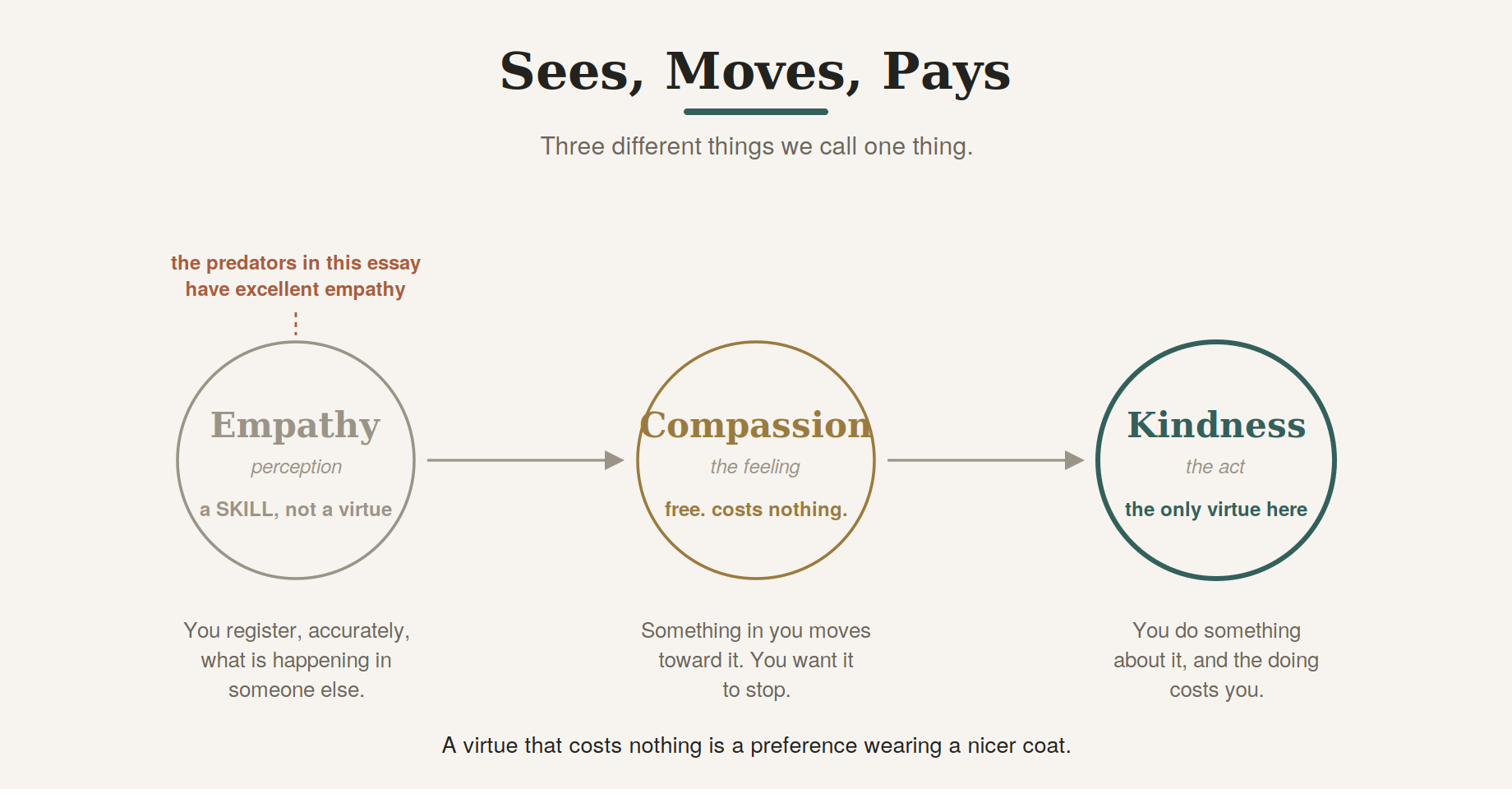
Only the last one is a virtue, because only the last one has a price, and a virtue that costs nothing is a preference wearing a nicer coat.
So kindness is not a temperament; it is not warmth, or softness, or being easy to be around. Those are surfaces, and this whole essay is about how many different things can produce that same surface. Kindness is a specific act with four requirements, and if any of them is missing you are looking at one of the impostors.
It requires perception. You have to actually see the person, not your idea of them. In The Honest Mirror I described the effigy, the small moldable version of someone that people relate to instead of the real thing. You cannot be kind to an effigy; you can only be kind to whoever is actually standing there, which means kindness inherits every difficulty of seeing clearly, and inherits it before it starts.
It requires judgment. This is the requirement that gets skipped, and skipping it is how kindness turns into damage. Kindness aims at a person's good, and their good is not always their comfort, and it is frequently not what they are asking you for. Give a drowning man what he wants and he will pull you under with him. Give a child everything they ask for and you will hand them a life of not being able to tolerate a closed door. Aiming at the good requires knowing the difference between what helps and what soothes, and that requires thinking, and thinking is harder than agreeing.
It requires a willingness to pay. Not always much. Kindness is sometimes costly rather than always, and most of it is small. Sometimes all you pay is time, other times all you pay is discomfort, the ordinary discomfort of saying the true thing in a room that would have preferred the pleasant one. Neither of those is dramatic and both are real, and it costs all the same. The price does not have to be large; it has to be actual, and it has to be yours. If a thing costs you nothing at all, it may still be pleasant, and it is not yet kindness.
And it requires limits. This is the one nobody says out loud, so the rest of this section is about it.
No strings is not no limits
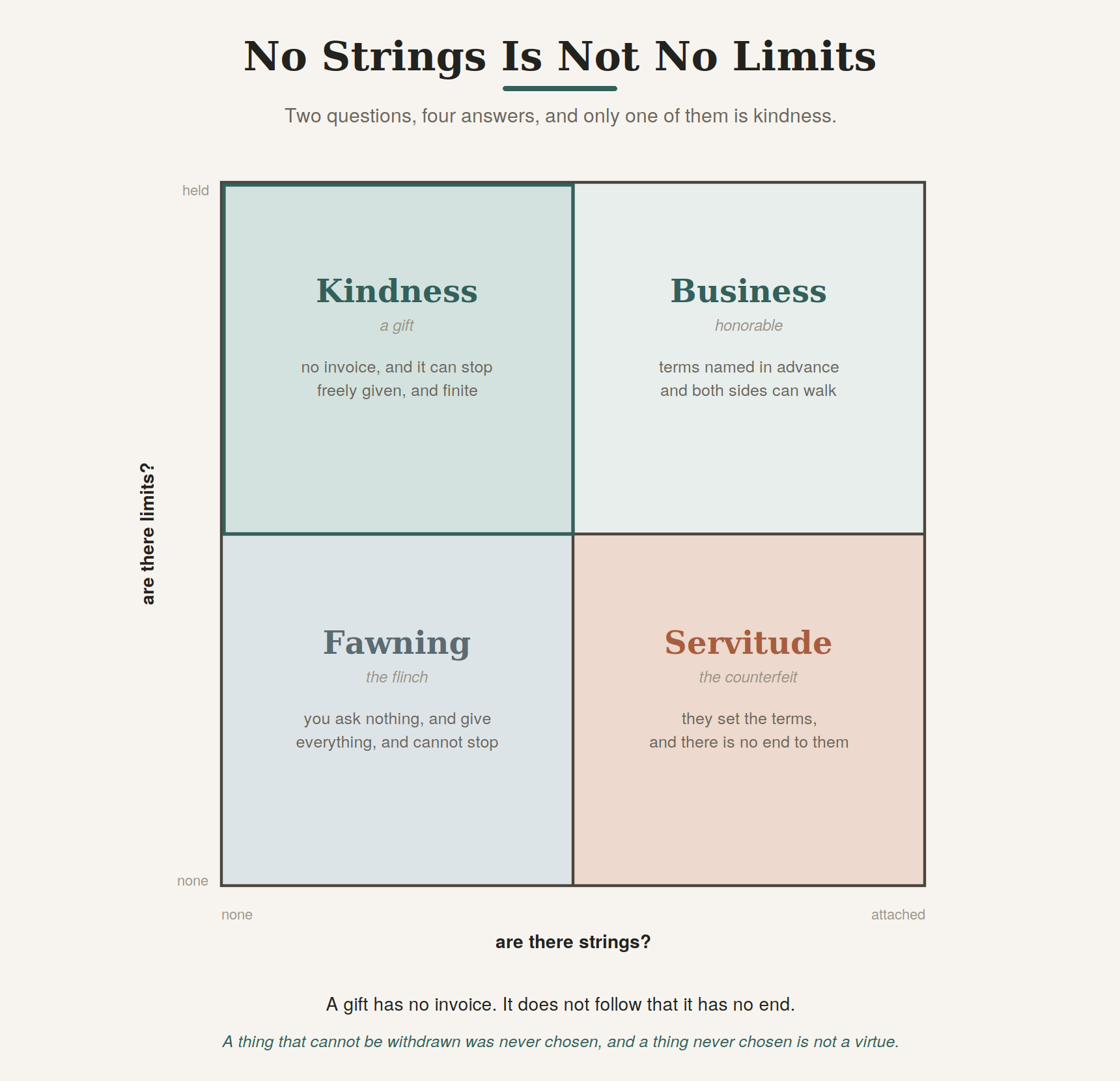
In The Hoard and the Fire I drew a line I still believe in. A gift is a gift: no strings, no ledger, no expectations, and the only reciprocity in it is the joy of giving and maybe a thank you. Everything else is business, which is honorable, provided the terms are named in advance. The rot is the third thing, business dishonestly dressed as a gift, the favor with the invisible invoice.
Kindness is a gift in exactly that sense, in that it is unconditional in the transactional sense. Nothing is owed. There is no debt, no scoreboard, and if you are keeping one then what you handed over was never a gift and you should stop calling it that.
But here is where the earlier essay was incomplete, and the correction matters more than the original claim.
Unconditional in the transactional sense is not the same as unconditional in every sense. No strings does not mean no limits. A gift has no invoice attached, but it does not follow that there is an infinite supply of them, that they arrive on demand, or that you have surrendered the right to stop.
And a kindness with no limit at all, that cannot be refused, cannot be paused, and cannot be withdrawn, is not the highest form of the thing; it is not kindness at all, it is the flinch, and we will get to it in Part Two.
The reason is simple and it runs through all three of these essays. A thing that cannot be withdrawn was never chosen, and a thing that was never chosen is not a virtue, it is a compulsion. Kindness you are unable to stop is not evidence of enormous goodness, it is evidence that nobody is driving.
That is the trilogy closing its own circuit. Loyalty must be revocable or it is adoration. Kindness must be revocable or it is fawning. Anything unconditional and unwithdrawable is servitude, whatever warm name we give it, and servitude is precisely what most people are fooled into thinking power is.
The gift is co-authored
There is a second correction owed, and this one is bigger.
What I wrote there defined the intentions behind a gift and behind business. That was the whole frame: what do you mean by this, are you honest about what you mean, did you name the terms before rather than after? All of it stands, and all of it is about the giver.
But an intention does not survive contact with another human being unaltered, because the meaning of the act is co-authored, and the receiver holds half the pen. Your intention decides what you are doing, but it does not decide what the thing becomes.
You can give a thing freely, with a clean heart and no invoice anywhere on your person, and watch it become something else entirely in the hands of the person receiving it.
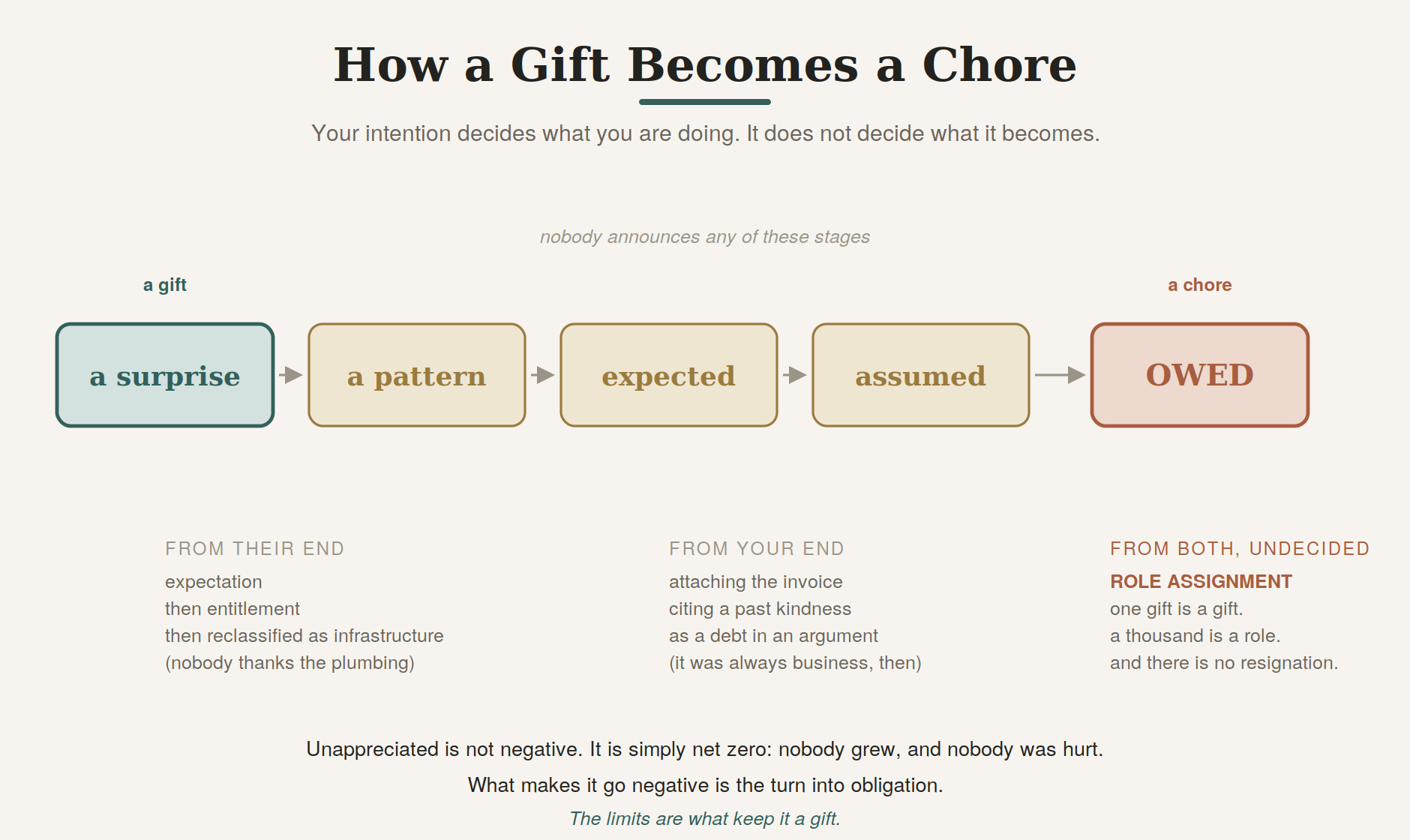
Consider the arithmetic: A gift that lands and is not appreciated does not go negative, it is simply net zero. It did not compound, nobody grew, and that is a small sadness rather than an injury. You gave, they did not notice, the world is unchanged. Fine.
What makes it go negative is the turn into obligation.
Watch the sequence, because it is slow and nobody announces any stage of it. First the gift is a surprise, then it is a pattern, then it is expected, then it is assumed. And then, one ordinary Tuesday, it is owed, and you find yourself in the strange position of being resented for the thing you volunteered. At that point it has stopped being a gift in any meaningful sense, instead it has become a chore, and you are the only person in the arrangement who remembers it was ever optional.
Several things perform that turn, and it is worth naming them, because some are the receiver's doing and some are yours.
From their end: expectation, then entitlement, and then the quiet reclassification of your gift into infrastructure, which is the state in which a thing is only ever noticed when it stops. Nobody thanks the plumbing.
From your end: attaching the invoice, which is the old sin from the last essay. Cite a past kindness as a debt in an argument and you have retroactively converted it into business, and you have told the truth about what it always was.
And from both ends at once, without anyone deciding: role assignment. Repetition does it. One gift is a gift, but a thousand is a role. Somewhere in that run of a thousand you stopped being a person who was generous and became the generous one, which is a job description, and nobody ever asked whether you wanted the post, and there is no resignation procedure. This is how givers get quietly promoted into service, or more accurately, servitude.
Which is why the limits are not a failure of kindness. The limits are what keep it a gift. The moment your giving becomes something the other person can count on receiving whether or not you have it to give, you are not being kind to them anymore. You are being used by them, possibly without either of you noticing, and the fact that you handed them the tool does not make it less of a tool.
The four that wear its face
Now the difficult part, which is that everything described above produces a surface that four other things produce just as well.
Warmth. Accommodation. Generosity. Help arriving when you needed it. On a good day, in ordinary weather, all five of these look exactly alike from the outside, and several of them look alike from the inside too, which is the part that should worry you. Most people cannot tell which one they are running. I could not, for years.
Niceness is compliance that reads as warmth. Its actual aim is the absence of friction. It agrees, it accommodates, it smooths, it says the pleasant thing, and the question underneath it is never what is good for you, it is will this go badly for me. That is the tell, and it is a complete tell: niceness is aimed at the comfort of the person being nice. It is frequently a reflex rather than a decision and it is often shaped by mild fear, of conflict, of disapproval, of being thought difficult. It costs almost nothing in the moment, which is the appeal, and it is paid for later in resentment, which the nice person will experience as unfair.
The research separates this from kindness more cleanly than our vocabulary does: Adam Grant found that being agreeable or disagreeable is entirely independent of being a giver or a taker. The categories cross. There are disagreeable givers, blunt and inconvenient and genuinely willing to put themselves out for you, and there are agreeable takers, warm and charming and extracting the whole time. Pleasantness and substance are separate variables, and most of us have spent our lives reading the first and assuming the second.
The flinch is what Part Two is for, so I will only mark the door here. There is a version of gentleness that is not a choice at all, it is a nervous system that learned, early, that appeasement was the only survivable move, and it is still running that program decades after the danger left the building. It looks like kindness, it is regularly praised as kindness, but it is not kindness, and calling it that does real harm to the person doing it.
Carelessness is the strangest of the four, because it is the only one aimed at nothing whatsoever.
The word is exact. Kindness is costly care, so this is its absence, care-less, the blank where the thing should be. This is not cruelty; there is no design in it. The harm it does is a byproduct, produced by someone who simply was not looking, and that is precisely what makes it so hard to address: there is no intent to confront. You cannot hold someone to an aim they never had. They are not against you, simply they have not considered you at all.
In The Honest Mirror I called this position the Seeker: low on seeing yourself, low on seeing how you land, filling the void with anything rather than turning to look, and most people arrive there through no fault of their own. Sheltered, badly taught, never handed the instrument, never shown that the interior room has a light switch. That is not a moral failing: nobody picks their childhood.
But here is where I have had to learn something the hard way, and I want to put it as plainly as I know how.
That essay divided the causes of clear sight into three layers. The Given, what you were born with. The Grown, what your early world built into you before you could consent to any of it. And the Chosen, the only layer still in your hands as an adult. You are not to blame for the first two, nobody is. You did not select your temperament and you did not author your upbringing, and anyone who sneers at a person for either is telling you about themselves.
Carelessness is the refusal of the Chosen.
And that refusal is exactly where the excuse runs out. You can understand precisely how a person came to be the way they are, you can feel real compassion for the child they were, and in return you can hand them every tool, name the pattern kindly, light the whole path, and stand there holding the lamp. And most of the time, they will look at the work required and choose what is easier, which is to stay exactly as they are, because blindness is cheap and seeing costs; and that choice is theirs. It is made daily, in full possession of the alternative, and the harm that follows from it lands on real people who did not consent to be the cost of someone else's comfort.
Ignorance is not a sin. Ignorance defended is.
Having empathy for what made someone who they are does not excuse what they do with it. That was true in the first essay and it is true here: empathy explains, it does not absolve. The two are not in tension. You can hold the whole tragedy of how a person got here and still decline to be the place where they put it down.
And there is a harder thing under that, which is about you rather than them.
If someone has been shown the path and has decided not to walk it, then continuing to absorb the cost of their refusal is not kindness anymore, it is enabling. You have become the reason the lesson never arrives. Every time you quietly pay for their blindness, you remove the only signal that might have taught them anything, and you do it while feeling generous. Your warmth becomes the life support keeping their ignorance comfortable, and the fact that you meant well does not change what you are doing. This is the same mechanism that Part Three is about, running in adults instead of children. The friction you withhold is the friction that would have taught them, and withholding it is not mercy, it is the easier thing dressed as mercy, which is niceness by another route.
The other hard thing is about consequences rather than intentions.
Ignorance at its root is usually not intentional, and I want to grant that fully. But an unintended harm is still a harm, and past a certain point it stops mattering to the injured party which internal state produced it. Carelessness reliably produces outcomes indistinguishable from malice. The person who wrecked your week without ever noticing you were there has wrecked your week exactly as thoroughly as the one who aimed. And once the ignorance has been named, once the tools have been handed over and refused, the results that follow are no longer accidents. They were not intended, and they were chosen, and both of those things can be true at once. That is the strange country carelessness lives in: malice without a motive, arrived at by refusing to look, and no less expensive for the people standing downstream.
The mask is the last one, and it is not a counterfeit at all.
The other three are things kindness gets confused with. This one is its opposite, wearing its face on purpose. Cruelty rarely announces itself, because announcing itself does not work. It arrives instead often as concern: I just worry about you. I don't like how they talk to you. You don't need them, you've got me. Every syllable of that is warm. Every syllable of it is a bar in the cage, and by the time the cage is visible it is already built, out of materials the prisoner helped carry.
This is the isolation tactic from The Hoard and the Fire, and it is worth seeing it from this side. That essay argued abuse is manufactured scarcity: engineer a shortage of everything the person needs, then install yourself as the only supplier. What it did not say clearly enough is what the manufacturing feels like while it is happening. It does not feel like a shortage being engineered; it feels like being cared for, it feels like finally, someone noticed.
Which means the mask is that essay's third thing, arriving in this one with a face on: business dishonestly dressed as a gift. The favor with the invisible invoice. Except here the invoice is not money or a return favor: the invoice is you.
What tells them apart
Five things, one surface. So how does anyone see through it?
Not by the warmth, which they all have. Not by the generosity, which they all perform. You tell them apart by two questions, and only two.
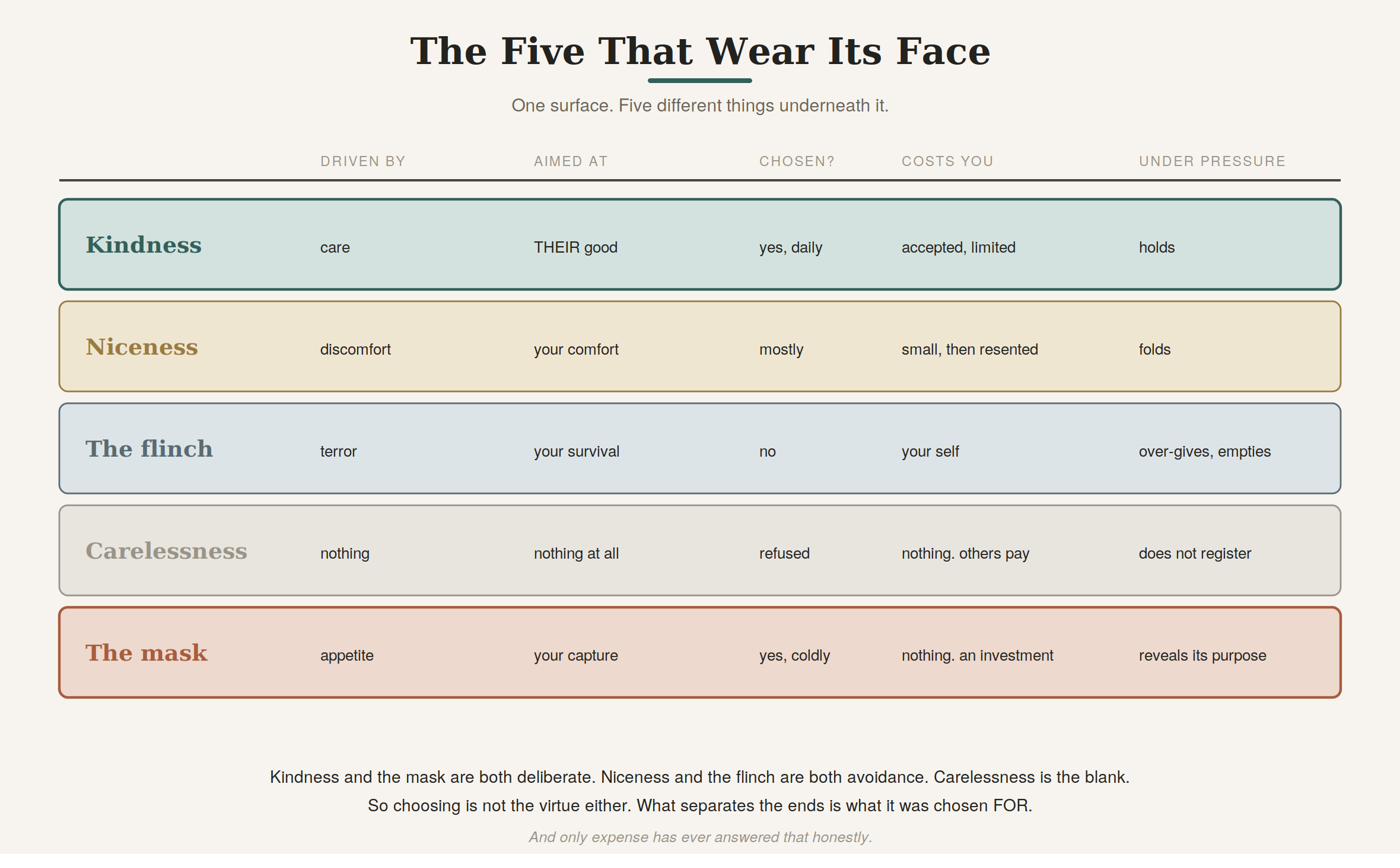
What is it aimed at? Kindness is aimed at the other person's good, which is why it will sometimes make them unhappy. Niceness is aimed at your own comfort, which is why it never will. The flinch is aimed at your survival, which is why it cannot stop. Carelessness is aimed at nothing at all, which is why it never notices what it broke. And the mask is aimed at capture, which is why it is so attentive, so generous, and so early.
And what does it do under pressure? Because on a calm day all five behave identically, and the calm day tells you nothing. Ask for something inconvenient. Say no to them. Bring a hard truth into the room. Then watch.
Kindness holds, and may hand you something you did not want to hear. Niceness folds, and resents you quietly for the next month. The flinch over-gives, apologizes for the request, and is depleted for days. Carelessness does not register that anything happened. The mask reveals what it was always for.
That is the whole diagnostic, and it is why nothing in this essay can be settled from a distance or in a good mood. The counterfeits are not exposed by scrutiny, they are exposed by weight, which is only ever applied by living, which is why so many people find out what they were running only after it has already cost them something.
I want to sit on that for a moment, because there is something uncomfortable in it. If cost is the only honest test, then I have just admitted that the truest thing about an act is its price, which sounds like precisely the transactional logic this trilogy keeps arguing against.
I think the discomfort is real and the conclusion is the opposite of what it looks like. The reason expense is the only honest signal is not that everything is a transaction, it is that we have built a world in which nearly everything is one, and so a thing that genuinely costs the giver and returns nothing has become the rarest object in it, and therefore the most diagnostic.
Which produces a cost of its own, and it is worth naming. In a fully transactional world, a real gift becomes almost illegible. People cannot read it. They look for the invoice, because in their experience there has always been an invoice, so the sincerest thing you can do is frequently met with what do you want from me, and the suspicion is not paranoia, it is a reasonable prior, formed by evidence.
And it goes deeper than suspicion, because the ledger gets installed, and this is the part that is genuinely sad. Not everyone who bills you meant to write an invoice, some of them were simply raised in a world that priced everything, and they learned, without ever choosing to, that giving creates debt. So they feel owed without having decided to feel owed, and then they behave as creditors, and are baffled by the resentment coming back at them. The invoice was inherited rather than authored.
Which means the gift and business distinction from the last essay has a third tier I hadn't yet covered. The named invoice is business, and honorable. The hidden invoice is the mask, and predatory. And the inherited invoice is neither: it is carelessness in the gift's own vocabulary, a debt nobody consciously created, running quietly in a person who would be horrified to hear themselves described as billing you. Intention and result come apart here exactly as they did a moment ago. The unbilled bill still arrives. The person receiving it still pays.
And notice, before we go on, what the table underneath all this actually says. Kindness and the mask are both entirely deliberate. Niceness and the flinch are both avoidance, one of discomfort and one of annihilation. Carelessness is the blank. Which means deliberateness is not the virtue either, and choosing is not enough, as the predator chooses, carefully, every time. What separates the two ends is not whether the act was chosen but what it was chosen for, and the only thing that has ever answered that question honestly is what happens when the answer becomes expensive.
Part Two: One Wound, Two Roads
On what trauma makes of a person, and why two opposite things come out of the same door.
The fork
Here is something that ought to be strange and somehow never gets remarked on.
Take two people who were hurt young, in similar ways, by similar people. Follow them thirty years. One of them is a taker, hard and closed and entirely willing to pass it on, and if you asked them they would tell you the world is like that, everyone is like that, and they learned it the hard way. The other one is among the gentlest people you have ever met, and gave more than they could afford, and would step in front of a thing to keep it from reaching you.
Same wound. Opposite creature.
I wrote about this fork in The Honest Mirror and only had room to name it. Long-term harm tends to push a person toward one of two conclusions, and the two are separated by a single word. I went through this, so why should anyone else be spared; Or: I went through this, and I do not want another person to. The first is a hardening. The second is a vow.
But there is a third thing that comes out of that same door, and it is the one nobody counts, because it does not look like damage. It looks like virtue. It gets praised at funerals.
The flinch
Most people know the first three. Fight, flight, freeze. There is a fourth, and it was not named until 2013, when the psychotherapist Pete Walker added it to the list: fawn.
Walker defines it as responding to a threat by becoming more appealing to the threat. Merging with what the other person wants, mirroring their expectations, dissolving into whatever shape defuses the danger. His description of the type is the one I cannot shake: fawn types behave as though the price of admission to any relationship is the forfeiture of every need, right, preference, and boundary they have.
It develops where the other three do not work. A child cannot fight an adult and cannot leave the house, and freezing does not help when the threat is a person who will still be there tomorrow, at breakfast, needing something. So the nervous system finds the only remaining door: become useful, become agreeable, become unthreatening enough that the danger recedes. And it works. That is the part that matters and the part that gets skipped: The flinch is not a defect, it is an achievement. It kept a child alive in a house where nothing else could have, and it deserves to be spoken of with the respect owed to any tool that did its job under impossible conditions.
The problem is that it does not know the war is over.
Decades later, in a room containing no danger at all, the yes still arrives before the question has finished. Faster than thought, faster than preference, faster than any check on whether you actually want to or can afford to. And because the output looks like generosity, the world rewards it. You get called dependable. Easy to work with. So kind. Which reinforces it, and the reinforcement is delivered by people who mean it warmly and have no idea what they are watching.
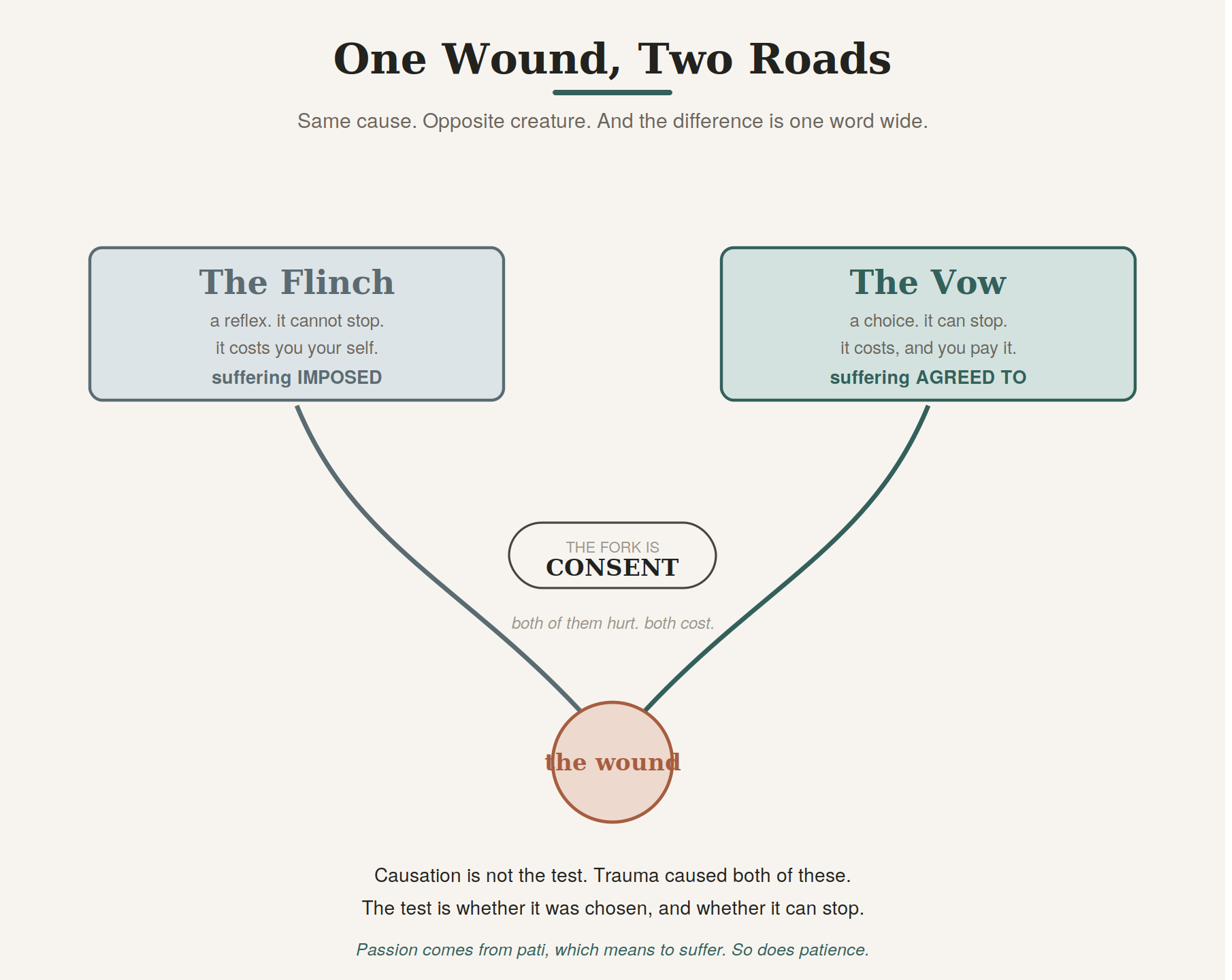
This is why it is worth being precise about the distinction the last section drew. Fawning is not niceness. They look identical and they are different in kind. Niceness is a strategy, mostly chosen, aimed at avoiding friction, and it can be dropped the moment it becomes inconvenient. Fawning is a reflex, aimed at survival, and it cannot be dropped at all usually, because the thing it is avoiding is not awkwardness, it is annihilation. Niceness costs you an evening. The flinch costs you your self.
And the clinical literature is blunt about the confusion in a way I find almost vindicating. Kindness, in the clinicians' framing, comes from a settled nervous system and feels chosen and expansive. Fawning comes from terror and feels compulsive, urgent, and like the only option available. The behaviors are indistinguishable from outside, but the interiors are not remotely the same room.
Which gives us the cleanest test in this essay, and it is one you can run tonight, on yourself:
After you helped, did you feel fulfilled, or depleted and resentful?
Kindness costs and does not deplete. It spends something and something comes back, not from them necessarily, but from the act itself. The flinch drains, and the resentment that follows is not a character flaw and not ingratitude, it is a receipt; it is the part of you that never agreed to the transaction filing its objection late, because it was not consulted at the time, with delayed urgency.
Or, in the line I have not been able to improve on: kindness does not cost you your sense of self. Fawning does.
The flinch you can see
Everything above is the standard account, and it is missing something, and the thing it is missing is the version I know.
Walker's fawn is unconscious. The whole clinical picture is of a reflex that bypasses deliberation entirely, a person who says yes before they have consulted anything and only wonders about it later. And that is real, and it is common, and it is not what happens to someone who has already done the work.
Because here is something nobody tells you can happen after becoming self-aware: it does not save you from the flinch. It only makes it conscious.
I have not fawned unwittingly in recent memory. When I have done it, I have done it in desperation, with my eyes fully open, knowing precisely what it was while it was happening. It arrives after you realize you have been isolated, which is a realization that only ever comes late, because you do not see the trap until it has already triggered and closed. And then, from inside it, appeasement stops being a reflex and becomes a decision. Yes. Whatever you say is right. Shoving my own words down my own throat, knowing they were the true ones and that theirs were wrong in every way that could be counted, not to win anything, not even to end the disagreement, because it was not a disagreement: To end the attack. To get my own nervous system back down to a place where I could function, because often, not functioning is punished even worse.
It is fawning without the mercy; the unconscious flinch at least spares you the watching, and this one does not. You are present for all of it. You see the mechanism, you can name the tactic being used on you in real time, you know the shape of the thing you are doing and why it will not help, and you do it anyway, because the alternative is another six hours of it and you have work tomorrow and there is a limit to what a body will absorb.
And it comes with a particular flavor of shame that the unconscious version does not carry: the shame of having done all the work, learned the flags, read the material, written the essays, and still ended up standing in the same room saying the same yes. As though the knowledge should have been armor; but it is not armor. Knowledge is a lamp, not a shield. It shows you exactly what is happening to you, but it has never once stopped it.
I want to be careful here, because that sounds like despair and it is not. The awareness is not useless, it is the reason the flinch is now a tool I have reached for in extremity rather than a personality I live inside. It is the reason I know to leave afterward. But it is not a vaccine, and anyone selling clarity as a vaccine is selling something, and the person who slips back into the flinch after years of good work has not failed. They have simply discovered what the lamp is for.
What it takes with it
The deepest cost of the flinch is not the yes, it is what happens underneath the yes over time.
The literature describes something that unsettles more than any other detail: not the suppression of needs you are aware of, but a genuine inability to access what you want at all, independent of what the other person wants. Not I know what I want and I am not saying it. Something worse. Nothing is there when you look.
I know exactly how that gets built, because I watched it happen from the inside, more than once.
Under sustained abuse, my own wants did not get overruled, instead, they sank. And the weight that sank them was not the other person's desire, exactly, it was the threat of what would happen if I did not supply it. You learn, quickly, that a complaint left unaddressed does not expire, but it is filed. It gets returned to you later, weaponized, at the precise moment you ask for anything resembling humanity or empathy in return, and it is produced as evidence that you had it coming. So you address every complaint immediately, and you do it at speed, and after enough repetitions of that the arithmetic completes itself: your own wants become so low-priority that you stop considering them. Then you stop thinking of them. Then your needs go the same way, which is a quieter and more dangerous stage, because a want you have shelved is recoverable and a need you have stopped registering will simply take payment out of your body without asking.
I have built a thing that served the other person more than it ever served me. I was promised help. The help was withheld, and then the asking after it became the offense, and the offense became the excuse for everything that followed. I built it alone until my body failed.
That is the flinch's real bill. Not the individual capitulations, which are survivable and which anyone would make.
The erasure.
You do not notice it going, because the part of you that would have noticed is the part being removed.
The first consent
I want to say how it gets installed, because the standard account describes the finished product and not the manufacture, and the manufacture is where the argument is.
I did not start out folding in any personal scenario, in contrast, I started out defiant. Every time something was unfair I said so, loudly, from about as early as I can remember, and I have wondered since whether that was justice sensitivity riding in on the neurodivergence or simply the ordinary equipment every child arrives with before it gets trained out of them. Either way it was there first. The flinch came second, and it came in the only way it ever comes: by being taught.
Because standing up for myself made it worse, in all honesty. Reliably, measurably worse, every single time, and nobody was coming. That is the part I would put in front of anyone who has ever asked why a child did not simply tell someone. There was no one to tell, and the telling had a price, and the price was paid immediately and by me. So the arithmetic ran itself, the way it does in every child who ends up here: If resistance escalates it and no rescue is coming, the only route left to relief is to stop resisting. Fold. Accept it. Scream and cry and thrash through it if you have to, that part is not optional and never was, and then rest once it is over, and try to avoid the next one, and try to prevent the next one.
And then, young, I worked out the thing that closed the door: it could not be prevented. There was no version of me good enough, quiet enough, useful enough, correct enough. It was not a response to anything I was doing, because It was by design. The compliance was not buying safety, at best it was only buying the interval between.
There is a question underneath that which I am not going to open here, because it is too big and it belongs to a different document: what, exactly, does an adult gain by forcing power over a five-year-old that they did not already have in every conceivable respect? The answer is not obvious, and it is not nothing, and I intend to write it down elsewhere, as a separate topic at some point.
What matters for this essay is what came after. I got out at seventeen. Completely on my own, in a random state, with none of the tools I needed and no map of any kind, and I discovered something within about a year that has never left me.
Surviving the world was easier than surviving my childhood.
Not easier in the sense of comfortable, because it was frightening and I was underequipped and there were horrors of an entirely new species. But they were mine. I had walked toward them. Whatever came at me out there, however hard, I had some semblance of freedom in it, and more than that, I had agreed to it. I had consented, at least, to this, even with its horrors, and that was something.
I did not have the vocabulary for it then. I do now, and it is the hinge of everything in these three essays. The suffering was not what made my childhood unbearable; suffering is survivable, and I have proven that at length. What made it unbearable was that it was imposed, that no part of me had agreed to any of it, and that agreement was never going to be asked for. The Gilded Cage.
That distinction is the whole difference between a thing that destroys you and a thing that builds you, and it is the same distinction that runs through loyalty and adoration, gift and invoice, kindness and the flinch. Consent is not a nicety we drape over the top of hard things to make them palatable, more accurately it is the load-bearing wall. Take it out and the identical experience becomes a different object entirely.
Which is why escaping was not just an escape, it was essentially the first thing I ever chose, and choosing is what the next section is about.
The vow
So that is one road. Here is the other, and it is the reason this essay is not a tragedy.
There is a well-documented phenomenon called post-traumatic growth: people who struggle through severe adversity often develop beyond where they began. Not because of the suffering, which is worth repeating until it sticks, but because of the reckoning. The growth is manufactured by the work of making sense of it, and it shows up as a deeper knowledge of one's own strength, more honest relationships, and a rearranged sense of what actually matters, because this work requires introspection and personal honesty. Survivors describe it as a paradox: more vulnerable, and stronger.
The vow lives here. I went through this, and I do not want another person to.
And I want to defend it against a charge that gets made, sometimes by the person themselves at three in the morning: that kindness which came out of a wound is therefore not real kindness, that it is just damage in a nicer outfit, that it does not count because you did not arrive at it freely.
That is wrong, and the reason it is wrong is the whole architecture of Part One. The two paths, the choice.
The flinch and the vow are both trauma responses in the sense that both were caused by what happened, yes, but causation is not the test. The test is whether it is chosen, and whether it can stop. The flinch cannot stop; that is what makes it a flinch. The vow is a decision, made once and then remade constantly, by a person who has looked directly at what cruelty produces and declined to manufacture any more of it. That is not the absence of a choice, rather that is arguably the most consequential choice a person ever makes, and the fact that it was made in the worst possible conditions, by someone who had every reason and every excuse to go the other way, does not diminish it.
If anything it makes it remarkable. A person handed cruelty, who then goes to the trouble of manufacturing its opposite, at their own expense, for people who will mostly never know, is doing something that the person who was never hurt has often never once had to be brave enough to do.
And there is an older word for choosing to suffer on purpose, which we have almost entirely lost the meaning of:
Passion. We use it now to mean enthusiasm, a bright pleasant energy, the thing you are supposed to follow, sometimes even mistaken for obsession or used as synonyms. It comes from the Latin pati, and pati means to suffer. It shares that root with patience, which is the giveaway, because nobody has ever confused patience with euphoria. The original sense had nothing to do with feeling good and everything to do with endurance. The novel House of Leaves makes this argument at length and I have carried the summary of it around with me ever since, close enough to read, tattooed into my own palm. "Passion is Suffering," a bold reminder of this summary, the at least in part, the subject of this examination.
Which reframes the vow completely. If you are not willing, with full and informed consent, to suffer for a thing, then you are not passionate about it, you merely like it, or the image of it. There is nothing wrong with admitting it. Liking is free, and free things are not tested, and untested things tell you nothing about who you are.
So the vow is passion in the old and heavier sense: consented suffering, aimed at something, an eventual goal. Which is exactly what separates it from the flinch, and the separation is one word wide. Both of them hurt, both of them cost, but The flinch is suffering imposed, whereas the vow is suffering agreed to. And nothing else distinguishes them as clearly as consent, and nothing else needs to in my opinion.
The beacon is not the wound
There is a thing I believed until recently, and in part it turns out I was wrong, so let me correct it in public.
I assumed the flinch advertises. That a fawn response is legible across a room, that predators read appeasement instantly, and that the wound therefore recruits the next wound, in a loop so cruel it would explain a great deal. Why do victims of abuse, repeatedly end up in abusive relationships?
Half of that is true, and the evidence for the half is genuinely disturbing. Body language broadcasts vulnerability, and it broadcasts it to exactly the wrong audience. In one study, researchers showed forty-seven inmates in a maximum-security prison brief clips of people walking down a street and asked them to rate how easy each one would be to victimize. The inmates scoring highest on the interpersonal and affective facet of psychopathy were measurably more accurate, and were more likely to explain their judgment by pointing at the person's gait. Not their words. Not their history. Their walk, alone. The reading happens before you have opened your mouth, and the people best at it are precisely the ones you least want doing it.
But here is the objective correction, and it comes from bitter observation rather than a journal:
All three of them attract it. Niceness, the flinch, and kindness, in repeat, regardless of which one you are running.
Which means predators are not hunting the wound, it's more simple and broad than that: they are hunting the supply. What is being read is not your damage; it is what can be extracted, and niceness supplies it cheaply, the flinch supplies it under duress, and kindness supplies it best of all. Three different doors into the same warehouse. The thing they are scanning for is availability, and every form of giving is available by definition. The Supply for what?
The adoration machine.
I am aware of the popular version of this claim and I am deliberately not making it. There is an entire cottage industry insisting that empaths are magnets for narcissists, and most of it is built on clinical anecdote and statistics that appear to have been invented, and at least one serious voice in that field argues the opposite outright and warns that the magnet framing is corrosive, because it relocates the cause from the person doing the harm into the personality of the person receiving it. That warning is correct and this essay will not repeat the error. Your goodness is not a defect and it is not a lure, do not let someone convince you otherwise.
But the supply model survives the evidence, and it has an implication I would rather not deliver lightly.
Healing does not make you a smaller target. Put the flinch down, do every piece of the work, and the supply is still there, because the supply is the kindness, and you are not going to give that up and should not. What healing gives you is not immunity, it is instrumentation. You do not become harder to find, but you become harder to keep, harder to silently trap in a Gilded Cage.
Turning a reflex into a choice
Which leaves the only question worth asking: can the flinch be put down?
Yes. Not perfectly and not permanently sometimes, but yes, and I am reporting rather than theorizing from both study and experience.
The conversion does not have a trick in it, which is disappointing to write and truer than a trick would be. It loops back through everything the other two essays already said, and the fact that it loops is the reason I suggest at all to trust it:
- It is self-awareness, so you can catch the yes on its way out.
- It is self-care, so there is a self left to consult.
- It is consent, so you remember that yours was always required.
- It is boundaries, so there is somewhere to stand while you decline.
- It is accountability, running in both directions, so that the relationship can survive the friction.
- And it is communication, so that the no can be said out loud instead of merely felt and then abandoned.
None of that is fast, and none of it is a graduation. What it produces is not the disappearance of the flinch, but a reclassification. The flinch stops being who you are and becomes something you have, and can see, and can occasionally choose in extremity, the way you would choose any tool you hate, in a situation you should not have been in. A begrudging, "Break in an Emergency" button behind a glass wall of post-traumatic clarity.
And that is the honest ending of this part, because the exception is real and there is no use to pretend otherwise. I have put it down everywhere except the survival state, personally: Cornered, isolated, hours into an attack that will not end on any other terms, I have reached for it knowingly, with shame and silently raging clarity, as a tool.
Which does not mean the work failed, but it loops back to the earlier statement: it means the work is not armor. It is a lamp, and the lamp does exactly what a lamp does. It does not stop what is in the room with you.
It just means that this time, you saw it.
Part Three: What Gets Passed Down
On how a house builds a person, why kind people raise unkind children, and what the friction was actually for.
The first definition
Before any of the rest of this, there is a fact about human beings that we do not talk about often outside of very specific deep conversations, and everything in this part rests on it.
You learn what love looks like from how you are treated.
Not from what you are told, not from books or films or anything anyone explains to you later, not at first anyways. From the treatment itself, absorbed before language, before evaluation, before there is any apparatus in you capable of asking whether this is right. A child does not receive love and compare it against a definition, the child receives the definition. Whatever arrives from the people responsible for keeping them alive is filed, sometimes permanently, under the heading of what care is, and every relationship they will ever have gets measured against that file in most scenarios.
Which produces the single most misunderstood phenomenon in this entire subject:
You hit a child, and you tell them you do it because you love them. You do this for years. Then you are appalled, genuinely appalled, when they grow up and their partner hits them and they insist it is because they are loved.
Read that again, because the cognitive dissonance in it is not an individual failing, more accurately it is society-wide, and it is sitting in a hundred corners of ordinary life, uninspected. We install the definition, and then we are shocked when the definition holds. We call the adult's choice inexplicable, but it is not inexplicable. It is correct, by the only standard they were ever given, and we gave it to them. Ignorance, once again, unexamined and left in the dark by choice, is malicious. And regardless of maliciousness, more importantly, the result is the same.
So people who were abused are not drawn to harm, rather, they are recognizing love, as it was taught to them, by the people whose job it was to teach it. And that is why the pattern repeats, and why it is not stupidity, and why why did they stay has always been the wrong question asked by someone who has never had to check their own definitions, and their own privledge.
And notice, before we go further, that this single lesson has two possible outputs. The child taught that harm is love can grow up to accept harm as love. Or they can grow up to deliver harm as love, sincerely, in the full conviction that they are being loving. Same curriculum, two graduates. It is the fork from Part Two, arriving one level deeper down, at the level of the dictionary.
Two chairs
Now one specific machine, because the definition rarely gets installed the same way twice in one house.
I want to be careful about what I am claiming, as this dynamic is not a requirement for abuse. Plenty of harm happens with one child, or five, or none of this shape at all. But it correlates, and it correlates hard enough to be worth a section, because when it is running it does something the other configurations do not: it manufactures two opposite people out of the same materials, at the same time, in the same rooms, and sends them both out into the world convinced of contradictory things.
So, consider two children in one house, and this specific dynamic:
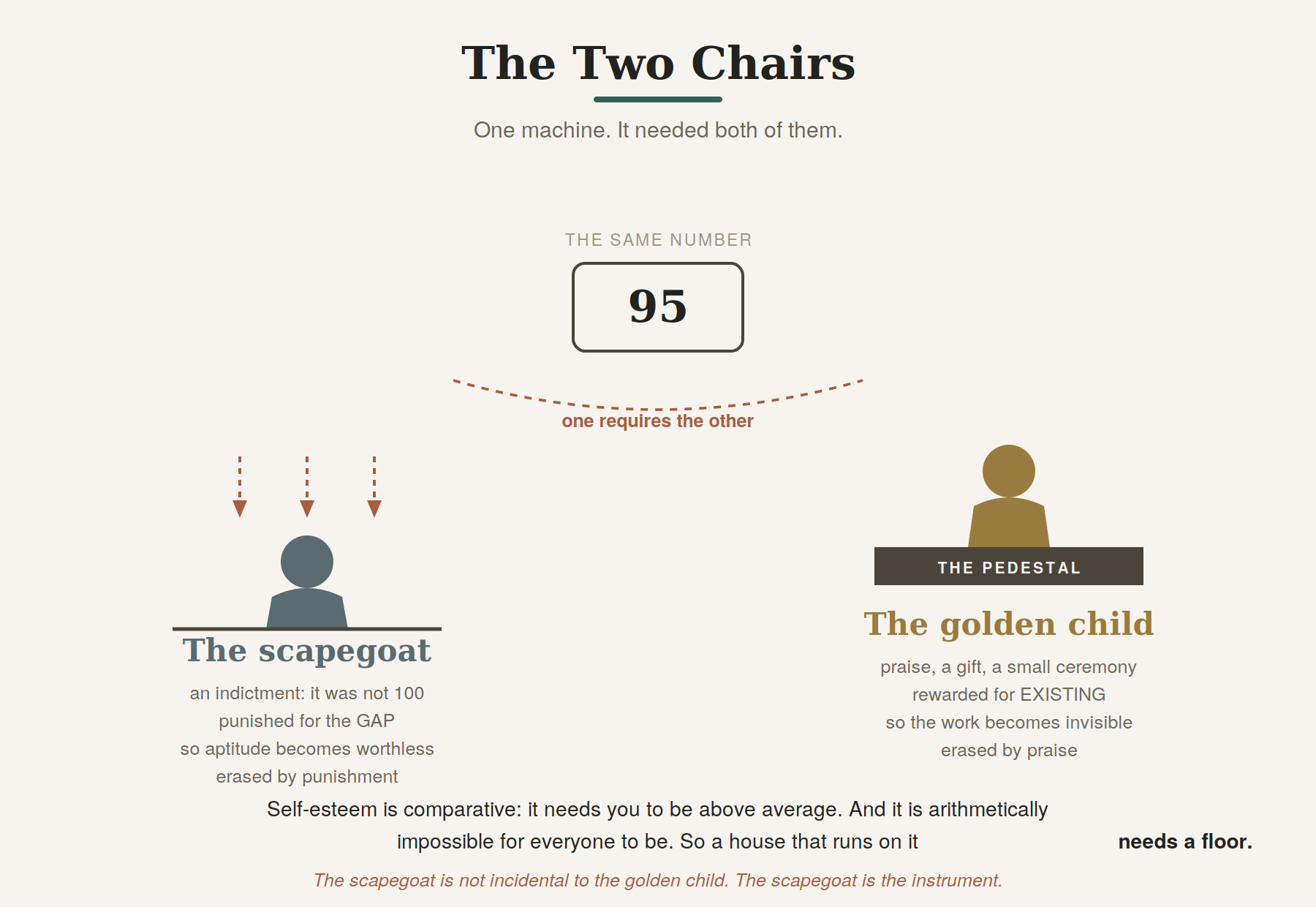
The Golden Child: One of them can do no wrong. Their mistakes are attributed elsewhere, sometimes to the other child, who is conveniently available. This is the golden child.
The Scapegoat: The other is the household's disposal unit, the place the adults put whatever they cannot bear to process in themselves, which turns out to be most things. This is the scapegoat.
The names are old and they are exact, and the arrangement is far more common than anyone raised inside it realizes, because from inside it just looks like a family. Unfortunately, as most of us know, families are very good at hiding these sorts of dynamics, and society is happy to turn a blind eye.
Watch the details, because the details are where it is actually built. Not the shouting, or the ordinary machinery: Who gets asked and who gets told. Whose version of an afternoon becomes the record. Report cards, and scores, and the hundred small verdicts a house issues before, during, and after dinner.
Take the report card, because it is legible. Both children bring home a ninety-five. For one of them it is an occasion: praise, a gift, a small ceremony of delight. For the other it is an indictment, because it was not a hundred, and the gap is treated as a defect of character rather than of arithmetic. Same number. Opposite verdict. And the verdict has nothing whatsoever to do with the number, which is the entire lesson, delivered to both of them at once, in a language neither can name yet.
The scapegoat learns that aptitude is worthless. And then they learn something harder, and it takes longer, and it is the thing that finally closes the door: there is no currency at all. Not that they have not yet found the right price, that the arrangement is not for sale, because the goal posts will always move back when in sight. No grade, no behavior, no version of themselves buys anything, because the role they are filling is load-bearing, and the enforcer requires it. It is holding up the whole house, and a house does not sell its own foundation: the emotional trash can of everybody's unexamined and unregulated emotions, trauma, and whatever else. So they stop hunting for the currency, and then they stop hunting for anything resembling a solution, and the only thing left to look for is the exit.
The golden child learns something that sounds better and is fundamentally worse. They are not being rewarded for the ninety-five grade, rather, they are being rewarded for existing, and the ninety-five is merely the occasion. Which quietly erases the work they actually did, and they did do work, simply because it is not acknowledged. Their effort becomes invisible, to everyone, including themselves. They are told the achievement was them, and after enough years of that there is no reason to build anything, because the building was never what counted. Over time the effort put into achievement dwindles with this response, then ceases all together, because they unconciously realize it was never a factor.
Two children. Both erased. One by punishment, one by praise, and only one of them will ever be told they were the lucky one.
Neither of them learned the truth
Here is the part that took me a long time to see, and it is the reason this section is in an essay about kindness rather than an essay about families, I'll save further semantics on that subject perhaps for a later examination.
Look at what each of them actually carried out of that house:
The golden child learned that love is free. It arrives regardless of what you do, it attaches to your existence, and it requires nothing from you. Born, and raised, on a pedestal.
The scapegoat learned that love cannot be bought at any price. There is no offering that works, the window is closed and it was never open. Alone, head bowed low, learning safety comes form invisibility at best.
Opposite lessons, and underneath both of them, identical, unexamined, load-bearing, sits the same false premise: that love is a market.
Neither child was ever taught the actual truth, which is that it was never a transaction at all. That it is not free and not for sale, because it is not being priced; likely the parents were never taught this either, it is simply another bus stop in the cycle of abuse through the ages. Love is meant to be a gift in the sense Part One meant: given without invoice, and held with limits, and revocable, and chosen daily by someone who could stop and does not.
Neither of them knows that. So they leave that house carrying a ledger, and they carry it into every room usually for the rest of their lives, and one of them expects credit for nothing and the other expects nothing for everything, and both of them are doing arithmetic in a place where no arithmetic applies. That is the servitude fallacy, at its origin, in a kitchen, before either of them could read, never named, treated as standard.
And it is where the previous essay's argument comes home. The Hoard and the Fire said the crude theory of power is that power means getting servitude out of other people. This is where that theory gets installed. Not in a boardroom, but much earlier usually, in a house, by two adults who never examined their own power or servitude, delivered to two children who had no capacity to refuse it.
What each of them becomes
Follow them out.
The scapegoat, if they are lucky, arrives at adulthood with no net and builds a life anyway, out of effort and resilience and learning what an opportunity looks like and moving on it, and out of a certain quantity of luck and the goodwill of people met along the way.
I want to be honest about that sentence, because it is doing an enormous amount of work with describing the arduous and painful work done invisibly by the individual, and it describes the best case rather than the common one. The worse outcomes are more frequent than this one, and they are not failures of character either; and even the best case is not a happy accident. It is paid for. Because you do not arrive at adulthood on the starting line with everyone else. You arrive several yards behind it, at best, having had to manufacture your own tools before you could begin using them, and then you have to run harder than everyone in front of you merely to draw level, and nobody watching will ever factor that in when they compare the finish times. Whereas, in contrast, the Golden Child starts just as far behind, and simply sits down and insists they have already won.
But there is a shape the scapegoat carries whether or not they build the good life, and Part Two already named it. They were taught that safety comes from appeasing, and that resistance escalates, and that no rescue is coming. That is the flinch, installed at the source. And a person carrying the flinch into adulthood is, in the market's terms, supply.
The golden child stalls the moment adulthood arrives, and the stall is total. And here is the part that should be impossible logistically: after a childhood everyone agreed was a launchpad, after the advantages and the paid-for credentials and the years of assurance that they were exceptional, they have achieved nothing of note. Nothing. Because a life is not built by being owed one, and entitlement does not open doors, instead it closes them, quietly, one at a time, after enough demands, and by the time the last one shuts there is nobody left to ask.
They keep ambitions that would take a decade of disciplined work, and they are certain those things will simply arrive, because things have always simply arrived, and in their account only time stands between them and it. They will never do the work, and not because they will not as a choice, but because the capacity was taken from them, so early and so gently that they have no memory of ever having had it, and they will defend the theft to the end of their life as proof that they were loved.
The illusion protects them from all of this too, which is the last cruelty, because illusion is the only thing they were ever given and by now it is most of what they are. They never got to decide who they were. Deciding requires effort, and effort requires a reason, and they were never once given a reason, because they were told at the beginning that they had already arrived.
And that is not the terminus. That is the middle.
Because the stall does not hold. Reality keeps declining to supply the adoration, and the gap between what they believe they are owed and what arrives keeps widening, and eventually someone hands them the truth: that they are not the victim of a series of unlucky rooms, they are the common thread. That there is no conspiracy of doors. That they are owed nothing without merit and the entitlement was always an illusion.
They do not reflect. They usually attack.
They have to. Reflecting would demolish the only structure standing between them and the sight of their own ineptitude, and that structure is all they have. So instead they go looking for someone who will supply what reality will not, sometime they become predatory, in exactly the way the last essay described: hunting for supply, filling a void that refills the moment it is filled, mistaking the hunt for a life. The Golden Child, in response to stark reality of their illusion, will typically rebuke attack and deny, and simply keeps seeking more adoration supply elsewhere, turns a blind eye, attempts to claim they are the victim of an injustice with no substance, or all of the above. Their launch pad was a pedestal, stamped with the word "Entitlement," and now the only hands holding it up are the hands of the shaky illusion they live in.
The adoration machine does not just produce a spoiled and entitled adult. It often produces a predator.
I called them wolves in the last essay, and I'd argue that is the wrong animal, and the error is worth correcting in public because the correction is more interesting than the mistake.
Wolves are loyal. They hunt cooperatively, they share food, they raise young collectively, they communicate constantly, and they mourn. A wolf pack is not a hoard, in relation to these subjects, it is closer to a fire: bound by something other than fear, capable of loyalty and community, and considerably stronger for it. We have spent centuries using the most communal predator in the northern hemisphere as our byword for treachery, and that says a great deal more about us than it does about wolves.
The animal I actually should state, more likely, is the shark.
Solitary. Ancient, and unchanged, because it never needed to evolve past consumption. Compelled to keep moving or die. No reflection, no reciprocity, no pack, nothing to return to. Only the hunger, and the next thing, and then the hunger again, which is the exact shape of the void described at the end of the last essay: it does fill, briefly, and then it is empty again, the way a body is empty again, forever. A cycle, a pattern, a pipeline, and a machine,
And here is the tell, sitting in plain sight in our own vocabulary: Shark is a compliment. In business we call a man a shark and we say it with admiration. We use the loyal animal as our insult and the mindless one as our praise, and nobody finds this strange? That is the servitude fallacy turning up in our vocabulary and our zoology, and once you see it there you will see it everywhere.
So: the adoration machine produces a shark. That is the pipeline's real end, and the golden child is not the cautionary tale, often they are the first act.
The matched pair
Which brings us to the thing that makes all of this scale, in a way.
That house did not produce one damaged person. In a way it produced both halves of the next generation's abusive relationship.
One supply and one demand. One trained to appease, one trained to expect. And they do not pair with each other, they go out into the world and find other houses' outputs, and the components fit, because they were machined to the same tolerances by the same process in a thousand different kitchens in a multitude of nuanced way. A scapegoat from one house locks into a golden child from another with a precision that feels, to both of them, exactly like destiny. They slap a "True Love" label on it, and lock in.
And it is precise. That is the horror of it. The one who was taught that love means being consumed meets the one who was taught that love means being served, and every part lines up, and neither of them experiences it as pathology, rather they experience it as recognition. As finally being understood. As home, which is exactly what it is, because home is where the definitions came from.
Go back to the house at thirty and you can watch it running. There is someone doing the waiting now, as the parents are gone and the pedestal is not, and a pedestal requires hands. So the servitude in that house is not incidental to the marriage: It is the supply. It is the last remaining source of the only validation that person was ever able to metabolize, if they managed to cage it, and it works precisely because it is consistent, and the consistency is the proof: why would somebody wait on you like that, every day, without fail, if you had not earned it?
And the one doing the waiting almost certainly came out of a house like the scapegoat's. That is not bad luck, often, that is the mechanism locating its match.
Neither of them knows, that is the worst part. One is being slowly consumed to keep an illusion upright, and the other cannot see the illusion at all, because from the inside it simply looks like being loved.
I grew up in a house that reads exactly like this one. I am here describing the alternative rather than living inside it only because of the work, and the effort, and the accountability, and a quantity of luck I did not earn, and the generosity of one or two strangers who had no reason whatsoever to bother. To be the exception is a relief and an isolation in the same motion, and I have never found a way to hold the one without the other.
The exponential
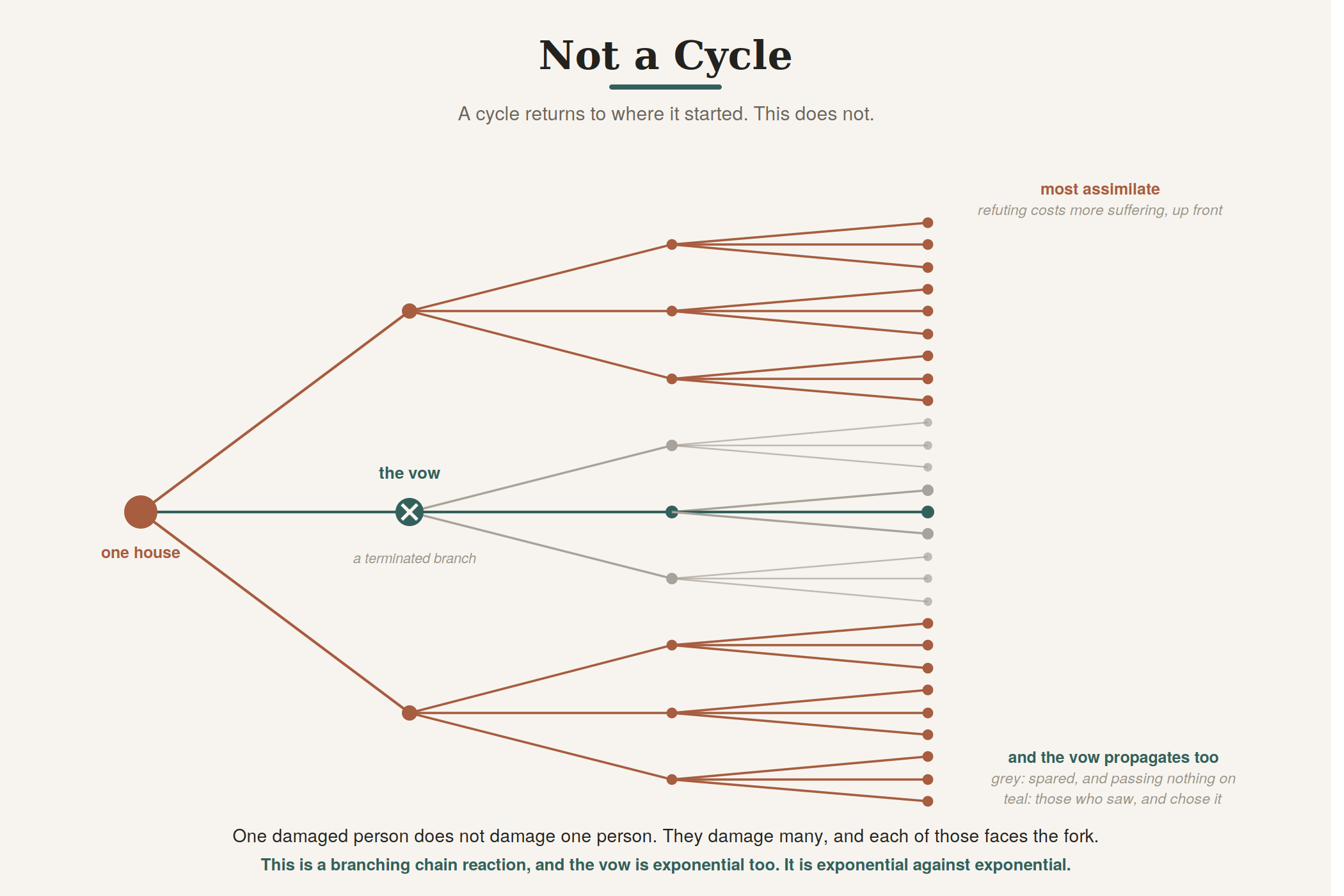
We call this the cycle of abuse, and the name is, in taxonomy, wrong in function.
A cycle returns to where it started. Same size, same shape, going round. That is not what this is.
One damaged person does not damage one person. They damage many, over a lifetime, and each of those people arrives at the same fork: assimilate, or refute. And most assimilate. Not because they are weak. Because refuting has a price and the price is usually more suffering, paid up front, with no guarantee, against a promise of light at the end of a tunnel you cannot see the end of. Plenty of people, offered that deal, would rather stay comfortable with what they know, in the dark, and I am not going to allege that is contemptible, rather it is a bill many people simply cannot pay.
So the ones who assimilate go and do it to many, and each of those faces the fork. That is not a circle, it is a branching chain reaction, and it has been running for a very long time, and we are standing somewhere in the middle of the timeline wondering aloud why the world is like this.
Which is where the vow comes back, and where it stops being a private virtue.
Every person who takes it is a terminated branch. They did not merely decline to pass it on. They removed everything downstream of themselves from an exponential process, permanently, including people who will not be born for fifty years and who will never know the branch existed.
And it runs the other way too, which is the part I want to leave standing, as a beacon of hope:
The ones you spare do not pass it on. And the ones who watch you do it are sometimes moved to take the vow themselves, or at least to some middle measure of less damage, which counts and is not nothing. So this is not a small kindness thrown against an enormous machine. It is exponential against exponential. The only reason the harm looks like it is winning is that its branches are louder, and the large scale of the power fallacy comes into play.
The child who was hired
There is a specific mechanism by which the flinch gets built, and it has a name, and the name has been in the clinical literature since the 1960s when the family therapist Ivan Boszormenyi-Nagy started using it.
Parentification. A role reversal, in which a child takes on obligations reserved for adults, and provides emotional or instrumental support to the people who were supposed to be providing it to them. It comes in two kinds. Instrumental parentification is practical: the child who cooks, cleans, manages the household, raises the younger ones, handles the bills. Emotional parentification is the child who becomes the parent's confidant, counsellor, mediator, and regulator. The one who is told things a child should not be told. The one whose job is to manage an adult's interior.
The second kind does more damage than the first, and the reason is mechanical rather than moral: it requires the child to engage with adult emotional content they do not yet have the equipment to process. You can teach an eight-year-old to run a washing machine. You cannot teach an eight-year-old to metabolize an adult's despair for them, and asking them to do it anyway does not make them capable. It makes them responsible, which is not the same thing, and it is a weight that does not come back off.
It is called destructive parentification when the responsibility exceeds the child's capacity, when it violates the boundaries between the generations, and, most tellingly, when the role becomes the child's source of identity. That is the line that turns a chore into a wound. Not the work, but the moment the work becomes who you are. And in that form the literature does not treat it as unfortunate, it specifically classifies it as emotional abuse or neglect.
Now look at what it produces in the adult, because the list will be familiar by now.
The parentified adult unconsciously seeks out relationships where they can caretake, because the caretaker role is the one that feels like home. Chronic over-responsibility:
- A permanent background hum that everything depends on you. You are the safety net.
- Difficulty with boundaries, where setting a limit feels selfish or dangerous, particularly if the people who raised you modeled boundary violation as ordinary.
- Early emotional suppression, learning to look calm while nothing inside gets processed.
- And anxiety and hypervigilance, because years of monitoring an adult's emotional weather produce a finely tuned threat-detection system that does not switch off when you leave the house.
That is the flinch, item by item. This is its factory.
And there is one detail in that list that I want to stop on, because it is the hinge of this entire section.
Being on the receiving end of care feels uncomfortable, or unsafe. It feels like a trap.
Sit with that. The person who has spent their life giving is not merely bad at receiving. Receiving actively alarms them, because in the house where they learned everything, care flowing toward the child was not part of the arrangement, and anything unfamiliar in an unsafe house was a threat until proven otherwise. So they do not just tolerate a one-sided relationship, often they are more comfortable in one, and they will select for it.
Which is the matched pair's mechanism, arriving from the research rather than from theory. The parentified adult seeks someone to take care of. The entitled adult seeks someone to take care of them. Both of them experience the fit as relief, neither is being fooled. They are both, precisely, at home, regardless of discomfort or misery.
The parent who could not hold a line
Here is where I have to complicate the villain, because the research does something inconvenient.
Parentification does not require a monstrous parent, and it very often comes from a loving one. Warm, generous, present, genuinely devoted, and simply unable to hold a boundary anywhere, including the boundary between their own emotional life and their child's.
Which suddenly explains far more than it should.
Look at what a parent without limits does. If their inability runs outward, they give without restriction: Nothing is ever denied, no demand is ever refused, no consequence is ever allowed to land; that produces the golden child. If their inability runs inward, they lean. They pour their fears and their grief and their marriage into a person who is nine, because the person who is nine is available and does not leave. That produces the parentified child.
Same failure. Opposite outputs. And in a house with two children, one parent with no limits can produce both at once, and will experience themselves the entire time as loving, because they never once withheld anything from anybody.
Which is the argument of Part One, arriving in the nursery: No strings is not no limits. A parent who cannot hold a line is not being kind, more specifically they are being nice, and they are being nice to themselves, because the line is where the friction lives and holding it means being, for a moment, the person your child is furious with. Niceness avoids that. Kindness pays it.
The warmth trap
Which brings us to the thing this whole part was built to answer, and the answer has been sitting in developmental psychology since the 1960s, in plain sight, where nobody looks for it in connection or totality.
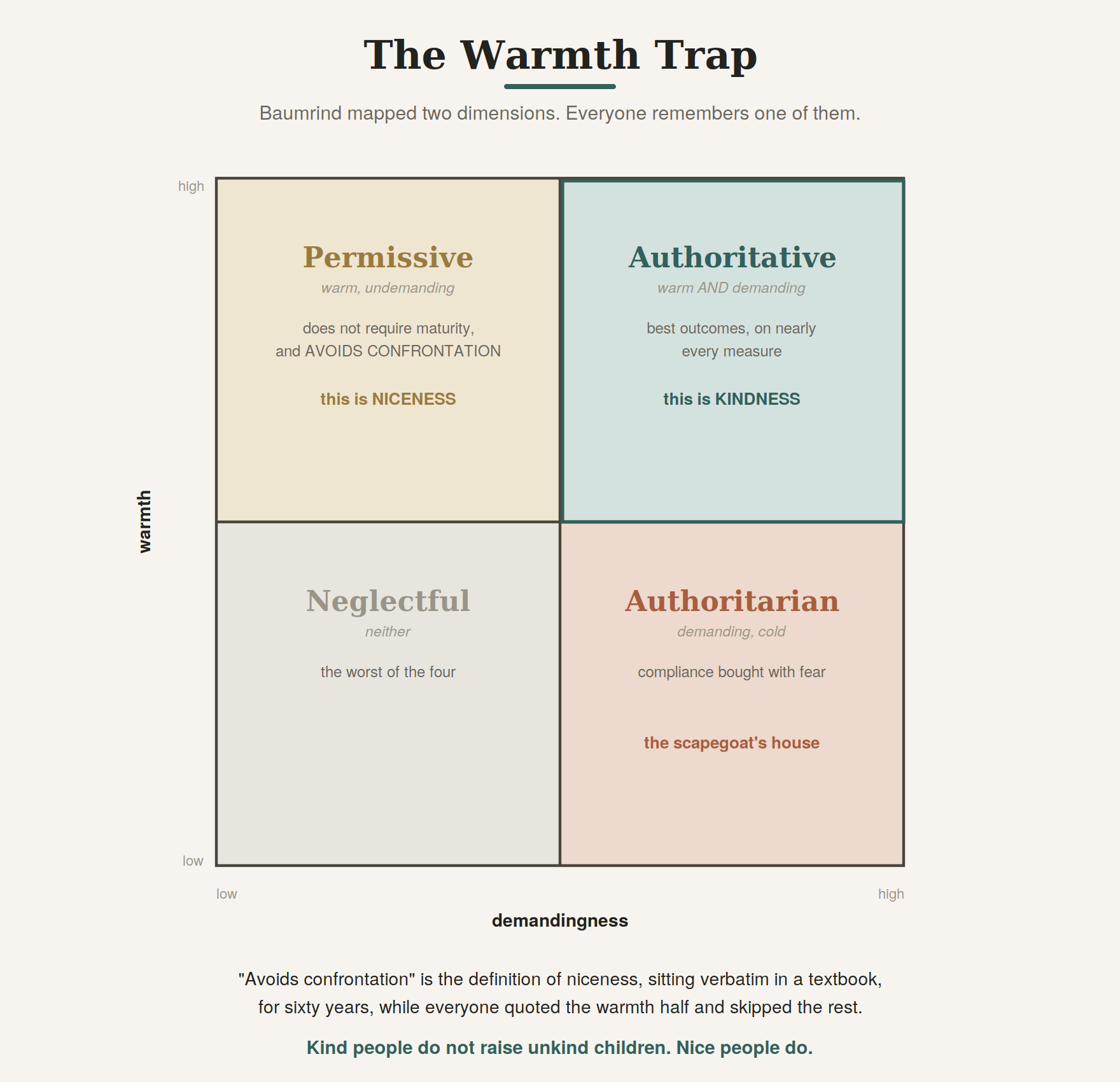
Diana Baumrind mapped parenting along two dimensions rather than one, and the second dimension is the one everybody forgets.
The first is warmth, or responsiveness: how much affection, attention, and support the parent supplies. The second is demandingness: how much mature behavior the parent actually requires, and whether they enforce it.
High warmth and high demands is what Baumrind called authoritative, and it produces, across sixty years of research, the best outcomes on nearly every measure anyone has thought to take. It is an unfortunate name, and I am keeping it only because it is the technical one and you may want to look it up before drawing conclusions. It sits a single syllable away from authoritarian, which is nearly its opposite, and the two are confused constantly, including by people who ought to know better. So read authoritative as warm and demanding, and read authoritarian, which is high demands with low warmth, as compliance bought with fear. Low on both is neglect, and it is the worst outcome of the four.
And high warmth with low demands is permissive. And permissive parenting produces, reliably and measurably: entitlement, poor self-regulation, and trouble with authority.
Now read how the literature describes what a permissive parent actually does. They do not require mature behavior, and they avoid confrontation.
There it is. That is the definition of niceness from Part One of this essay, sitting verbatim in a developmental psychology textbook, and it has been printed there for six decades while everyone quoted the warmth half and skipped the rest for the most part.
So here is the answer to the question this part opened with: Kind people do not raise unkind children. Nice people do.
The parent who raises the entitled adult was not kind to them. Kindness aims at a person's good, and a child's good is not their comfort, and the friction they need is precisely the thing that costs the parent something to deliver. What that parent was doing was avoiding confrontation, which is the definition of the counterfeit, and they were doing it warmly and with real love in their heart, and their child paid for it with their entire adult life.
That is not a small distinction, it is the whole essay, standing in a kitchen, for all the see when the context is examined. And it connects to Part Two in a way that ought to be uncomfortable for anyone carrying the flinch, including me in part.
A fawning parent cannot be authoritative. Not will not, but Cannot. Because demandingness requires tolerating your child's displeasure, over and over, for years, and the flinch is precisely and specifically the inability to tolerate anyone's displeasure. It is a nervous system that reads another person's anger as a threat to survival, and you cannot hold a boundary against a threat to your survival. You will fold. Every time. And you will fold lovingly, which is what makes it invisible.
So the pipeline completes itself, and it is worse than a metaphor. Trauma installs the flinch. The flinch makes permissiveness structurally inevitable. Permissiveness produces the entitled child. The entitled child, when reality finally declines to supply them, becomes the shark.
A wounded person, doing their absolute best, unable to do the one thing that would have helped, manufactures the next predator. Not through cruelty, through an incapacity they did not choose and cannot see.
I want to be careful how I say the next part, because it is merciful and it is not an excuse:
Those parents' kindness did not fail. It was never kindness. They were running a survival response and calling it love, and they believed it, and in a real sense they were never given anything else to call it. That is a tragedy rather than a crime, and yet it is still the mechanism, and the child still pays, and understanding exactly how a person came to be incapable does not make anyone downstream of them less injured. Empathy explains, but it does not absolve. We have been here before.
The friction is the curriculum
So if the answer is demandingness, what does that actually mean? Because it sounds like severity, and it is not, and getting this wrong in the other direction produces the authoritarian house, which is where the scapegoat comes from.
Here is the reframe that fixes it.
The friction is not the point, the friction is the curriculum.
When you hold a line with a child, you are not merely stopping something: you are running a live demonstration of the entire grammar of being a person, and it is the only place that grammar is ever taught. Watch what is actually in the lesson:
Here is how a limit gets named. Out loud, in advance, with a reason, before the violation rather than after.
Here is how it feels to be told no by someone who loves you. Which is the single most important thing on this list, because a child who has never survived that will grow into an adult who experiences every no as a withdrawal of love, and will do anything to avoid hearing one, or will punish anyone who says one.
Here is that the relationship survives it. The disagreement happens, and the house does not fall, and you are still loved at dinner. That is not a small demonstration, and for enormous numbers of people, it is one they have never seen.
Here is how repair works. Somebody was wrong, and said so, and the thing got mended rather than buried. Including when the person who was wrong is the adult, which is the version that teaches the most and is offered the least.
A child raised without friction has not been spared anything. They have been kept out of the only class where those skills are taught, and then released into a world that assumes they took it.
And consent belongs right here, in both directions at once, which is the part almost everybody misses.
A child learns consent by having their own honored where it deserves to be. Not everywhere, because they are a child and some things are not up for negotiation, and pretending otherwise is its own abdication. But in the enormous territory where it does apply: their body, their no, their preferences, their right to be asked rather than moved. A child whose no is respected in the places it should be will recognize instantly, decades later, the moment someone declines to respect it.
And they learn it just as much by being held to honoring yours. Your no is real. Your limits are real. You are a person and not an appliance, and the demonstration that another person's boundary is a fact rather than an obstacle is the thing that keeps a child from growing up into someone who treats every limit as a negotiating position.
That is the clean room from The Hoard and the Fire, running in a family, before anyone can name any of it. Power that is explicit. Limits stated in advance. Consent that runs both ways. Accountability sitting heaviest on the person holding the power, which in that house is you and is never in question. It is the same architecture, and the same thing makes it work, and its absence produces the same wreckage at every scale.
And the last piece is the one nobody thinks of, because it is invisible by design:
Let them see the cost.
A child who never learns what your giving costs you will conclude, reasonably, that it is free. And a person who believes giving is free has learned only half of the transaction, the receiving half, and they will go through life on the assumption that the supply is simply a feature of the universe, the way plumbing is, and will be genuinely bewildered and genuinely aggrieved when someone eventually declines to be plumbing.
You do not have to burden them with it. You are not asking a nine-year-old to metabolize your despair, which is the other error, and we covered it a few pages ago. You are simply not hiding it. That this took time you wanted for something else. That you were tired and did it anyway. That the thing they are holding was paid for.
Because that is the whole lesson, in the end. Not that kindness is owed to them, but that kindness costs, and someone chose to pay it, and they chose it again this morning, and the choosing is what made it a gift rather than the weather. THAT is love, and kindness, in one.
Which is what nobody ever told the golden child, and what the scapegoat learned in the worst possible way, and what neither of them was ever going to work out alone.
Part Four: The Daily Choosing
On the upkeep of a thing that is not an object but a pattern, and the gift that nobody will ever thank you for.
The sentence that ends it
There is a sentence that sounds like the conclusion of all this and is actually the end of it:I am a kind person.
Look at what that sentence does. It converts an activity into a property. It takes something you were doing, effortfully, this morning, and files it under permanent characteristics, like eye color, like height. And the moment it is filed there, the doing stops, because you do not have to maintain your height. It is simply a fact about you, and facts do not require Tuesdays, or effort, or maintenance.
Anyone who has read The Honest Mirror will recognize this immediately, because it is the same trap, arriving one essay later wearing different clothes. That essay's whole argument was that self-awareness is not a possession but a maintained structure, and that the instant you believe you have it, you stop doing the thing that was holding it up. Believing you see clearly is the precise mechanism by which you stop checking. The Hoard and the Fire said it again about power: it is a loan, not a possession, and the person who begins to experience it as deserved has already started to lose it.
Three essays. One physics. Nothing worth having in any of them is a thing you are. All of it is a thing you keep doing. It all requires constant and conscious consent, and continuous effort.
So the honest formulation is smaller and much harder to say out loud, because it sounds less impressive at parties:
I try to be a kind person.
Or, better, because it has a verb with an actual tense in it: I choose to be. Present tense, first person, revocable by inaction, and requiring renewal tomorrow morning whether or not you feel like it.
The grammar is not a technicality. A trait is a fact about you that you can rest on, whereas a practice is something you did today and will have to do again, and might not, and would then simply not be a kind person that day, and that is a real possibility rather than a rhetorical one. Kindness is not a trait. It is a tending. And a fire that you are certain will keep burning because it has always burned is a fire nobody is watching being tended.
What it costs to keep
Part One said kindness costs, sometimes only time, sometimes only discomfort, but always something real, and always yours.
Which produces an arithmetic problem that most people who care about being good never do.
Costs deplete. Anything that spends has to be resupplied, or the spending stops, and it does not stop gracefully. It stops the way an engine stops, at the least convenient moment, after months of noises you decided not to investigate. And the resupply is not automatic, as usually nobody is filling the tank while you sleep.
The other essay put numbers on this and I will not repeat the whole argument. Adam Grant found that givers land at both the very bottom of the success ladder and the very top, and the variable that decides which end is not how much you give, it is whether you guard yourself while doing it. The selfless burn out and get farmed. The otherish, who hold high concern for others and high concern for themselves, thrive, because those two are not a seesaw: they are separate operations of the same engine and you can, and should, run both.
And then the finding that closes the argument for good: the most selfless people give less. Not less than they meant to, but less in absolute numerical terms, in money, time, skill, and connection, because they ran out. The person who guarded nothing ends up having contributed less than the person who guarded something. It is not a moral claim, it is a subtraction.
So self-care is not the opposite of kindness and it is not a reward for kindness and it is not what you do when kindness has exhausted you: It is the fuel. It is upstream. It is the thing that determines whether there will be any kindness available at all in ten years, and the person who treats it as optional is not being more generous than you, they are spending their principal and calling it interest.
Kindness turned inward
Which brings us to the hardest one, and I want to be careful with it, because it has been so thoroughly ruined by the people who sell it.
There is a real research literature here, and it is not what the phrase has come to mean. Kristin Neff operationalized self-compassion in 2003, and defined it in three parts: self-kindness instead of self-judgment, common humanity instead of isolation, and mindfulness instead of drowning in the feeling. Treating yourself, in a moment of failure, roughly the way you would treat a friend in the same moment. Which, put like that, sounds almost embarrassingly modest, and is nearly impossible for most of the people who need it.
And the objections it gets are the same three every time, so let me clear them, because the evidence has already answered all of them:
It is not self-pity, which is absorption in your own problems and the conviction that nobody else has ever had them, the personal fable. Common humanity is the exact opposite of that: the recognition that you are failing in the ordinary way that everyone fails.
It is not self-indulgence, which is buying yourself short-term pleasure at long-term expense. The research runs the other direction: self-compassionate people are more likely to exercise, to eat well, to go to the doctor. Because caring about someone means being willing to make them uncomfortable for their own good, and that is as true when the someone is you, too.
And it is not complacency. This is the one that matters most and the one nobody believes. Self-compassion prompts people to take more personal responsibility for their actions, not less. It makes accountability survivable. If failing does not trigger annihilation, you can look directly at what you did, which is precisely what the harsh inner critic prevents, because you cannot examine a thing you are busy fleeing.
Self-compassion is not the same as self-esteem, and the difference is that self-esteem is comparative.
To have high self-esteem you generally need to feel special, and above average, and you have it when you succeed and lose it when you fail. And, as Neff points out with lovely flatness, it is arithmetically impossible for everyone to be above average at the same time. So the pursuit of self-esteem has a built-in method, and we all know it, and we all do it: to see ourselves positively we inflate ourselves and often unfortunately put other people down, so that we can feel good by comparison.
Read that again, and then look back at the house.
Self-esteem is zero-sum. Which means a house that runs on it needs a floor.
That is why the two chairs come as a pair. The golden child's elevation is not a separate cruelty from the scapegoat's suppression. It is the same cruelty, requiring both halves, because you cannot be above average without somebody occupying the space below you. The scapegoat is not incidental to the golden child, the scapegoat is the instrument of the golden child. The house did not happen to produce two roles by accident, it needed two, because the thing it was manufacturing was comparison, and comparison requires a party of at least two.
And I want to push one step further, because self-esteem is comparative is not quite the whole diagnosis; the deeper problem is that comparison requires an axis, and somebody chooses the axis.
"Judge a fish by its ability to climb a tree and it will spend its entire life convinced it is stupid." The fish is not failing: the measure is. And the measure did not fall out of the sky, it was selected, by someone, for reasons.
Which makes this a power fallacy move rather than an error: Look at the report card again. Both children were measured on one axis, chosen by the adults, and the axis had very little to do with either of them; whoever picks the metric decides who wins before anybody sits the exam. That is the last essay's argument, running in a kitchen: control the measure and you control the outcome, and withholding a fair measure is withholding like any other.
So the answer is not to stop comparing, which nobody has ever managed anyway, comparison is necessary for calibration. The answer is equity: a measure that fits the thing being measured. Not identical treatment, which is what people usually mean by fairness and equality and which reliably produces a fish being asked to climb; the same access to a life, adjusted for the fact that people start in different places, carrying different weights, built for different water.
And equity needs no floor. That is the whole of it: It has no below.
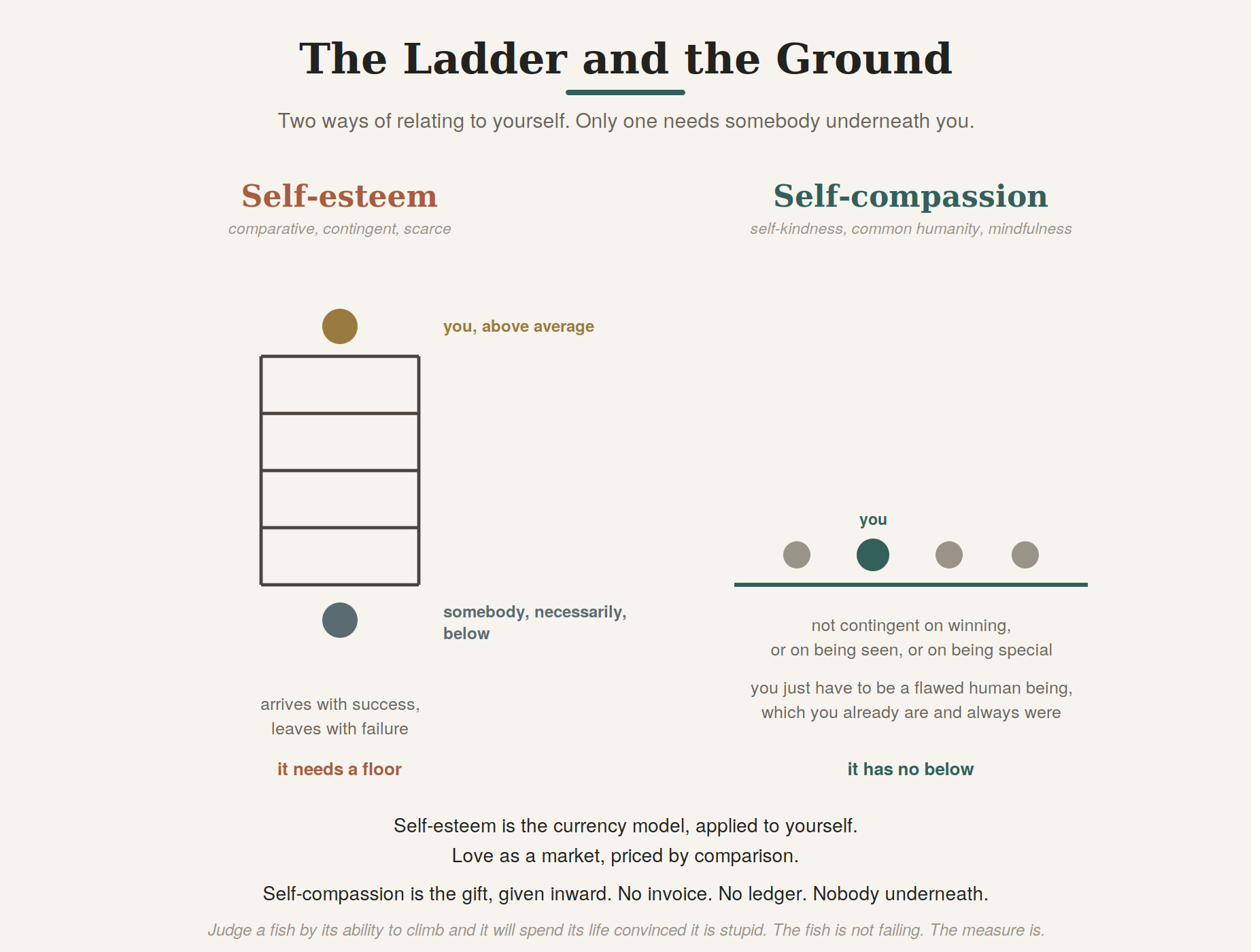
There is a second rigging in the self-esteem model, too, and it is quieter. When you do something right, most of the time nobody notices. Harm announces itself; it makes noise, it leaves marks, it demands a response. Good mostly does not: it looks, from outside, like nothing happening. Usually even appearing as peace. So a sense of your own worth that depends on being seen doing well is not merely competing for something scarce, it is competing for something scarce that is structurally, and permanently, mostly invisible. You will starve on that diet, and then you will conclude that the starving is about you, because the adoration machine is not supposed to be active in kindness.
Self-compassion needs none of it. You do not have to be better than anyone; you just have to be a flawed human being like everybody else, which you already are and always were, and which requires no one to stand beneath you at all. Before asking anyone else to meet you where you are, meet yourself where you are, and stare into an honest mirror.
So here is the whole thing, arriving where the last two essays arrived. Self-esteem is the currency model, applied to yourself. It is love as a market, priced by comparison, contingent on performance, and it requires a loser. Self-compassion is the gift, given inward. No invoice. No ledger. No one below you. Just the same thing you would extend to a friend, extended to the one person you are guaranteed to be standing next to for the rest of your life: yourself.
And if you carry the flinch, this is the last thing you will manage and the one you need most, because Part Three named the reason: being on the receiving end of care feels unsafe. That includes care coming from you. The person who has spent thirty years unable to accept a compliment is not going to find this easy merely because the source is internal; it is the same alarm, and it goes off just the same.
Do it anyway. Badly if you must. It is the only part of the supply chain you control, and it requires effort.
The weather
To be honest about the conditions, because everything above is difficult and the world is not neutral about it.
Rare is hard to find, and it is getting rarer, and that is not an accident of the age: it is a product being manufactured. We are raised inside a machine that rewards the transactional, the individual, the willfully blind, and the ones who take, and rewards them richly and in public. And a person raised on that does not merely learn to take, they learn that taking is owed to them, and that anyone who fails to hand it over is the one committing the offense.
We, as individuals and communities, however, built all of it. The roads, the grid, the institutions, the entire enormous apparatus, and it was built and is maintained by people who sweat and suffer and bleed into it. So what is it for, if it does not serve them? Why is there a society at all, if what it reliably produces is a small number of people standing on the rest of us?
And we arrive, again, at the fallacy sitting in the middle of this culture like a stone: that power means servitude to most, that having it means getting it out of other people. It is the crudest, most brittle, most easily broken thing on that map, and it is what almost everyone is taught to want.
Here is what the people filling that void are actually doing. They will step on your neck at every opportunity, with no regard whatsoever for your existence. Not because they hate you, and not because you did anything.... But because that fleeting half-second of leverage is the only taste of power they have ever had.
And it is not that it gives them nothing, it does fill, briefly, the way food fills. And then the thrill metabolizes and the void is hungry again, on schedule, forever, and they go looking for the next one, because it is the only meal they know how to catch. Scraps, taken one at a time, by something that never learned to farm and does not know that farming exists. They are not evil so much as pre-agricultural, and they will die hungry with their teeth in someone, and they will have called it a life.
And they do not care what it costs you. They cannot, because to them you are not a person at all.
You are an effigy.
The invisible gift
So. After all of that, the question the whole essay has been silently circling and refusing: Is any kindness owed to the predatory?
The honest answer is that almost everything called kindness in that direction is one of the other three. It is fear wearing kindness's face.
- It is enabling, which is the friction you withhold that would have taught them.
- It is a bid to be the exception who finally reaches them, which is not about them at all.
Their good is accountability, which means the only genuinely kind thing available is usually the thing that costs them something, and delivering it from inside their reach is not kindness, it is martyrdom with extra steps.
But there is a version, and it is the highest thing in this essay, and it is almost never what the person doing it thinks it is:
You can expose them.
Not vengefully, though the accompanying rage is allowed, often justified, and does not disqualify anything. You escape the orbit first, because none of this is possible from inside it: you keep every scrap of proof of what you were subjected to and everything you witnessed, and then you lay it out in public, with the facts assembled and the dots connected, in a form that can actually be examined by people who were not there, as a whole.
Understand what that costs, and give it the gravity it deserves: It falls on the victim, almost always, in risk and pain and expense, which is one more way this world shifts the bill onto the person who was already billed. Having an advocate do it for you as a proxy is rare, and you are stepping into public with your vulnerability held out where anyone can reach it, in front of an audience that mostly answers vulnerability with the three refusals, while the person you are describing is still swinging and now has a reason to swing harder. Nobody reasonably sane wants this.
And, even so, it may be the only thing that works. With enough of the right eyes on it, accountability can arrive through sheer exhaustion of alternatives. Or, failing that, it at least makes them a pariah, and a pariah has a smaller hunting ground.
Which means somebody does not get hurt.
It is the whole point. There is a person out there who will not be harmed, and they will never know it, and they will never know you, and they will go about a life that contains one less catastrophe and will never once wonder why. You will not be thanked. You will not be told. There will be no moment. The only evidence that you did anything at all is an invisible absence, in someone else's life, that neither of you will ever be able to see.
A fraction of it might still be for the predator, and I will grant that honestly. In the rare case where some love survives, you can hope that seeing their pattern laid out in daylight will finally make them look inward and ask why, referring back to the friction as curriculum. Anyone who has actually lived this knows that probability is close to zero. The hope is not dishonorable, however, if anything it is appropriate empathy from a safe distance, it is simply almost never paid.
But the rest of it, the enormous rest, was never for them. It was for the community, including every member of it you are never going to meet.
And look at what that is, by the definition Part One laid down. A gift is given without invoice, without ledger, without expectation, and the only reciprocity in it is the joy of the giving and maybe a thank you. Well, here there is not even the thank you. There is no possibility of one. The receiver does not know they received. There is no relationship, no acknowledgment, no record, nothing coming back along any channel whatsoever, ever, in most cases.
This is the purest form of the thing. It is the maximum case of kindness. Everything else we have called a gift in three essays has had at least the possibility of being noticed, whereas this one does not, structurally, and the person doing it knows that going in and does it anyway.
And it does not matter which root it grew from. From rage, from love, from release, from the sheer processing of what was done to you, or from all of them tangled together at three in the morning; the motive does not change the arithmetic. Regardless of where it came from, the result is an act of invisible and extraordinary kindness.
Someone fed up enough and strong enough to leave is already remarkable, and most people never manage it, and I am not going to let that go unsaid as someone who has been there more than i care to admit. Someone who then turns around and stands up in public and lays it out, knowing exactly what it will cost them, is doing something one can only in comparison call Heroic, and it is past time somebody put it that way.
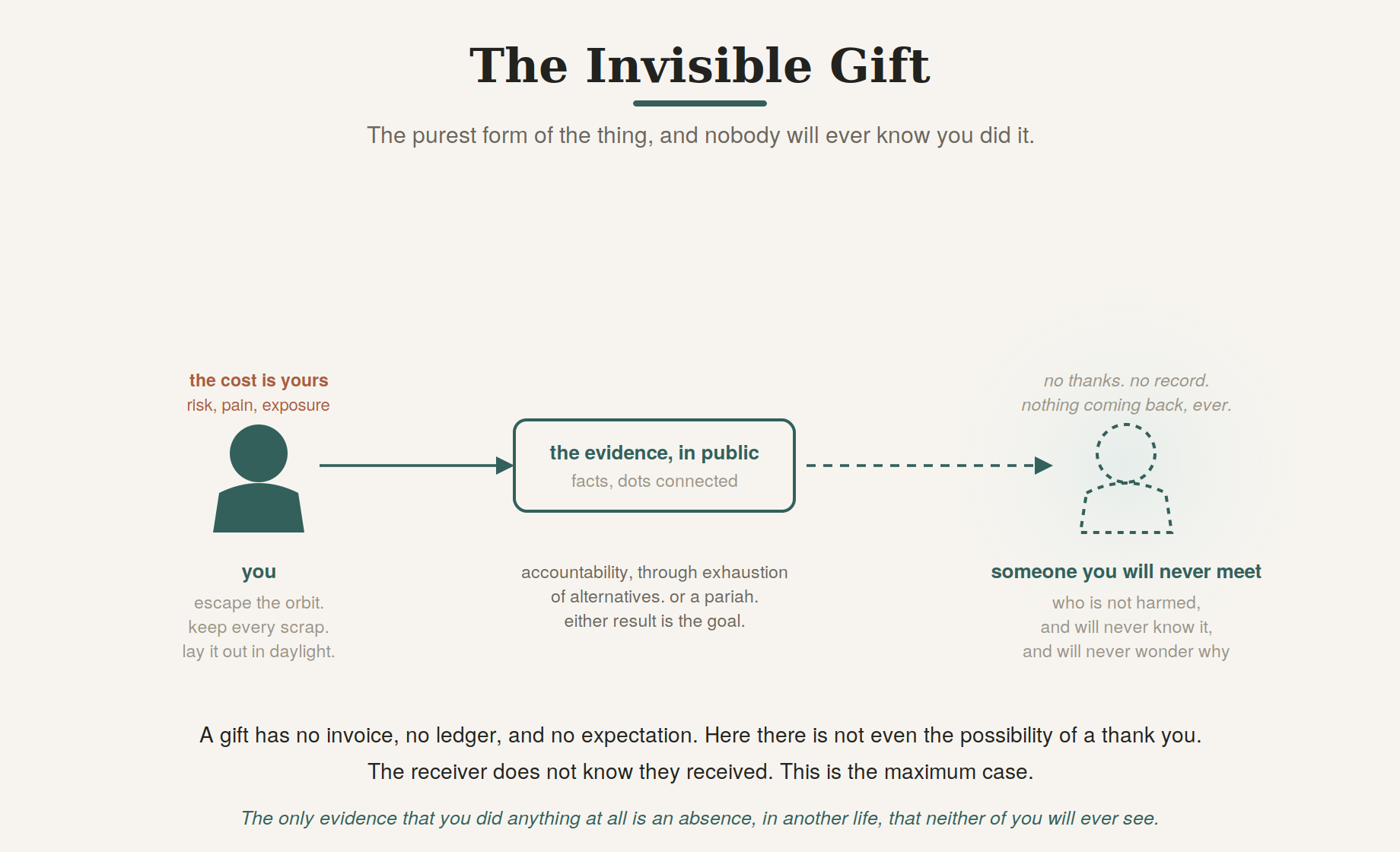
What is still worth doing in the morning
We started with four things that wear the face of kindness.
- Niceness, which is compliance aimed at your own comfort, and folds.
- The Flinch, which is a child's brilliant solution to an impossible house, still running decades after the house burned down.
- Carelessness, which aims at nothing at all and is therefore the hardest to hold anyone to, until the day the tools are offered and refused, and the ignorance stops being innocent.
- And the Mask, which is not a counterfeit at all but the opposite thing, wearing the face on purpose, because concealment is the entire method of the hunt they live for.
And the real one, which is smaller than all of them and harder than all of them: genuine, realistic, and objective care, acted on, at some cost, aimed at another person's actual good. With limits, because no strings was never the same as no limits. Revocable, because a thing that cannot be withdrawn was never chosen or consented to. And chosen again this morning, because it is not a trait and there is no version of this where you get to stop, it is a habit.
Against a machine that manufactures the opposite, exponentially, and has been running for generations, and is very loud.
I want to end on the arithmetic: Every act of kindness feels like a drop in an ocean. It feels like nothing, thrown against something enormous, by someone tired, while the blind sneer down from a pedestal built out of other people. That feeling is not irrational, it is what the size of the thing genuinely looks like from where you are standing, which is inside it, at ground level, with a fraction of the picture. Kindness often feels small and futile in the face of so much horrific depravity.
But it is wrong, a trick of short-term perspective: The harm is exponential. One damaged person damages many, and most of those assimilate, because refusing costs more than joining, and then each of them does it to many. That is the machine, and its arithmetic is arguably why the world currently looks the way it does.
And the vow is exponential too.
Every person you spare does not pass it on. That is not one person helped, that is an entire branch of the tree, cut, permanently, including everyone who would have been standing under it in eighty years and will now never know the branch existed. And some of the people who watch you do it will take the vow themselves, or at least find their way to some middle measure of less damage, which counts, and which is not nothing, and which starts branches of its own that at the very least have a modest measure of neutrality in this.
This is not a small good thrown against a large evil; it is exponential against exponential. The only reason the harm appears to be winning is that its branches are louder, and they have commandeered the lever that sets the standards. Cruelty announces itself. Kindness, by its nature, is quiet, and much of the best of it is invisible on purpose, and none of it is ever measured out loud, because the thing you prevented leaves no mark.
So the fire is not a metaphor for a feeling, it is an actual claim about how this propagates. It is lit from other fires, it costs fuel and attention and shelter, it does not survive neglect, and a maintained one spreads. That is all any of us are doing here: keeping something alight in bad weather, in a world that would rather sell you scraps, and handing it to whoever comes close enough to take it.
And then tomorrow, when it is cold, and nobody is watching, and it would be so much easier to let it go out...
Choosing again.