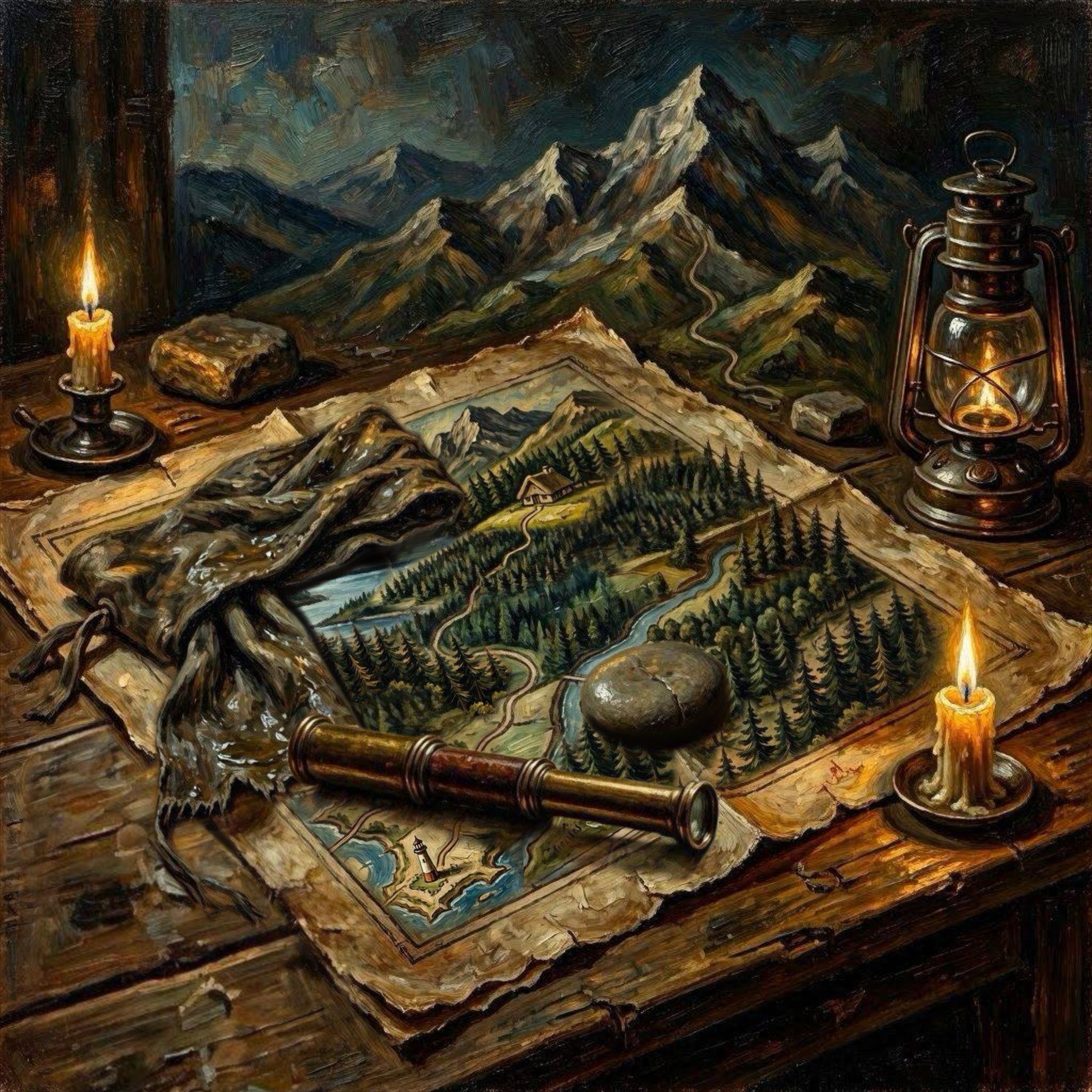
The Threshold
On the terms we stand on, stone by stone, and the landscape they build
by Darkageon Youngblood
Some words first, in their plain form, before we weather them.
- A boundary is the limit a person sets on what they will do, and on what they will permit to be done to them. It is defined by the self and enforceable by the self alone. The line in the sand, the borderstone.
- An agreement is a shared understanding between two or more people about how they will act toward one another. It requires all parties to keep it, and no one party can enforce it alone. The bridge.
- Consent is permission, freely given by someone with the capacity to refuse, for a specific thing, revocable at any moment. The garden gate, the fence of fieldstone.
- Assent is agreement given without the full power or capacity to refuse. It resembles consent and is not consent, because the no was never actually available. The iron fence, the gilded cage.
- Accountability is the ownership of what one has already done, and of its effects on others. The Cairn.
- Responsibility is the ownership of what one is obligated to do going forward. A person can hold responsibility for repair without holding fault for the injury. The work.
- Autonomy is the condition of governing oneself, of being the author of one's own choices, one's own lines, and one's own crossings. Every step forward or backwards, chosen with intention.
- Freedom is the possession of real, available options, and the capacity to move among them. It is not the absence of all limits. It is the presence of a genuine choice. The lnadscape, upon arrival, as a whole.
Those are the definitions. Hold them lightly, because a definition is a thing you can read while standing perfectly still, and not one of these words will stand still. Each of them, once you stop looking it up and start living it, stops being a meaning and becomes a place, and not the kind of place you visit, the kind you make, something you build in it, a habit you create a keep. A boundary is not a definition of a limit, it is a line you walk down to the water and draw, and draw again when the tide takes it. Consent is not a clause, it is a gate you hung with your own hands and a wall you stacked beside it one stone at a time, each stone a thing you sometimes learned the hard way. Accountability is not a principle, it is a cairn you built over something in yourself that you had to lay down honestly.
None of it is language.
All of it, in totality, is terrain, and all of it is work, and the work is never finished, because a path left alone overgrows, and a line left undrawn washes out, and a fire left untended goes dark. The weather comes through and takes a season of it, and then you go back out and rebuild what the weather took, which is not a failure and not an interruption, it is simply the other half of the labor, the half nobody mentions when they hand you the words.
So set the dictionary down. What follows is not a list of what these words mean, it is a walk through the landscape they build when a person takes them seriously, up a slope from the waterline, where a stranger first sees your shore, to a single locked door near the top that opens only from the inside and only to a handed key. And if the walk is made all the way, and the place is real, there are fires along it that can be seen from a great distance: one at the coast that says approach with care, there are rocks, I am here; one at the peak that says come and find me, I am within; and one inside the door that says you are welcome, stay as long as you like. Every station of that climb, every stone and gate and bridge and flame, is a place someone made, in weather, on purpose, and keeps making. Come and see what the words become when a person actually does them.
The Waterline
Everyone reading this arrived somewhere. You came up out of your own weather onto your own shore, and you may have been standing on it a long while before anyone else appeared, drying off, taking stock of a coast you did not choose and did not expect to be standing on, alive somewhat to your own surprise. That is the first thing the landscape asks you to understand, and it asks it before anyone else has walked into view: the ground you are standing on was reached. You did not begin here. You were carried here, by storms we will get to, and the fact that you are upright on the sand at all is the first work already behind you, uncounted, because no one was there to count it.
Feel the ground a moment, before anything else. The sand is cold and gives under your weight, there is salt drying on your skin, and your legs do not yet trust that the heaving has stopped. This is the body the whole climb will be made with, and it arrives before any of the thinking does. So stand in it a moment. Notice that you are breathing. Notice that the water is behind you now and not over you, that the shaking in your hands is slowly becoming the shaking of someone who is safe rather than someone who is drowning. That is information too, the oldest kind there is, and it is the first thing the shore gives you that the storm never could: somewhere to put your feet.
But before you build a single thing on that sand, there is a harder thing to do, and almost no one names it, so it gets done late or not at all. You have to become convinced that the storm has actually passed. That the quiet you washed up into is real quiet and not the deceptive stillness at the center of the thing that threw you here, the eye you have already learned, at a cost, to distrust. A person fresh out of the water does not build, because building assumes a future, and the eye taught you not to trust one, taught you that calm is the exact moment before the second wall. So you stand there a while, longer than an onlooker would understand, scanning a sky that may hold nothing, unwilling to turn your back on the sea. And only when you finally decide, and it is a decision, and a dangerous one, because deciding wrong is precisely how the false calm drowns people, only when you decide that this stillness is weather you can build in, do you turn away from the water at last and begin.
Before you build anything on this shore, it helps to know what the first thing you will build even is. The first thing you make here is a boundary, and almost everyone was taught the word wrong. A boundary is not a wall. A wall refuses contact. A boundary regulates it. The nearest true thing to a boundary in the physical world is not a fortification at all. It is the membrane around a living cell, selectively permeable on purpose: it lets the needed thing in and keeps the toxic thing out, and would, if it ever became a perfect wall, kill the cell it was protecting, because a cell sealed against all exchange is not safe instead it is starved. So the first correction is this: a boundary is the thing that makes contact survivable, and therefore the thing that makes contact possible, and a person with no boundaries and a person who is all wall have arrived at the same loneliness by opposite roads.
And once you are steady enough to lift your eyes from your own feet, you may notice, very far off and very high, a small light burning at the top of the cliffs. You will not know yet what it is, or who keeps it, or whether it was lit with anyone like you in mind. Only that someone, somewhere above all this weather, climbed high enough to build a fire and has not let it go out. Hold onto that. It will matter later.
The Weather
It is worth staying at the water a moment longer, because the sea is the first thing the landscape has to teach, and it teaches by taking.
Nothing you draw at the waterline holds still. The line in the wet sand is real, it marks where one thing ends and another begins, and the water takes it back on a schedule no one consulted you about, so the drawing has to happen again, at dawn and at dusk, for as long as the line is meant to mean anything. Consider the person who has spent years asking, and then asking more plainly, and then, worn down, asking in a way that sounds like begging, to be met as a person rather than a use, and who wakes to find the same line gone again, and draws it again, as though the thousand mornings before this one had left no mark. It looks like failure. It is worth sitting with why it is not. The line was never built to stay drawn; the tide was always part of the design. The real difference is only this: whether the drawing is done alone, down at the waterline in the half-light, or whether at some point another set of footprints comes down the beach and someone crouches to help. That difference, between redrawing the line by yourself and having it drawn with you, is most of what separates surviving other people from connecting with them.
But not all erasure is the tide, and a definition that stops at the tide will leave a person blaming themselves for the wrong thing. The water keeps seasons and moons. There are stretches when it barely reaches the line, and stretches when it will not let the line stand through a single afternoon: whole months of slack water, whole months of surge. None of it is a verdict on the one drawing the line. It is only weather, and the person who reads a hard season as a personal failing has mistaken the height of the water for the worth of their hand. And then there are the storms, which are their own thing entirely. The storm comes in fast and out of turn and takes the line while the hand is still drawing it, and takes the next one, faster than any hand can move, so that drawing stops being maintenance and becomes a kind of arguing with the sea. Its ordinary human names are the abusive house, the trapped year, the stretch of pure survival. It differs from the tide in the one way that counts: in a tide the line holds until the next erasure; in a storm it does not hold at all, because the force taking it is not a schedule but a will, or a chaos, that has decided your lines do not get to exist. The reflex is to draw harder, to believe one more firmly drawn line will finally stand, and to read its washing away as proof of some failure in the drawing, and that is a misreading, plainly, because no line holds in that water and the drawing was never the variable. A storm can leave you gasping. It can get a hand around your ankle and pull for the bottom. And here the truth is the one it would be kinder to soften, which is that not everyone who goes under has a hand reaching down for them, that kindness does sometimes arrive at the surface and close around your wrist and haul, and that just as often it does not come at all. Sometimes others would gladly help the storm drag you under even. Some of us learn instead to hold our breath. To stop fighting the water on the water's terms, to go still, to keep the one thing that is still ours, and to wait out the pull until it eases enough to break the surface, and to find our own way back to land, and to draw the line again there, on a beach we reached without being carried. That is not the happy version. It is only the true one, and it is the one more people like myself have lived.
And then, rarely, there is the weather that is larger than surviving. Not the storm that takes the line, but the hurricane that takes the beach, that removes the ground itself, so that there is no longer a shore to redraw the line on and no use in waiting for the water to drop, because when it drops there will be nothing there that you knew....
There was a hurricane on my sixth birthday. I did not understand yet that it was the smaller of the two things arriving that year, that a house was about to be remade around me into something with different rules and a weather of its own, and that the storm on the coast would turn out to be the one that left. But I remember the water, and I have never entirely stopped reading the sky.
There is a thing the hurricane does that the tide and the storm cannot, and it is the most dangerous thing in all the weather, because it looks like the opposite of danger. In the center of it there is a silence, where you feel the pressure drop until your ears give, and the birds have stopped because the birds know what the stillness is and have gone to ground, and the wind falls off to nothing, and the walls of the thing stand turning far out at the edges of sight... And it presents, to anyone who has not learned better, as calm. As quiet. As peace, finally, arriving. It is not peace. It is the eye, the exact middle, and the second wall is still coming, and the person who reads that hush as the end is the one who walks out into it unguarded and is standing in the open when the other side of the storm returns. To survive the eye you have to do the hardest thing the body knows, which is to distrust a peace it is starving for, to stay braced inside a silence that is offering you everything the storm denied, because you have learned, at a cost, that calm is sometimes only the center of the thing that is still trying to kill you.
Standing still in weather like that is not defiance, but its own form of drowning. What it asks is the last and hardest thing the water ever asks: let the old ground go. Stop reaching for a shore that no longer exists. Stay afloat with no land in sight and no promise of any, for however long it takes, until you come up against a beach you never chose and maybe would not have chosen, unfamiliar under your feet, and understand that this is where the line gets drawn now. You do not return from that one. There is no returning; the place you would return to is gone. There is only the new shore, and the fact that you reached it at all, and the person who crawls out of that water is not the person the storm found, because the crossing remade them on the way.
Against everything the weather has just shown, the hurricanes are seasonal, and that they come to certain shores and not to others. You may live through one, or through several, as some of us have, and still it remains true that enough swimming, enough work, enough of the stubborn refusal to go under, can carry you, if you are lucky (and luck is the honest word for it,) to a shore the great storms do not reach. An actually peaceful one. Not the eye, not the lull between walls, not the seasonal relief, but the quiet that is only quiet. And here is the last thing the weather has to teach, the thing almost no one is warned about, which is that reaching that shore is not the end of the labor: It is the start of a different one. Because a body that survived the eye has learned to read calm as the center of something coming, and it does not unlearn that at the new waterline. You arrive on the peaceful shore already braced, scanning a sky that holds nothing, distrusting a silence that has finally earned your trust, and the work that begins there: the slow and unglamorous work of teaching yourself that this peace is not a trap, that the stillness is just stillness, that you are permitted at last to set the watching down. It is in some ways the hardest crossing of all. The line, on that shore, is drawn in dry sand, well above the tide. It stays where you put it. And learning to believe that it will is a threshold of its own.
The Line in the Sand
So, having decided the storm has passed, you draw it. Low on the beach where the water still reaches, the most provisional mark there is, made without quite deciding to, the moment you trust the ground enough to claim any of it. It says only this: here is where I begin. It is written in the one medium guaranteed not to last. The first line you draw in the sand is not really a boundary yet, it is a declaration that you have chosen to believe there will be a tomorrow to defend it in.
And then, if you are fortunate, and this is fortune and not a reward, someone else washes up. Not on your sand. On theirs. A different stretch of the same long coast, reached out of their own weather, which you did not see and will mostly never see. This is the part the maps of other people get wrong, because you do not meet a person at your shore. You meet them across a distance, each of you standing on ground you crossed water to reach, and the very first thing that passes between you, before a word, before a name, is the question of how each of you is going to treat the other's line in the sand.
A person can stand on their own beach and watch you crouch at the waterline in the failing light and redraw a line the sea just took, and what they do with the sight of it is the truest early thing you will ever learn about them. Some see the labor and go still, and understand, without being told, that a line drawn that many times against water that patient is not a wall thrown up against them but a wound worn into a ritual, and they wait to be shown the way in. Some do not see a line at all, only wet sand, and walk through it, and never know they crossed anything. And some see it perfectly well and step over it precisely because they can, because a mark you have to redraw is a mark they have decided does not count.
You cannot control which of those a person is. That is weather too, of a kind, arriving from a sky you did not make nearby. What you can do, and what the rest of this climb is about, is build inland from the waterline everything the sand alone cannot give you: the marks that do not wash out, the tests a stranger has to pass to come further, the fires that tell the honest ones you are here. The line in the sand is not your defense. It is your first honest sentence, drawn in the most fragile thing on the beach, and the people worth letting past it are, before anything else, the ones who saw how many times you had drawn it and lowered their voice.
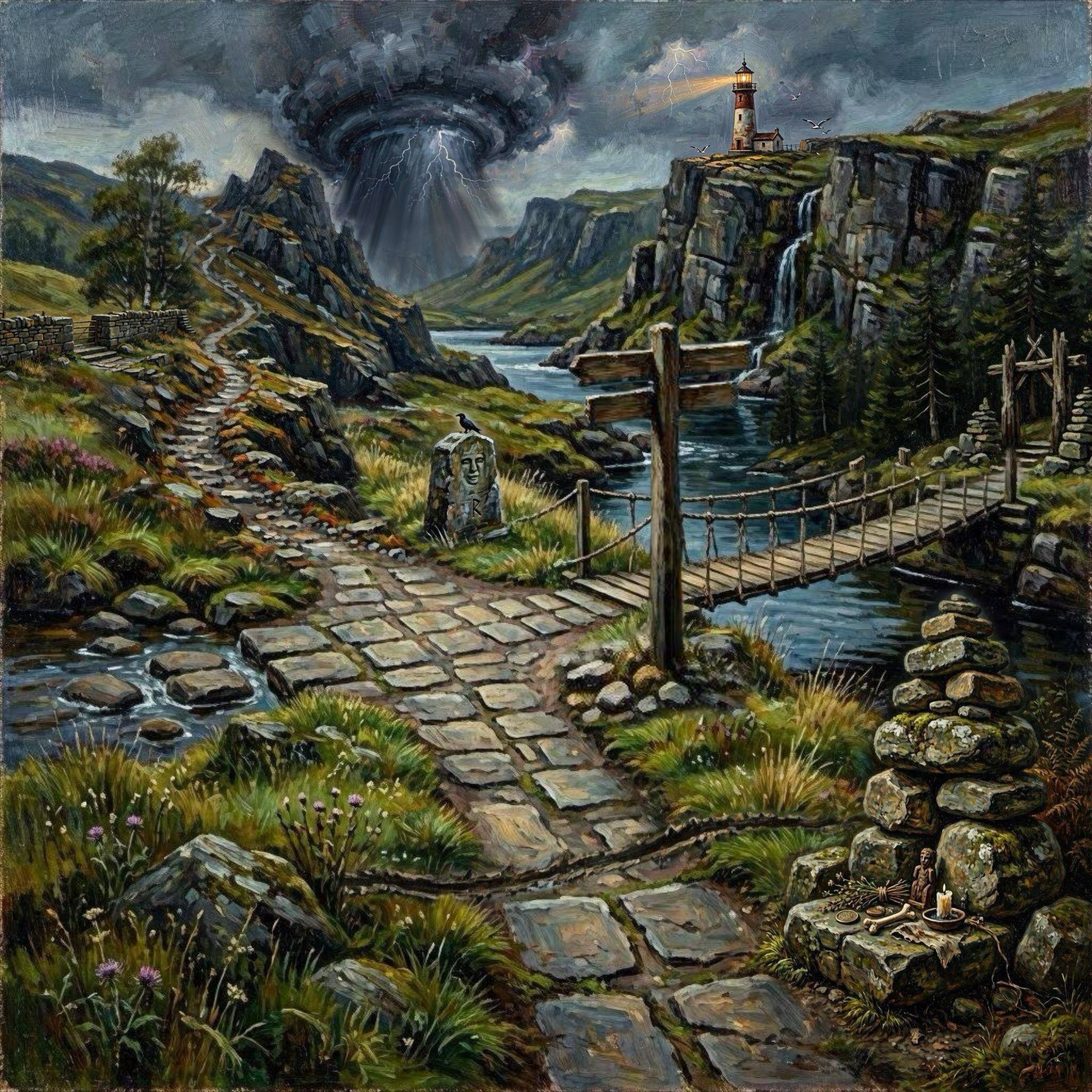
The Borderstone, and the Trail
There comes a point, if you keep at it, when you get tired of the tide.
Not tired in a way that makes you stop. Tired in a way that makes you move the important lines up the beach, out of the water's reach, and set them in something the sea cannot rewrite nightly. This the first stone you begin building with.
This is the borderstone.
It is the same line you were drawing in the sand, the same sentence, here is where I begin. But you have carried it to higher ground, sunk it deep, and let it hold on its own weight, and now you do not go down and redraw it at every tide, because it is no longer written in tide-medium: It is written in stone. Some of your lines earn this and most never will, and knowing which is which is a good part of the work, but the ones that do earn it change in nature when they cross from sand to stone. They stop being provisional. They stop being explained. A borderstone does not argue. It is simply there, sunk past the frost line, and its whole statement is that this particular line is not up for the daily negotiation the sand lines are, and will not be moved by weather, or by charm, or by the sheer persistence of someone who assumed every line washes out if they wait for the tide.
This is where the flat definition earns its keep, the one that said a boundary is enforceable by you alone. Down at the waterline that is only words, but up here it is the whole nature of the stone. You sank it by yourself. No one helped you carry it, no one else can move it, and no one else is required to keep it, because a borderstone is not an agreement between two people, it is a fact you established about yourself and set in the ground where it does not need anyone's cooperation to go on being true.
The old Romans had a god for exactly this stone and nothing else. Terminus was the god of the boundary marker, the sunk stone at the edge of a field, and his cult was so old and so serious that when they went to build the great temple on the Capitoline and had to clear the other shrines to do it, Terminus alone refused to be moved. They built the temple around him rather than shift the stone. A god the other gods deferred to, whose entire portfolio was the line that does not move. There is something worth keeping in that, which is that the immovable line is not the loud one. It does not announce itself or threaten. It just declines, absolutely and without heat, to be relocated, and the whole architecture of the nearby world ends up bending around the few stones a person will genuinely not move.
And here the sand and the stone reveal that they were testing different things all along. The line in the sand only showed you how a person looks at a boundary, whether they see the labor in it or see nothing. The stone shows you something harder and more useful, which is what a person does when they meet a line that will not yield to them. This is the first real filter on the climb. Some meet the stone and respect it precisely because it does not move, because an unmovable line is legible, and they can build a whole trust on knowing exactly where it is. And some meet the stone and feel it as an insult, a provocation, a thing to be worked at or gone around or slowly argued loose, and the tell is not that they dislike the stone, because everyone dislikes a stone that stops them, the tell is what they do next. The honest ones adjust their path... the others start looking for a lever, meeting it as a challenge, with no respect.
But none of this, the sand or the stone, is on a map yet, because no one has come this way before you. Rember, you are not walking a path inland, you are making one. There is no trail from the waterline to the high ground until you cut it. Every stone you set as a cairn, every mark you sink as a border, every yard of slope you clear so that a foot can find it, is trailblazing. First-passage work through ground that has never been crossed, and it is brutal, slow, and no one can do it for you, because a path someone else cuts to your interior does not go to your interior, it goes to theirs. Autonomy is not a state you are in, it is this. It is the machete work and the stone-hauling and the deciding, alone, where the path even goes, and the fact that when it is done there is a route up your own slope that exists solely because you made it exist.
There is the quiet mercy in the labor, the thing that makes it more than endurance.
The trail you cut does not vanish behind you.
It stays. Every pass you make up your own slope wears it a little clearer, and the cairns you stack along it are not only borders, they are waymarkers, so that the path becomes findable, by someone you might one day choose to let follow it, and, on the darkest days, by your side. Because you will lose your own way inland sometimes, if life is unkind. The fog will come down over the garden; the rain will make the slope slick and unreadable; a bad season will overgrow the trail until you cannot see the next step. And on those days the only thing that brings you back to your own hearth is the line of cairns you had the foresight to stack when the weather was clear, each one saying to your later, more lost self: this way, you were here, you built this, keep climbing. The trail you leave in your wake is the path back to yourself, and that is why you blaze it carefully. Not only so another can find you, but so you can find your own way home when the weather takes the view.
The Fjord, and the Bridge Across It
Not far up from the borderstone, the ground opens.
You did not put the fjord there. It is original to the landscape, cut long before you started building, a deep cleft where the rock simply stops and the far wall stands across a gap with cold water moving far down at the bottom of it. Some people's fjords are narrow enough to see across and read a face on the other side. Some are so wide and so deep that the far wall is a rumor in the mist, and the person standing on your rim cannot tell whether anyone is over there at all. The depth is not a choice and it is not a flaw. It is how far down the ground was cut in you before you ever had a say. And it asks the plainest question the landscape knows how to ask: will you come to me where I actually am, across a gap this real? Or is this simply too far, too deep, too much... will you turn back down the slope and leave me on my side of it? Most turn back. That is not cruelty in them, usually, it is only that the gap was wider than what they had come prepared to cross.
For the builder, the fjord is where the work changes character, and where it costs the most, because before you can build a single plank out over that gap, you have to go down into it. There is no bridging a fjord you have not been to the bottom of. You climb down the near wall, or you fall down it, which is how most of us first learn the depth, and you stand on the cold bedrock at the floor of the deepest cut in yourself, in the dark, with the far wall lost somewhere above you, and you learn exactly how deep it goes by standing on the bottom of it. That is the descent nobody sees and nobody counts, and it is the whole reason the bridge is worth anything later. Because the person who builds a span across their own fjord is not, usually, a person who found an easy gap. It is a person who went all the way down, touched the floor of the wound, and then, instead of leaving the drop open for the next arrival to fall into the way they fell, built up from the bedrock a way across.
And that is the thing the finished bridge says, to anyone who reaches its edge and understands what they are looking at. It does not say the gap is small. It does not hide the drop, or plank it over so smoothly that a visitor forgets there was ever a wound here. It says the opposite: Witness the scar. Look down, see how far it falls, respect that this was a genuine peril, because it was, to me, and I have the descent behind me to prove it. And then it says the kind thing, the thing that separates a bridge from every cheaper structure: you do not have to suffer it too. I already went to the bottom. I paid that once, on my own behalf, your behalf and on the behalf of everyone I might one day want to reach, and what I made out of having paid it is this crossing, so that you can come to me across the real depth of the thing without having to fall into it to learn the depth. That is not the safety net that catches you from your own fall and teaches you nothing, that is the hand, built from bedrock, reaching across a scar its maker refuses either to hide from you or to make you bleed for.
And here the fjord makes the sharpest cut in the whole landscape, because two people can stand on the identical bedrock, having taken the identical fall, and climb back up as opposites. Everyone who reaches the floor of their own wound draws a conclusion from it, and there usually are only two, and which one a person draws is one of the truest things about them.
One conclusion is I suffered this, so why should anyone after me be spared it? That person builds no bridge, on purpose. They leave the drop open and call it fairness, and they stand on the rim as newcomers approach and feel something settle into place when one of them falls, because the falling is what makes it even. They have decided that their descent was a toll, and that the toll must be collected from everyone who comes after, and they will describe this, often, as wisdom, as only asking of you what was asked of them, and there is a flat even-handedness to it that can pass for integrity if you are not looking closely. It is the logic of the one who was hazed and now hazes, the uphill-both-ways, the scar turned into an admission fee. And it is a lie in the shape of fairness, because it has confused having suffered with being owed.
The other conclusion is drawn from the same cold floor, in the same dark, at the same depth, and it is simply this: no one should have to be here. That person takes the exact knowledge the fall gave them, the precise measure of how far down it goes, and spends it on a crossing, so that the depth they now know so intimately becomes the thing they are most determined to spare someone else.
Same wound. Opposite building.
And you cannot tell the two apart by their suffering, because their suffering was in a way identical, which is the whole trap of it. You tell them apart by what they left at the edge of the fjord: an open drop with someone standing beside it waiting to be paid, or a bridge with an inscription a careful visitor can still read, which says I have already paid this, all of it, at the bottom, so that you would not have to, now go across. Only one of them has actually metabolized the fall. The other one is still falling, and has merely decided, somewhere on the way down, to charge admission to the pit.
To be precise about where the toll-keeper actually stands, because their position is the whole tragedy of them: They crossed the fjord. They had it in them; they made it over the hardest gap in the landscape. And then they stopped, right there on the far rim, and never took another step up the slope, and let the one crossing be the whole of them. The small structure they build is not on the way to anywhere. It is a tollbooth on the far side of a bridge already crossed, collecting from no one, administering a fee to an empty trail, because everyone worth reaching kept climbing and left them standing at a booth in the middle of nothing, guarding a crossing that is already behind them. The one hard thing they ever did becomes the last thing they ever did worth mentioning.
And there is a worse version of that one, worse precisely because it is so ordinary, so recognizably human, that most people have felt its pull at least once. This one does not merely decline to build. They sit down. They settle onto the near edge of their own uncrossed fjord and they watch, as people approach the gap and hesitate and lose their nerve and turn back, and they take something from the watching, because every person who fails to cross is, for that moment, lower than they are. The few feet of rock they happen to be sitting on begins, in their mind, to feel like height. They mistake the rim of a hole for a pedestal. And this is the power fallacy in its plainest and most common form, smaller than the colossus on his tower of admirers but built of the same error, the belief that being above someone is the same as being worth more than them, when all they are above is a drop they refused to bridge. Their elevation is not elevation. It is just the near side of a gap, and they have confused the gap with their own greatness. The tell of this one is the bootstrap, the claim that the absence of a bridge is itself the proof of worth. I crossed with nothing, they say, so wanting a crossing is weakness, and they appoint themselves the judge of everyone who arrives, because judging the failures is the nearest thing to company the ledge affords. And it must afford so little, because the whole position depends on the gap staying uncrossed. A person whose status is made entirely of other people's inability to reach them has a quiet stake in that inability. They root for it; they need the fall to keep happening, so that surviving it stays meaningful; and they call this rooting standards, or discernment, or simply having been through things.
But the arithmetic is merciless.
If your worth is the gap, then no one can ever cross to you without erasing it and so no one does, then you are left exactly as alone as the position requires, on your ledge, unreached, growing colder and more certain by the year that the loneliness was done to you. It was not done to you. You poured the foundation of it yourself, the day you decided the drop was a throne and sat down to guard it.
There is a colder variant still, worse than the toll-keeper and worse than the one on the ledge, in which a person does not merely leave the drop open but wants to watch you fall, and will sometimes disguise the drop to be certain you do. That one runs on machinery old and deep enough to need its own examination, and it will have one. I will only mark it here, at the edge of the gap, and climb on.
Set all of that against what the bridge actually is when it gets built, because the bridge is where the flat old distinction between a boundary and an agreement finally becomes something you can feel in your arms. Everything below the fjord, the sand and the stone, you drew and sank and enforced alone, because a boundary is yours to keep and no one else can keep it for you. But a bridge over a real gap is the first structure that is not yours alone. It holds only because both rims hold it, your side and theirs, each anchoring an end, and if either of you lets go, or was never really holding, the whole span falls into the water and is useful to no one. That is what an agreement is, seen from up here. It is not a gift you extend to someone across the gap. It is a thing the two of you build toward each other, plank by plank, from opposite rims, and it meets in the middle or it does not meet at all. And the whole time you are building, you are watching to see whether the person on the far side is holding their end... or has quietly set it down and is simply enjoying the view of you straining to keep the structure aloft.
And this is where the two coasts you arrived on finally matter, because the fjord is what keeps them from collapsing into one. A person who wants past your gap by erasing it, who wants the two of you to become one ground with no cleft between, is not offering closeness, they are offering to fill in the thing that makes you two separate people, and the name for that filled-in fjord is not intimacy: it is enmeshment. One nervous system worn by two bodies, no line anywhere that marks where you end and they begin. The bridge is the alternative and the whole point of it: It reaches the far side without pretending the gap is not there. It grants passage without dissolving the two rims that make passage mean anything. A person you are bridged to can cross to you and return to themselves, and so can you, and the fjord stays, uncrossed except by the span you both maintain, which is the only arrangement that lets two whole people be close without either disappearing. That is interdependence, and it is worth the harder word. It is not independence, which builds no bridge and stays lonely on its own rim; and it is not enmeshment, which fills the fjord and calls the drowning love. It is two people who kept their own ground and built a way across it anyway.
Now stand where the one who comes after stands, on the far rim, looking across at everything you built. They see the cairns climbing away behind you up the slope, the stone sunk at the border, the trail worn clear by your own passing, and if they are the kind worth reaching, they understand at a glance that all of it was labor. That the person on the other side of this gap did not arrive assembled but built every visible thing stone by stone in weather. And they see the bridge, half-built from your side, the planks reaching out over the drop as far as one rim can carry them, stopped at the middle where their hands would have to take up the rest. and the whole question of whether they belong on your path is answered by what they do at that edge. The ones who matter test their weight on the first plank, feel whether it holds, and begin building back toward you, slowly, both of you out over the cold air now, meeting in the middle where neither of you could have reached alone. The ones who do not either turn back, which is honest; or worse, they walk to the edge of what you built and demand you finish the span to their feet, so they can cross without ever lifting a plank, and stand there on the far rim with folded arms, waiting to be reached. Which tells you everything you need to know. A person who will not help build the bridge has already shown you exactly how they intend to cross every gap between you for the rest of the way up.
The Garden Gate, and the Wall Beside It
Past the fjord, on ground a person had to cross real depth to reach, stands the gate.
A gate, in this context, is an archway with a way through it that you can open and close, and here, high on your own slope, is the fact that undoes most people's understanding of consent: the gate, by itself, stops no one. It stands in the open. A person who has reached it and does not care to honor it simply steps around the post and keeps walking, because there is nothing beside the arch but air. This is not a flaw in the gate. It is the entire nature of the thing. A gate standing free was never built to be a barrier. It was built to be a threshold, an offered way through, and it means something only to a person who was already willing to be stopped by a line they could physically ignore. So the first honest thing to say about consent is that it is not a wall and cannot hold like one, and a person who treats it as a fortification will spend their life astonished that it keeps getting breached, when it was never breached at all. It was disregarded, by someone who was always going to disregard it, and the gate did the one thing a gate can do, which was to show them exactly who had arrived.
Because that is what the free-standing gate is actually for. It is not protection. It is information. Who reaches the archway and stops, and asks, and waits to be admitted, and who reaches it and strolls around the post as though it were decoration, is one of the truest thing the path up the slope will ever tell you about a person, and it is offered up for free, at the threshold, before you have let them one step further in. The gate sorts. A person who walks around your gate has not defeated it, they have answered it.
And now the hardest part, the part that is really about the difference between two kinds of people you have already met in this series. If a gate standing alone can simply be walked around, then a gate with no wall beside it is not really enforcing anything. It is an invitation with no consequence for refusing it, a threshold that costs nothing to ignore, and that, precisely, is niceness. Niceness is the archway standing open in the open, hoping to be respected, declining to build the thing that would make respect matter, watching people trample through the gap beside it and saying nothing, because saying something would require a wall, and a wall requires admitting that not everyone is going to honor the arch. The person who is only nice keeps building gates and never builds walls, and calls the resulting invasions bad luck, or the price of being open, or other people's failing, and never their own refusal to enforce a single line.
The wall is what you build when you have learned better. Stone by stone, up either side of the gate, sunk and stacked and mortarless like the cairns, and not one of them set for a single reason. Some stones you lay for plain practicality, because a thing happened once, witnessed or lived, and you would prefer it not happen again. Some you lay as lessons, hard ones, each stone the exact shape of a particular time you left the gap open and paid for it. And some you set for reasons that are nobody's business but yours, and owe no one an account of. You build it to whatever height the exposure demands, higher where the ground is most open, and there are stones, if you have lived enough to need them, that you shape deliberately so that going over the wall instead of through the gate does harm to whoever tries. Because a person who climbs a wall rather than pass through the gate standing right beside it has told you precisely what they intend, and a wall is permitted to answer intent honestly. When it is built, the gate is a real choice at last and not a suggestion, because the only sensible way through is the way you opened, and walking around is no longer something a person can do without meeting stone.
That wall is the whole distance the third examination walked, from the flinch to the vow. The flinch is the person who has only the archway, who learned their gate would be walked around no matter what they did and so never built the wall, who kept building arches and stands at an open arch letting everyone through because stopping anyone was never a power they believed they had. The vow is the wall going up beside the gate at last, the decision that some lines will be enforced and not merely hoped for. The moment niceness matures into kindness, which is the harder and less pleasant thing, because a wall says no to someone, and the nice never could. To build the wall is to accept that being open to everyone and being safe to anyone are opposites, and to choose, finally, the gate that can actually close.
And a gate that can close is the last necessity, the one that makes consent, actually consent at all. An archway that only ever opens, that once swung wide cannot be swung back, is not a gate, it is a permanent gap in a wall that no longer means anything. A yes that cannot later become a no was never consent, it was assent, or capture. Revocability is not a refinement added to consent. It is the hinge. Anything that cannot be withdrawn was never freely given, and here it is simply carpentry: a door that will not close is not protecting a threshold, it is marking where one used to be.
And it is never only one gate. A path of any length has many of them, set at intervals all the way up the slope, and each is its own threshold with its own wall, because the yes a person earned at the first gate was never a key to all the others. This is the thing the ones who mean well and the ones who mean harm sort themselves out over, quietly, again and again on the way up. The honest traveler arrives at each new gate and treats it as what it is, a fresh line, to be honored again or not. They either pass through the way it opens or turns back down the trail, no offense taken, because turning back is always allowed. The other kind arrives at the second gate holding the first one's permission like a writ, affronted that there is a second gate at all, and reaches for the top of the wall. You will not always see which kind you let through the first arch. But the slope is long, and the gates are many, and a person shows you, at one threshold or another, whether every yes has to be earned or whether they believed the first one entitled them to the rest.
The Slope, and the Garden
You will have noticed by now that none of this is level ground.
The whole landscape tilts. From the waterline inward it climbs, gently in some stretches and steeply in others, and the climb is not incidental to the walk. It is the walk, because going deeper into a person's merit and going higher up their slope are the same motion. The gate that stands farther in stands also farther up. The effort of reaching it is not only the effort of earning trust but the literal work of ascending: of spending breath, of choosing to keep going when the grade steepens and the easy thing would be to stop where you are and call this far enough. Most people call it far enough somewhere on the lower slope. That is not an accusation, as the climb is real and it is tiring and not everyone owes you the summit. But it does mean that the people you find highest up, near the cottage, are without exception the ones who kept choosing the ascent long after the ground stopped being easy, and that fact alone tells you something about them that no words at the shore ever could.
And partway up, past the last of the gates, the ground opens into the garden, and this is the first of you a person sees that is not a defense.
Everything below the garden guarded. The line, the stone, the fjord, the gate, the wall, all of it existed to filter, to test, to keep the wrong feet off the slope. The garden does not guard anything. It is the outer self, the surface of you that a person meets once they have been let far enough in to meet a surface at all, and it is simply how you have chosen to grow in the open. Some gardens are cultivated to the inch, deliberate, ordered, every bed planned and kept. Some are wild, native flowers seeding where they please, unpruned and unruled and no less beautiful for it, sometimes more. There is no right way for it to look, and the variety is the point. A garden is not a performance of a self; it is the honest overgrowth of one, the part of you that grows toward the light without being asked to. And whether it grows in rows or in riot is only the shape your particular life took when it was finally allowed to grow at all.
The garden does two things at once, and they are worth separating.
The first is that it welcomes.
A person admitted this far is meant to be here, meant to walk the beds and take in the scent and the color and understand that this is you, a real part of you, offered.
The second is quieter, and it is a last filter of a gentler kind, because what a person does in your garden tells you whether they should go any further.
The ones worth the woods beyond slow down here. They notice. They ask the names of things. They understand, standing among the beds, that a garden is labor and weather and years, and they treat it as something grown rather than something staged, and they do not assume that because they have reached the flowers they have reached the whole of you. That last understanding is the tell, because the garden is not the destination and was never meant to be. And the people who matter know it, and look past the bright open beds toward the treeline where the path keeps climbing into shadow, and understand that the real distance is still ahead.
And then there are the ones who arrive in the garden and think they have arrived at you.
This is where the landscape shows you one of its oldest and saddest patterns, and it is the seed of a great deal of harm the later documents will have to take apart. A certain kind of visitor reaches the garden, decides the surface is the sum, and begins, without ever asking, to build something in your flowerbed.
An effigy.
A figure they stake into your ground in the shape of who they have decided you are: a scarecrow dressed in the version of you they find most convenient, a small pedestal with their idea of you set on top of it. And they fall in love, or into something they call love, with the figure they built rather than the person whose garden they are standing in. It never occurs to them that there is more. The treeline is right there, the path visibly continuing up into the woods toward everything they have not seen, and they do not look, because the effigy they made is easier to adore than the self they would have to keep climbing to meet... And easier to control, because a figure you built yourself never surprises you and never says no.
And here is the cruelty that waits inside that, the one that turns a sad pattern into a dangerous one. The effigy is not you, and so eventually it fails to behave as you would or as they wish you would, because you are a person and it is a scarecrow in essence. When the real you does something the built figure never would: contradicts it, disappoints it, refuses the script it was staked into the ground to perform... the visitor does not conclude that they built the wrong figure. They conclude that you broke the right one. And some of them, when the effigy fails, tear it down in a rage that was never really about you at all. And some of them, in that rage, put the whole garden to the torch, and burn the years of honest growth to the ground because the surface of you would not hold still and be the thing they decided to worship.
That fire is a subject for its own examination. But it starts here, in the garden, at the exact moment someone mistakes the outer self for the entire self and begins loving a figure instead of a person. And the only defense the garden ever had against it was the same one every station has: the hope that the visitor was the kind who looks past the flowers to the treeline, and understands that they have not yet met you at all.
Because the garden has its own weather, too, and it does not only fall at the coast. The fog that rolls off the water climbs inland and settles over the beds on the bad days. On those days even a welcome visitor cannot see the shape of what you planted, cannot read the garden clearly, and has to decide whether to trust that there is order under the murk or to assume the blur is all there is. And it rains, up here as much as anywhere, and the paths through the beds go slick and muddy and harder to walk, and the whole tended place looks for a season bedraggled and unloved, when the truth is only that the weather came through as it always eventually does. The gardener knows this and does not panic at it, because the gardener has learned the thing the whole landscape has been teaching since the waterline: that the weather takes a season and then you go back out and tend what it battered. The garden that looks ruined in the rain is the same garden, waiting, under the mud, for the hands that keep it to come back out and lift it.
The Woods, and the Cairns Along the Path
Past the garden the treeline begins, and the light changes.
This is the part of the walk that most people never take, and the fewness is not an accident of the terrain, it is the terrain. The woods are where the easy welcome of the garden ends and the path climbs into shadow, into the parts of you that do not grow in the open, the sheltered things, the ones that took the cover of trees to survive at all. It is darker here, and steeper, often the steepest grade on the whole slope, and colder, and a person walking it beside you is no longer strolling through your bright surface being charmed. They are climbing into the dim interior of you, the growth you did not cultivate for anyone's pleasure and would not have chosen to show, and the plain fact is that most turn back at the treeline. They reach the edge of the woods, feel the temperature drop, see the path narrow and darken, and decide that the garden was enough... that they would rather keep the pleasant surface than climb into whatever the shadow holds. They go back down to the flowers and stay there, and call that knowing you.
That is not always cowardice and it is not always failure, and the woods themselves make it survivable to be turned back at, because turning back is allowed at every station. But it does mean the woods are the truest filter left, gentler than the wall and harsher than the garden, because they ask for the one thing that cannot be faked or hurried: the willingness to walk into the dark of another person and not flinch from it, and to be trusted, by then, enough that the walking is welcome. By the time two people are in the woods together, each should be holding the other's hand in a sense at time, and each should trust the hand they hold, because this is not ground you let just anyone onto, and it is not ground you can walk beside someone you are still testing. The testing was the sand and the stone and the fjord and the gates, lower down, in the light. The woods are past the testing. The woods are where trust, already established, gets spent, on the walking of the darkest part of you with someone you have decided has earned the dark. Where you begin to be truly seen, witness as your are, unpolished.
And it would be a lie to call the woods only dark, because the dark is not empty. A whole ecology lives under those trees that the bright garden could never hold. Like the growth that needed cover to survive at all, and it is not one thing. There is life in the shade, and there is danger in it, and there is beauty and fear and rawness in equal measure, and none of it cancels the rest or waits its turn, none of it is above the other.
Some of what grows in your woods is the most alive and most beautiful growth you have, and it is beautiful precisely because no one ever pruned it for display, because it was allowed to take whatever shape survival required in the low light. And some of it is genuinely dangerous, and should be, every ecosystem has a food chain, priorities. And some is simply raw, unfinished, close to the nerve, the growth that never had reason to toughen because no one was ever supposed to come this far at first. The person walking the woods beside you, or along your path, has to be able to hold all of it as a single place, which is a stranger and harder thing than being brave. A person can brace for darkness and feel noble about the bracing. The woods ask something else, which is to stand in a place that is beautiful and dangerous in the same step, to be moved and unsettled at once. To meet the rawest growth in another person and neither recoil from the danger in it nor strip-mine it for only the beauty, but to let the whole living understory be what it is. That is the last thing the woods sort for, and it is the rarest... Anyone can love a cultivated garden. The person who can walk your woods can love the parts of you that were never cultivated for anyone, can see, in the shade, the life and not only the dark.
And the only reason the path through the woods exists at all is that you cut it, and the only reason it can still be walked is that you have kept it cut. This is where the whole climb turns back on the person making it, because a path into your own dark interior is not standing terrain, it is maintained terrain, and the maintenance is the work of the honest mirror. Every stretch of that path that is walkable, you cleared. Every yard of it that has not closed over, you kept clear, going back through your own woods in the honest light, cutting back what grew over the trail. Because the default of a path through woods is to vanish, to be reclaimed by the ordinary green indifference of things, and a person who stops doing the interior work watches the path to their own depths overgrow until they cannot find it either. That is the quiet catastrophe the woods hold, the one nobody warns you about: not that others cannot reach your interior, but that you can lose the way to it yourself, that a self left untended becomes a self you can no longer walk into clearly. The cottage still up there somewhere past the trees and the trail to it gone under bramble because you stopped keeping it clear.
Which is why the cairns matter more here than anywhere on the slope. All the way up you have been stacking them, and in the woods you understand at last what they were for: Each cairn is two things at once, and the doubleness and duality is the whole, real world, meaning of them.
A cairn is a grave.
It marks a place where you laid something of yourself down, a version of you that had to die for the next one to climb. A chapter buried honestly and with its weight acknowledged, accountability made into a monument, a small death paid its proper respect and then set as a stone.
And, a cairn is a waymarker.
The very same stone that buries the dead thing also says, to whoever climbs this path after, and to your own later and more lost self: this way, keep going, someone was here... the trail continues past this grave toward something worth reaching.
The dead are not the destination. They are the markers to it.
And on the days the fog comes down over the woods and the rain takes the path and the way forward is lost, the thing that brings you home to your own cottage is the line of cairns you had the honesty to build when the light was good. Each grave a lamp, small tithes laid at its feet, each buried thing now pointing the living way up, so that the parts of you that died turn out to be the exact stones by which you find yourself again in the dark.
The Cottage, the Well, and the Three Fires
At the top of the woods, on high ground the tides can never reach, in a place that is quiet the way the deep woods are quiet: shaded, half-hidden, kept, stands the cottage.
This is you. Not the surface, not the garden, not any of the tested and guarded approaches to you, but the built interior self, the one you made on purpose out of everything the climb cost you, and like everything else on this slope it comes in every raw honest form there is.
Some cottages are grand and some are plain. Some are cured and squared and finished to the joint, and some are rudimentary, raw timber and rough shelter, no less a home for being unpolished. Some are built openly on the height and some are hidden, tucked into a fold of the land, dug into the ground, set back in a cave, grown so far into the trees that a person could stand ten feet away and never know it was there. Some look inviting from the path and some do not, and the appearance is no guide to what is inside, because a plain door has opened onto warmth more times than a grand one has. There is no correct cottage. There is only the one you actually built, in the shape your actual life required, and the shape is the truth of you, which is why it is the last and most protected thing on the whole slope. It is also, and this matters, a place you had to trust was there before you could ever reach it. For most of the climb the cottage is not visible, it is only promised, a warmth you have to believe waits at the top of the dark in order to keep walking up into the dark at all.
And the door of the cottage is always locked. This is the threshold the entire document is named for, and it is the only one on the whole climb that does not open from the outside at all, by any effort, honor, patience, or force. Every other threshold could in principle be crossed by someone determined enough, the sand walked through, the stone gone around, the gate climbed over at a cost, the woods pushed into uninvited.
Not this one.
The cottage door has no exterior handle. It is locked not only against the visitor who has not been invited, but against the wild and malevolent things that roam any real landscape and would claw at it in the night if they could. And it holds against all of them for the same reason: it opens only from within, and only one way, which is that you decide, freely, to walk to it and hand someone the key. No one earns the key by climbing well. The climb earns them the right to be considered, to stand at the door having proven they can reach it... but the turning of the lock is always and only yours, an act of will at the innermost point, the final consent that no amount of worthiness can compel. That is why the word for it is threshold, and purposefully not gate.
A gate sorts. The threshold is chosen.
And to be handed the key to a person's cottage, after the shore and the stone and the fjord and the gates and the woods, is to be let into the one room in the whole landscape that they did not have to open and did.
Beside the cottage is the well, and the well is the first thing at the summit that is purely given. You dug it. Love and care are not found on the ground like water in a puddle, they are dug for, down through rock. A well dug carelessly runs dry or caves in, and even a good well silts up and fouls if it is never tended. So there is maintenance here too, as there has been at every station, the endless quiet upkeep that the whole landscape runs on. But a well dug true and kept clean has a property that nothing lower on the slope has, which is that it does not run out by being shared. The garden could be trampled, the woods could be overwalked, but the well only deepens and clears with honest use. If things go well, two people, two cottages, with a small stream between them and a stone bridge across it built stone by stone, can draw from the same well and keep it together and it will not give either of them less for the other's drinking. This is the fire from the earlier essay, translated into water. Love kept well is not a hoard that divides as it is spent. It is a source that provides more than enough for everyone who helps maintain it, and is made no poorer, and no smaller, by the number of clean hands that lower the bucket.
And that stream and that stone bridge are the shape of the only community this landscape believes in. Not one ground with the fjord filled in, not two people dissolved into a single blurred self... but two whole cottages on two kept slopes. Each with its own hard-won interior, choosing to build a small bridge over the water between them and share the well and the work. Separate, and communal, at once. The neighbor did not climb your slope and move into your cottage. They climbed their own, and built their own, and met you at the stream, and that is the only closeness that does not cost either of you the self you spent a lifetime building. If you are lucky, and it is luck, one day you look up from your own high ground and there is a cottage across the water that was not there before, someone who came up out of their own weather onto their own shore and did all of this, alone, the way you did. And is near now, by choice, on purpose, drinking from the same tended well. Sometimes, rarely, you carve your paths here side-by-side. Often, however, community comes much later.
And above all of it, at the very peak, some people build a fire, and this is where the whole inward climb turns at last back outward toward the world: There are three fires a person can keep, if they have built enough to keep them, and each says a different thing to a different distance.
The lowest is the lighthouse, down at the coast, the most public flame. Lit for people who are not on your slope at all and may never set foot on it, ships passing in their own weather far out on the water. The lighthouse says only this: I exist, the shore is real, approach with care because there are rocks, or take a wide berth. But do not mistake this coast for empty and do not run yourself aground on it, and do not, ever, mistake it for open water to be built over. It is the honest self made visible from a distance, the plain declaration of presence that asks for nothing but to be seen and not wrecked upon. The lighthouse keeper is often the one person who cannot see the light, standing directly beneath it, keeping it lit for the benefit of travelers whose names they will never learn, and there is a whole examination in that alone.
The second fire is the beacon. At the peak, past the cottage, higher than the most private room and more public than it, a watchfire tended on the summit and visible for miles to anyone who lifts their eyes toward the high ground. And the beacon speaks in two voices at once, to two different people, and the second voice is the one that matters most.
To the honest traveler out on the water, deciding whether to make the climb, it is an invitation. It says come and find me, I am here, I am within. And if you are willing to climb, cairn by cairn, and worthy of the woods, there is a hearth at the top of this slope and a place at it for you.
But to the other one, the one who is not deciding whether to visit you at all, the one still down in their own dark, mid-slope on their own mountain or lost in their own woods or not yet even certain there is a summit anywhere to reach... the beacon says something else entirely. And it says it across a distance it will never close. It says this can be done, because a light is burning up there and that means someone did it. It says you are not alone in the dark, because look, another fire, and someone is keeping it. It says the climb is worth making, and it asks, gently, from very far off, whether you are willing to try. It promises that there is a warm place beyond the trees, and it tells you the one thing the dark most needs to hear, which is that this will not kill you unless you let it. And it says, to the part of you that has been fooled before and is right to be wary, that this fire is not an illusion: that the light does not lie, that the warmth at the top is real even though it is a mystery from where you stand and you cannot yet see what it costs to keep.
That is the truest work the beacon does. It does not climb down and carry anyone, and it does not spare a single soul the woods. It simply refuses to let its own fire go out, up there on the reachable summit, so that someone still in the weather can take one more step by its light. It is the bridge over the fjord again, made of flame and broadcast to strangers, a person who crossed spending the fact of their crossing on everyone still trying to cross, whose names they will never learn. And in honesty, some who see it will turn away from it anyway, and choose the familiar water instead. The shore they already know returned to, and decide not to notice the fins moving in it, because the known danger asks less of them than the unknown climb, and that choice is theirs to make and one of the saddest the whole landscape ever witnesses.
And the third fire is the hearth.
Inside the cottage, behind the one locked door, the most private flame there is, seen by no one who was not handed the key and invited across the threshold to sit at it.
The lighthouse says approach carefully. The beacon says come and find me.
The hearth says only, to the few who made the whole climb and were let through the last door: you are welcome, stay as long as you like. It is the smallest fire and the warmest, and it is the destination the entire landscape was built to protect and to lead toward. The innermost light at the top of the slope: kept for loyalty, kept for love, kept for community, kept for the handful of people in a life who crossed the shore and honored the stone. Those who helped build the bridge and walked the woods and were, at the last threshold, handed the key and let in out of the weather to sit down at the fire and be, finally, all the way home.
The Spyglass
There is one thing left to hand you, and it is not another station. It is the instrument you were using to see all of them, whether you knew it or not.
Everything on this slope was there to be seen, but nothing on it sees itself. The line does not know it is a line. The fjord does not know how deep it runs. Whether any of it registers at all, whether a person looks at wet sand and sees a boundary or sees nothing, looks at a gap and sees a fjord worth bridging or an inconvenience worth resenting, looks at a locked door and sees a threshold to be honored or an obstacle to be forced... depends entirely on the glass they are looking through. This is control, or rather the belief about control that colors everything downstream of it, and it is where the walk has to end, because it is the difference between a person who can walk this whole landscape and a person who cannot see that there is one.
The glass comes in grades. Some people carry a clear lens, far-seeing and true, and they look at their own slope and see it plainly: the lines they drew and the stones they sank and the paths they cut. They understand that they are the author of all of it, that the latch was on their side the whole time, that the climb was theirs to make.
Some carry a tinted glass that colors everything one shade: so that every threshold looks like a threat, or every gap looks unbridgeable, or every locked door looks like a rejection aimed at them.
Some carry a kaleidoscope and insist it is a telescope: and see a shattered, turning, self-flattering pattern and call it the world, and these are most of the people operating under the fallacy that power is a thing you seize rather than a thing you tend.
And some, and this is the hardest to reach, have tied a blindfold across their own eyes and hold the empty spyglass to it anyway and announce that they see perfectly, by will, or by faith, or by the sheer refusal to admit the cloth is there. You cannot show a blindfolded person the latch, because they have decided in advance that their eyes are already open.
The whole treatment of that lens, how it forms, why the wounded so often inherit a fogged one, whether and how a person can grind themselves a clearer glass... is large enough to need its own examination, and it will have one. For now it is enough to hold the spyglass up once, at the end of the walk, and understand that the entire landscape you just crossed looks impassable through a blindfold and climbable through a clear lens. That the ground itself did not change, only the eye. Perspective is not a small thing that sits on top of the climb. It is the thing that decides whether you can see the climb at all.
Which leaves only you.
This was one slope. Mine, mostly, walked out in front of you so that the shape of the thing could be seen, the way a beacon is only useful because someone climbed high enough to light it.
But you have your own.
You are standing on it right now, somewhere, whether or not you have ever turned around and looked. So turn around. Look back down your own ground through the clearest glass you can hold, and ask the only questions this map can leave you with:
- Where are you on the path? How far in have you let anyone come?
- And how far in have you managed to come yourself?
- Have you looked around lately to be sure you have not walked straight past a signpost, a sunk stone, a cairn you stacked in better weather and forgot you would need?
- Are the lines you keep redrawing in the surf ones that should have been carried up into stone by now?
- Is the trail to your own cottage kept clear, or has it quietly overgrown while you were looking elsewhere?
- Is your fire lit, and who is it for?
And if none of this looked familiar, if you have walked your whole life across this landscape and never once noticed that it was a landscape, never saw the line or the gate or the woods for what they were, then perhaps this is the one signpost that finds you: there is a path. There has always been a path. It climbs from the water where you washed up, through everything you have defended without knowing why you were defending it, toward a warm and hidden place at the top that is yours to build and yours to reach. You have only to see it.
So take off the blindfold, if you have been wearing one, and few of us have not at some hour, for some stretch of the climb.
Lift the glass. Look ahead. The path was under your feet the entire time.
It goes up from here.